Zheng He's treasure fleet — the largest ships ever built, sailing routes the world had forgotten.
A century before Columbus, China sent fleets of four-hundred-foot ships across the Indian Ocean. Then it stopped.
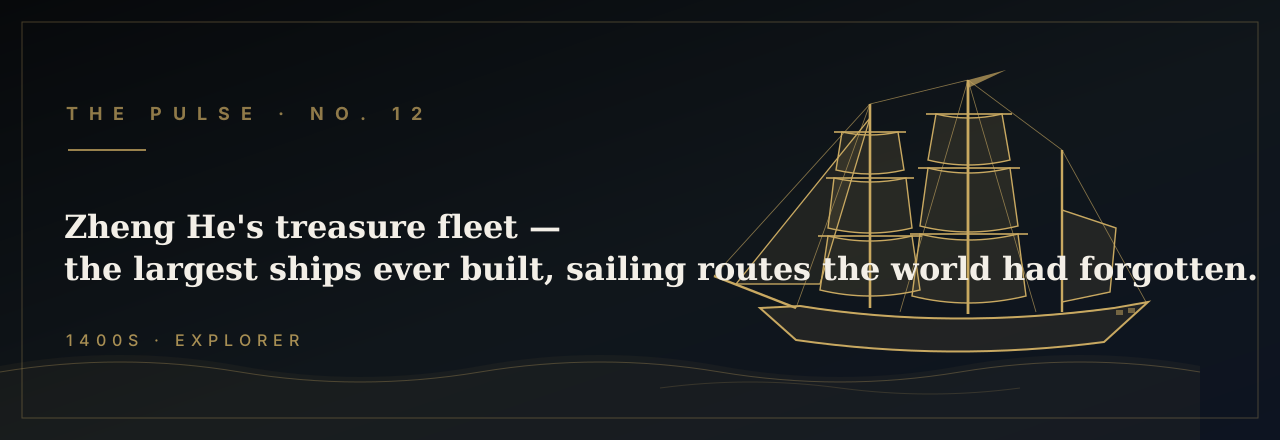
In the summer of 1405, a fleet unlike anything the world had ever seen slipped out of the Yangtze River mouth at Nanjing and turned south toward open water. The armada numbered 317 vessels and carried nearly 28,000 men — soldiers, doctors, astronomers, translators, and diplomats — aboard ships so vast that European sailors of the era would not have believed them possible. At the heart of the fleet rode the bao chuan, the treasure ships: nine-masted wooden leviathans reportedly stretching 440 feet from stem to stern and 186 feet across the beam. For context, the largest vessel Christopher Columbus would command eighty-seven years later measured perhaps 85 feet. China had not launched an expedition. It had launched a floating city.
The man who commanded this armada was Zheng He, and his rise to supreme admiral of the Ming dynasty is itself a story of improbable reinvention. Born Ma He around 1371 in the landlocked Yunnan province to a Muslim family — his father and grandfather had both made the hajj to Mecca — he was captured at eleven during a Ming military campaign, castrated, and pressed into palace service. There he caught the attention of the prince who would become the Yongle Emperor, Zhu Di, a usurper who seized the throne in 1402 and immediately began reimagining China's place in the world. Zhu Di renamed his eunuch commander Zheng He after a battle victory, then handed him a mandate that no admiral in history had received: go everywhere, impress everyone, and bring back tribute from the ends of the earth.
Between 1405 and 1433, Zheng He led seven treasure voyages across the Indian Ocean world, touching more than thirty kingdoms. The fleet's navigators worked from star tables, magnetic compasses, and detailed charts, threading the monsoon corridors that Arab and Indian sailors had used for centuries — but at a scale those sailors could scarcely imagine. The first voyage called at Malacca, Calicut, and Ceylon. Subsequent voyages pushed farther: the Persian Gulf, the Red Sea, and finally the East African coast as far as present-day Kenya and Somalia, where local rulers presented the Chinese court with giraffes — animals so fantastically strange to Chinese eyes that court painters depicted them as qilin, the mythical dragon-horse of Confucian legend. Zheng He's scribe Ma Huan recorded it all in obsessive detail: the tidal patterns off Hormuz, the coral harbors of Malindi, the pepper markets of Kozhikode.
The treasure ships themselves remain one of history's great engineering mysteries. Whether the 440-foot figures in Ming records reflect actual dimensions or bureaucratic exaggeration, scholars still debate — no complete hull has ever been excavated. Archaeologists working a Nanjing drydock in 2003 uncovered a rudder post nearly 36 feet long, suggesting a vessel of extraordinary scale even if the largest dimensions are partly mythologized. What is not in dispute is the shipbuilding system that produced them: the Longjiang shipyards outside Nanjing employed tens of thousands of workers, maintained timber forests across three provinces, and could launch multiple ocean-going ships simultaneously. The treasury expenditure was staggering. The fleet consumed more wood and silk and bronze per voyage than most European states spent on their entire navies in a decade.
The voyages were not merely diplomatic theater. Zheng He's fleet enforced order with real firepower, deposing a hostile king in Ceylon during the third voyage and capturing the pirate chief Chen Zuyi near Palembang, parading him back to Nanjing in chains. The Yongle Emperor understood sea power the way a modern strategist understands it — as the projection of legitimacy beyond your own borders. But the voyages also functioned as an elaborate tributary exchange: rulers sent envoys to Nanjing, acknowledged the Son of Heaven's supremacy, and received in return silk, porcelain, and the implicit guarantee that Chinese naval power stood between their ports and disorder. For a brief quarter-century, the Ming dynasty organized the entire Indian Ocean trade network around the will of a single court and a single admiral.
Then, with a swiftness that still stuns historians, it ended. The Yongle Emperor died in 1424. His son reigned briefly and suspended the voyages entirely. The Xuande Emperor permitted a final, seventh voyage in 1430, and Zheng He died at sea near Calicut in 1433 — his body, according to some accounts, committed to the very ocean he had spent thirty years mastering. What followed was not mere neglect but deliberate erasure. Confucian officials who had always viewed the voyages as wasteful and ideologically suspect reasserted control. The minister Liu Daxia reportedly burned Zheng He's logbooks and charts, calling them "deceitful exaggerations of bizarre things." By 1500, it was a capital offense to build a ship with more than two masts. The greatest navy on earth dismantled itself by fiat.
The Portuguese reached Calicut in 1498 under Vasco da Gama, sixty-five years after Zheng He's last departure from that same harbor. They found a bustling trade city with Chinese porcelain stacked in the warehouses — evidence of a commerce network China had pioneered and then abandoned. Had the treasure fleet voyages continued, historians speculate that China, not Portugal or Spain, would have encountered the Americas first, would have colonized the Swahili Coast, would have contested the spice routes that funded the European age of exploration. Instead, the world's most capable maritime power turned inward at the precise moment that seaborne empire was about to reorder global civilization. It is the great counterfactual of naval history: not a defeat, not a disaster at sea, but a decision — made in a palace far from the water — to stop.
The lesson that Zheng He's fleet carries across six centuries is one that maritime cities understand in their bones: command of the ocean is not a permanent condition but a political choice, renewed or abandoned with every change of government. San Diego has lived this rhythm — a sleepy rancho port, then a coaling station, then a Navy headquarters, then a hub of Pacific trade, its fortunes tracking precisely how much the nation chose to invest in the sea. Zheng He's bao chuan are long gone, their timbers dissolved into the silt of the Yangtze delta, their charts ash. But the currents they crossed still run, indifferent to whether any nation is bold enough to sail them.
Two designs for Pulse No. 12.
Bella + Canvas 3001 unisex tee. Printed on demand and shipped from the U.S. $34.99 + tax + shipping.
Treasure Fleet Tee
ZHENG HE · 1405–1433 · SEVEN VOYAGES
The Ships That Were Burned
The Emperor burned the fleet and outlawed deep-water voyages.