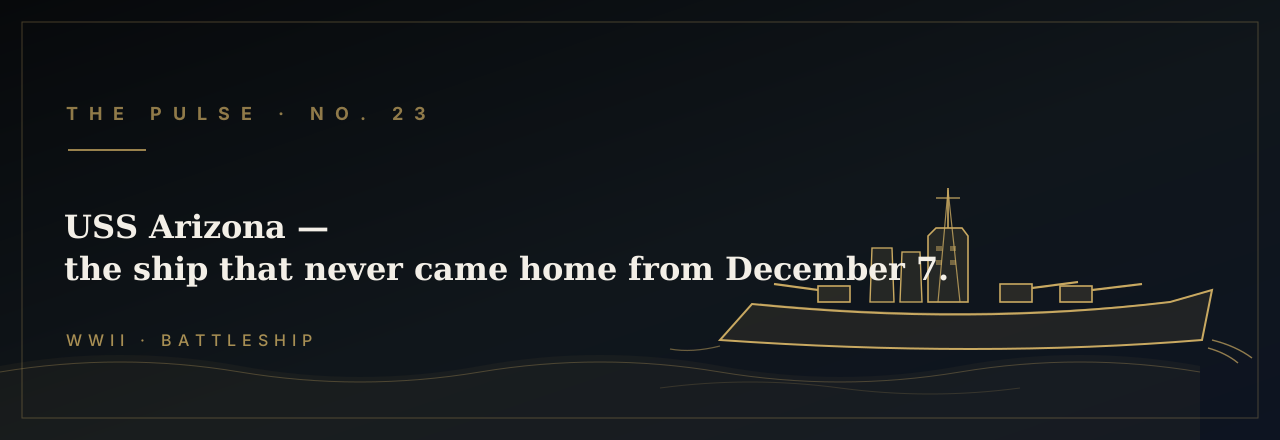
USS Arizona — the ship that never came home from December 7.
The Arizona was hit by a 1,760-pound bomb that detonated her forward magazines. She sank in nine minutes. Eleven hundred and seventy-seven of her crew are still entombed in her hull.
On the morning of December 7, 1941, the battleship USS Arizona lay moored at Ford Island, Berth F-7, in the still waters of Pearl Harbor, Hawaii. She was a Pennsylvania-class dreadnought, 608 feet long, displacing 32,600 tons fully loaded, commissioned on October 17, 1916, and already a veteran of convoy escort duty in the Atlantic during the Great War. Her 1,512 officers and men were settling into a quiet Sunday morning — some at breakfast, some still asleep in their bunks, some on deck in the pale tropical light — when the first wave of 183 Japanese aircraft came screaming out of the clouds to the north. Within the hour, Arizona would become the most catastrophic single-ship loss in American naval history, a wound in the harbor floor that has never fully closed.
The attack had been meticulously planned for months under Admiral Isoroku Yamamoto, Commander-in-Chief of the Combined Fleet, who had long studied the 1940 British raid on Taranto as proof that carrier-launched aircraft could destroy a battleship fleet at anchor. The strike was led from the air by Commander Mitsuo Fuchida, who flew above the harbor in a Nakajima B5N and transmitted the attack code "Tora! Tora! Tora!" — confirmation that complete surprise had been achieved. The striking force, the Kidō Butai, comprised six fleet carriers — Akagi, Kaga, Sōryū, Hiryū, Shōkaku, and Zuikaku — which had sortied from Hitokappu Bay in the Kuril Islands under strict radio silence on November 26, steaming 3,500 miles undetected across the North Pacific. Their 353 aircraft fell upon the American fleet in two coordinated waves. Arizona lay at the heart of what would become known as Battleship Row, the most concentrated killing ground in American naval history.
At 8:06 a.m., a 1,760-pound armor-piercing bomb — a Type 99 No. 80 Mk 5, machined from surplus 40-centimeter battleship shells and fitted with stabilizing fins — struck Arizona just forward of Turret Two. It pierced the teak deck, punched through an inch and a half of armored plate below it, and detonated deep within the forward magazines, where more than a million pounds of powder charges and projectiles for the ship's fourteen-inch guns were stored. The explosion was not merely a fire or a flooding — it was a detonation of such violence that it was captured by seismographs across the Pacific basin. A column of flame and black smoke climbed hundreds of feet into the harbor sky, visible from twenty miles away. The ship's bow was obliterated. Her foremast toppled forward. Photographs taken from Ford Island in the seconds after show Arizona encased in a fireball that dwarfs every other ship on Battleship Row.
What followed was not a sinking in any conventional sense. There was no time for flooding to be checked, for watertight doors to be dogged shut, for boats to be swung out. Arizona dropped to the harbor floor in approximately nine minutes, the harbor itself only forty feet deep, leaving her superstructure protruding above the surface in blackened ruin. Of her 1,512 men aboard, 1,177 were killed — nearly three-quarters of her crew — more than on any other ship that day, more than on all other ships at Pearl Harbor combined. Many died in the initial detonation with no warning whatsoever. Others were trapped below decks as harbor water poured in. A handful who made it to the surface found themselves swimming through burning fuel oil, the water itself on fire. The survivors who pulled struggling men from the oil slick through the morning were themselves often badly burned, and many would carry the scars of those minutes for the rest of their lives.
Among the dead were Rear Admiral Isaac C. Kidd, commander of Battleship Division One and the first American flag officer killed in World War II — his Naval Academy class ring was later found fused to the conning tower steel where the blast had caught him — and Captain Franklin Van Valkenburgh, the ship's commanding officer, who was last seen at the bridge directing damage control. Both were posthumously awarded the Medal of Honor. The ship's twenty-one-man band — Navy Band Unit 22 — had competed in a fleet battle-of-the-bands contest at the submarine base the evening before; all twenty-one musicians died that morning without ever playing another note. The youngest crew member killed was seventeen. The scale of the loss resisted arithmetic: to speak of 1,177 dead is to speak of 1,177 individual men with names, hometowns, families, and futures that simply ended in nine minutes on a Sunday in December.
In the weeks after the attack, Navy salvage teams assessed all eight battleships struck along Battleship Row. Nevada, West Virginia, Maryland, Tennessee, Pennsylvania, and California were raised, repaired, and returned to service — some fighting all the way to the final amphibious campaigns of the Pacific War. Oklahoma, capsized beyond practical repair, was raised and sold for scrap but sank under tow in 1947. Arizona alone was declared a total loss from the moment divers assessed her. The forward magazine explosion had so destroyed her structural integrity that raising her was judged technically and economically impossible. Salvagers removed her guns, her superfire control equipment, her anchor chains and propellers, but her hull — and the remains of most of those 1,177 men — was left where it had come to rest on the harbor floor. She was formally decommissioned on December 1, 1942, one year and one day after the attack. The Navy's notation in her record was terse: stricken from the Navy list.
The ship has never stopped weeping. Arizona's bunker fuel oil — approximately 500,000 gallons remained aboard at the time of the attack — continues to seep from her ruptured tanks to this day, a thin iridescent ribbon rising to the surface above the wreck that visitors to the memorial call "the black tears of the Arizona." At current leakage rates, geologists estimate the oil could continue rising for fifty years or more. The memorial — a stark white concrete structure designed by Alfred Preis that spans the sunken hull without touching it, dedicated on May 30, 1962 — receives more than a million and a half visitors annually, making it one of the most-visited sites in the Pacific. Below it, Arizona remains a commissioned vessel of the United States Navy. Navy divers who descend to the wreck are required to salute as they enter. By long-standing tradition, survivors of Arizona may have their ashes interred within the hull when they die — rejoining their shipmates, sealed in harbor mud and steel, on the bottom of Pearl Harbor.
The Pacific Fleet that lay at anchor on December 7, 1941, had been ordered to Pearl Harbor only eighteen months earlier from its home waters along the Southern California coast — a deliberate presidential gambit, President Roosevelt's attempt to use the fleet itself as a deterrent against Japanese expansion in the Pacific. Arizona had trained extensively in those waters, and many of her crew had come to know San Diego and Long Beach as the backdrop to peacetime service. Today, Naval Base San Diego dispatches warships westward across the same Pacific every month, and the Arizona's ship's bell — recovered from the wreck and held for decades by the University of Arizona — was replicated and returned to the Navy in 2017 as a symbol of enduring commission. Every December 7th, the bell is rung once for each of the 1,177 men who never came home. In the long American reckoning with sea power and sacrifice, Arizona holds a place apart: not a ship that was lost in battle after a fight, but a ship whose entire world changed between one breath and the next — a monument to the speed with which history can arrive, without warning, from a clear and cloudless sky.
Two designs for Pulse No. 23.
Bella + Canvas 3001 unisex tee. Printed on demand and shipped from the U.S. $34.99 + tax + shipping.
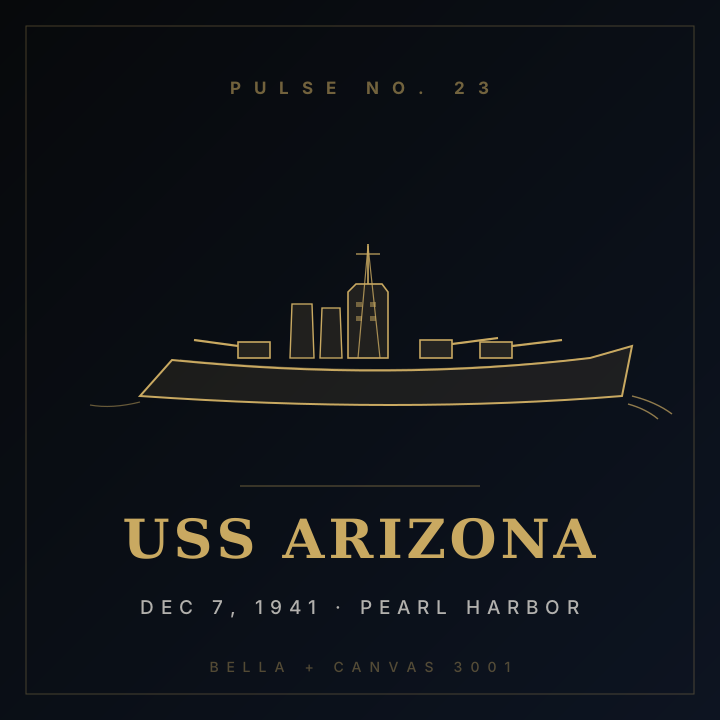
Arizona Tee
USS ARIZONA · DEC 7, 1941 · PEARL HARBOR
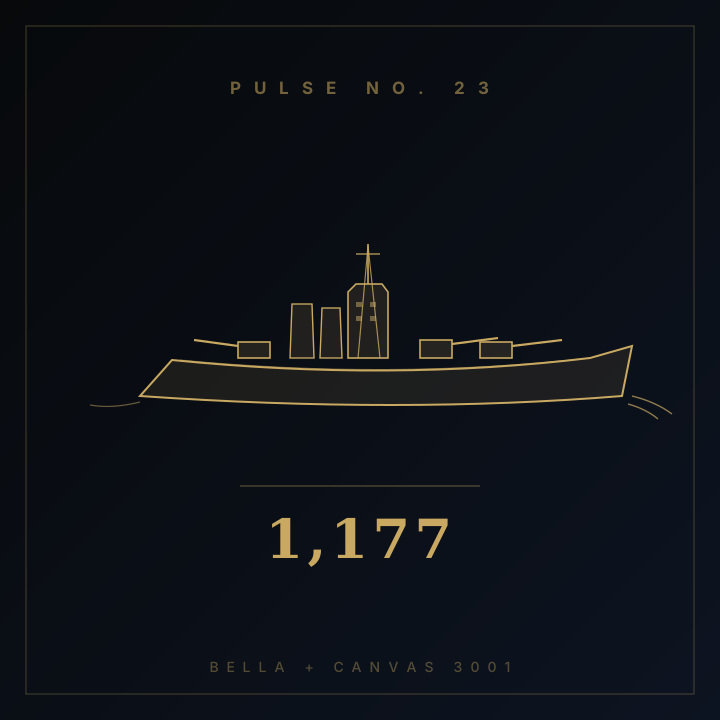
1,177
The number of Arizona's crew still entombed in the ship.