Kon-Tiki — a raft, the Pacific, and a man determined to prove everyone wrong.
1947: Thor Heyerdahl built a balsa raft using pre-Columbian methods and sailed 4,300 miles from Peru to Polynesia to prove ancient humans could have done the same thing.

In the spring of 1947, a thirty-two-year-old Norwegian ethnographer named Thor Heyerdahl stood on a balsa-log raft in the harbor of Callao, Peru, preparing to sail 4,300 miles across the open Pacific with five companions and no engine. Every serious maritime authority he had consulted told him the same thing: balsa wood would waterlog and sink, the prevailing currents would drive them off course, and the raft would come apart long before landfall. Heyerdahl had spent two years gathering evidence that ancient South American peoples had made exactly this voyage millennia before him — and he intended to prove it by doing it himself.
The theory had grown from a puzzle Heyerdahl encountered during a year of fieldwork on the Marquesas Islands in 1937. The sweet potato, a plant of undeniable South American origin, grew throughout Polynesia. Polynesian oral tradition spoke of a pale, bearded god-king named Kon-Tiki — a name strikingly close to the Incan solar deity Viracocha — who had sailed westward into the setting sun after his people were overthrown. Prevailing anthropological consensus held that Polynesia had been settled from the west, out of Asia, and when Heyerdahl presented his contrary thesis to academic audiences in New York after the war, he was politely — and then less politely — dismissed. The raft voyage, he decided, would settle the argument by demonstration rather than debate.
Construction of the Kon-Tiki began in January 1947 at the Naval Dockyard in Callao. Heyerdahl insisted on pre-Columbian materials and methods: nine balsa logs — the largest forty-five feet long and two feet in diameter — were felled in the Ecuadorian jungle and lashed together with hemp rope, with no nails, bolts, or wire. A bamboo deck covered the logs; a woven bamboo cabin with a roof of banana leaves provided shelter. A single mast of mangrove wood carried a square sail bearing the face of Kon-Tiki himself, painted by crew member Erik Hesselberg. Skeptics noted that the balsa would saturate with seawater within weeks, making the raft dangerously heavy. Heyerdahl believed — correctly, as it turned out — that the logs' own resinous sap would keep them buoyant for the entire duration of the crossing.
The crew of six assembled around Heyerdahl were a remarkable collection of wartime veterans and adventurers. Knut Haugland and Torstein Raaby were decorated Norwegian saboteurs: Haugland had participated in the famous commando raid on the Nazi heavy-water plant at Vemork, while Raaby had spent the war transmitting intelligence from inside occupied Norway, including the last radio signals ever sent from aboard the battleship Tirpitz before she was sunk. Herman Watzinger was a refrigeration engineer turned explorer. Bengt Danielsson, a Swedish sociologist fluent in Polynesian languages, brought along seventy-three books on balsa rafts and Pacific anthropology for the crossing. Erik Hesselberg, navigator and painter, had sailed with Heyerdahl in his youth. The U.S. Army and Navy, persuaded of the expedition's scientific value, supplied emergency rations, a military radio, and a liferaft — concessions to modernity that Heyerdahl reluctantly accepted.
The Kon-Tiki cast off from Callao on April 28, 1947, towed twelve miles offshore by the Peruvian Navy tugboat Guardian Ríos before the crew set sail on their own. They rode the Humboldt Current northwest before the southeast trade winds caught them and drove the raft onto its westerly heading. The early weeks were terrifying. The logs worked against each other in the swells, moaning and grinding underfoot, the hemp lashings stretching alarmingly in a way that looked like failure but was actually survival — the raft absorbed punishment that would have shattered a rigid hull. Within days they spotted the first of the great sea creatures that would shadow them across the ocean: whale sharks, the largest fish in the world, circling so close the crew could have stepped from the bamboo deck onto their backs.
At sea, the Kon-Tiki averaged forty-two miles per day — precisely the rate Heyerdahl had calculated from his study of currents. The Pacific in the tropic latitudes revealed itself as anything but empty. Flying fish crashed onto the deck each night, providing ready breakfast. Dolphins rode the bow wave in schools of hundreds. Dorado — the great gold-green fish of the open Pacific — followed the raft for weeks, so abundant the crew caught them by hand through gaps in the bamboo. On one famous night a snake mackerel of prodigious size — a deep-sea species marine biologists had never before observed alive at the surface — came slithering aboard after dark. The ocean beneath them was, they realized, a living highway that ancient navigators could have read as easily as a modern chart.
On August 7, 1947 — after 101 days and 4,300 miles at sea — the Kon-Tiki struck the reef at Raroia Atoll in the Tuamotu Archipelago of French Polynesia. The crew, lashed to whatever they could grip, rode the breakers across the reef with remarkable composure — Heyerdahl later wrote that they had accepted the possibility of dying on a reef as part of the original bargain — and washed up on an uninhabited island inside the lagoon. Four days later, islanders from a neighboring atoll arrived by canoe, astonished to find six sunburned Europeans camping on their coral. The Kon-Tiki had completed the longest open-ocean raft voyage in recorded history, and it had done it in fewer days than many critics had believed the wood could stay afloat.
The expedition's afterlife was as improbable as the voyage itself. Heyerdahl's book Kon-Tiki, published in Norwegian in 1948 and in English translation in 1950, sold more than fifty million copies in sixty-five languages, becoming one of the best-selling adventure narratives of the twentieth century. The documentary filmed aboard the raft won the Academy Award for Best Documentary Feature in 1952. The anthropological argument remained contested for decades — most scholars continued to favor the Asian-origin model for Polynesian settlement — but a landmark 2020 genetic study published in Nature found clear evidence of pre-Columbian contact between South Americans and Eastern Polynesians, vindicating at least part of Heyerdahl's intuition. What the Kon-Tiki proved beyond all dispute was something older than any theory: that human beings, given sufficient will and sufficient rope, will put themselves on the ocean. San Diego, whose own history is written in the wakes of Cabrillo's galleons, American tuna clippers, and Navy fleet carriers, understands that impulse at bone level. The sea does not ask for credentials. It asks only whether you will come.
Two designs for Pulse No. 25.
Bella + Canvas 3001 unisex tee. Printed on demand and shipped from the U.S. $34.99 + tax + shipping.
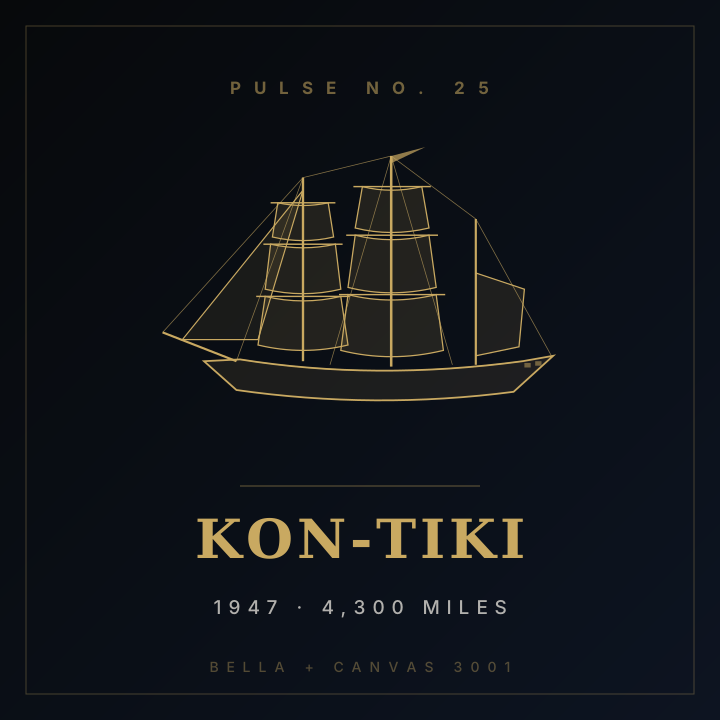
Kon-Tiki Tee
KON-TIKI · 1947 · 4,300 MILES

101 Days
The time it took Kon-Tiki to cross the Pacific.