The Continental Navy — America's first navy, and the ships that fought an empire.
John Paul Jones had one small frigate, three French prizes, and a crew of sailors who hadn't been paid. He took them into British home waters and won.
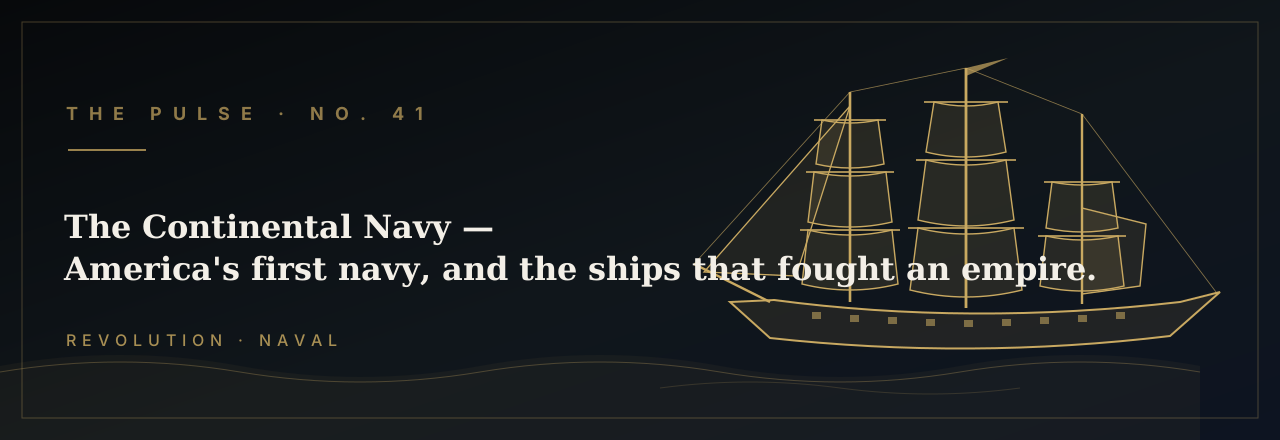
On October 13, 1775, the Second Continental Congress authorized the fitting out of two armed vessels to intercept British supply ships — an act so audacious it bordered on farce. The Continental Navy that emerged from that resolution would never field more than fifty ships against a Royal Navy numbering over one hundred ships of the line, the most powerful maritime force the world had yet seen. Britain ruled every ocean. She had three centuries of naval tradition, the finest shipwrights in Europe, and an officer corps tempered in war from the Caribbean to the Bay of Bengal. The Americans had a handful of converted merchant sloops, empty treasury coffers, and a Congress that debated whether a navy was even constitutionally permissible. What they also had, though no one fully knew it yet, was a Scottish-born seaman of furious ambition who would take the fight not just to British ships, but to British shores.
The first fleet assembled at Philadelphia in late 1775 was a motley collection of refitted merchant hulls pressed into military service. The flagship Alfred, formerly a Black Ball Line packet, flew the Grand Union Flag for the first time on December 3, 1775, hoisted by her first lieutenant, a thirty-year-old Scotsman named John Paul Jones. Under Commodore Esek Hopkins, the eight-vessel squadron — Alfred, Columbus, Cabot, Andrew Doria, Providence, Hornet, Fly, and Wasp — sailed south in February 1776 for the Bahamas, executing the new navy's first operation: a raid on Nassau to seize gunpowder and cannon the Continental Army desperately needed. The Battle of Nassau was more of a landing than a battle — the garrison offered little resistance — but two hundred cannon and eighty barrels of powder came north with the fleet, and America had its first naval victory.
Jones chafed under Hopkins and drove himself toward independent command with a focused intensity his contemporaries found unnerving. Given the sloop Providence in mid-1776, he proved immediately what he could do with a swift hull and a willing crew: in just over seven weeks he took sixteen prizes and escaped a pursuing British frigate through a combination of audacious maneuvering and what witnesses described as almost supernatural ship-handling, letting the enemy close to within pistol range before popping his topsails and running downwind. Promoted to captain of the Alfred that fall, he took two more prizes off Nova Scotia before returning to Portsmouth, New Hampshire, where Congress gave him something far more dangerous — the new sloop-of-war Ranger, eighteen guns, and orders to sail for France to receive a larger command that never materialized. Jones arrived in Brest in December 1777 to find that his promised French frigate had been promised to someone else. He decided, with characteristic directness, to make himself impossible to ignore.
In April 1778, Jones sailed Ranger into the Irish Sea — directly into the heart of British coastal waters — and on the night of April 22nd landed a raiding party at Whitehaven, the Cumberland port where he had apprenticed as a boy. It was the first hostile landing on British soil since the Dutch admiral De Ruyter's raid up the Medway in 1667. His men spiked the guns of the harbor forts, set fire to a collier in the harbor, and were back aboard before dawn. Two days later, on April 24th, Ranger intercepted HMS Drake off Belfast Lough and, after an hour's sharp engagement, accepted the surrender of the first Royal Navy warship ever taken by an American vessel in British home waters. Jones brought Drake back to Brest with 133 British prisoners and a reputation that made Parliament debate whether the laws of war still applied to him. France, watching carefully, decided the Americans were serious.
The command Jones finally received was not a frigate but something considerably stranger: the Bonhomme Richard, a condemned French East Indiaman of 900 tons, armed with 42 guns of mismatched caliber, some of them so old and poorly cast that his own gunners feared them more than the enemy did. Named after Benjamin Franklin's Poor Richard's Almanack — the French title translating as "Good Man Richard" — she was accompanied by four additional vessels: the American frigate Alliance, the French frigates Pallas and Cerf, and the brig Vengeance. The Alliance was commanded by Pierre Landais, a French officer of unstable disposition whom Jones regarded with deep suspicion and whose behavior during the coming action would prove every suspicion justified. Together, in August 1779, they sailed north around the British Isles, taking prizes as they went, until on September 23rd they encountered something worth fighting: a Baltic merchant convoy of forty-one ships, escorted by HMS Serapis and HMS Countess of Scarborough.
The Battle of Flamborough Head began at approximately seven in the evening under a full harvest moon, the chalk headland of Yorkshire white against the dark sea and hundreds of civilians gathered on the cliffs to watch. HMS Serapis was a new copper-bottomed 44-gun frigate, faster and better-armed than the Richard in every measurable way, and Captain Richard Pearson knew it. Within the first thirty minutes, two of the Richard's heaviest guns exploded on their own carriages, killing their crews and blowing out the lower gun deck; within an hour she was taking on water and her gunners were fighting knee-deep in the sea below. Pearson hailed Jones across the smoke and demanded to know whether he had struck his colors. It was then that Jones gave the answer that became the motto of an entire naval tradition: "I have not yet begun to fight." He lashed Bonhomme Richard alongside Serapis with his own hands and turned the engagement into a boarding action that neither ship could escape.
For three and a half hours, musket fire from the Richard's tops swept Serapis's deck while British cannon fired through the hull of the American ship at point-blank range, the muzzles of the two vessels sometimes touching. At one point, Landais sailed Alliance around the locked pair and, in an act of treachery — or madness — fired three broadsides into Bonhomme Richard, killing more of Jones's crew. The Richard was by then visibly sinking; her main pump had been shot away, her lower decks were on fire, and fifty of her 322 men were dead. At ten-thirty PM, Pearson hauled down Serapis's colors. Jones transferred his flag to the prize as Bonhomme Richard rolled and slipped beneath the North Sea on September 25th, taking her dead with her. Jones sailed a captured British warship into a Dutch port. Britain demanded his extradition. The Dutch refused.
San Diego inherited this tradition directly. The Naval Base San Diego — the largest naval complex in the world, stretching twelve miles along San Diego Bay — exists because the United States decided in 1775 that sea power was the only answer to a maritime empire. The logic Jones proved at Flamborough Head — that audacity and crew cohesion could defeat tonnage and broadsides — runs in a direct line from that chalk Yorkshire headland to the carrier strike groups that sortie today from 32nd Street. The USS Midway, moored a mile west of downtown as a museum ship, represents the apex of that tradition: an instrument of oceanic reach built by a republic that started with a converted merchant packet and a Scottish sailor who refused to be outgunned. When the light is right and the bay is still, you can almost see the connection — the rotting hull of the Bonhomme Richard beneath the North Sea and the gray steel of a modern destroyer slipping past Point Loma, both bearing forward the same stubborn argument that Jones first made to an empire: the ocean belongs to the bold.
Two designs for Pulse No. 41.
Bella + Canvas 3001 unisex tee. Printed on demand and shipped from the U.S. $34.99 + tax + shipping.
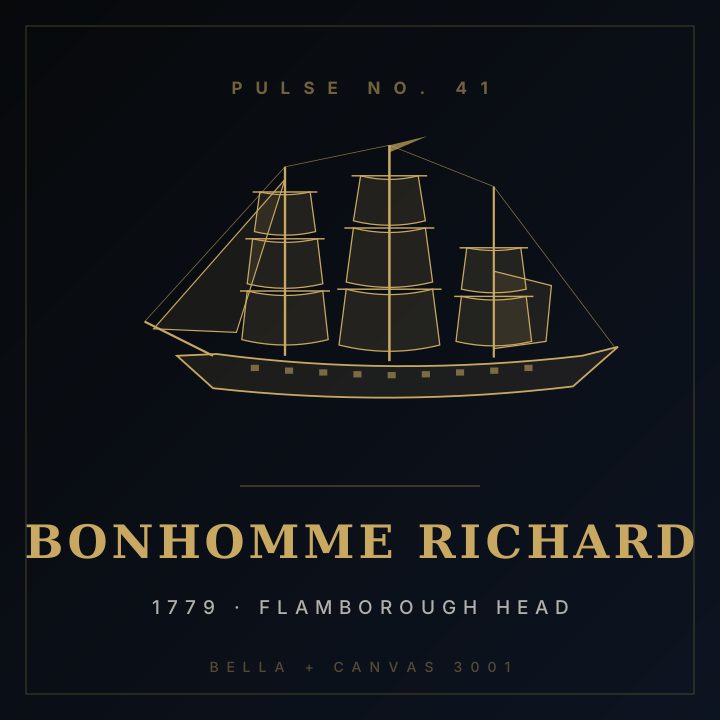
Bonhomme Richard Tee
BONHOMME RICHARD · 1779 · FLAMBOROUGH HEAD
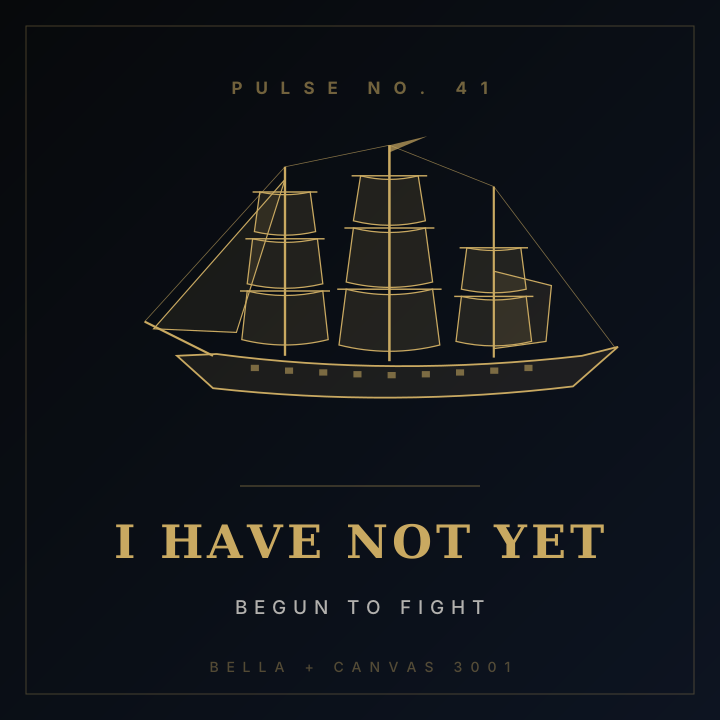
I Have Not Yet Begun to Fight
John Paul Jones, when asked if he was ready to surrender.