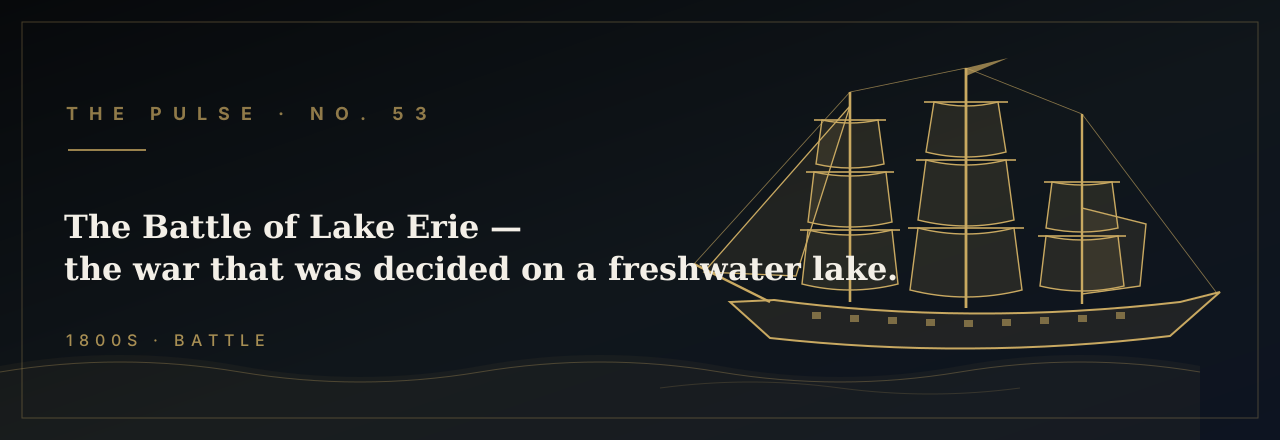
The Battle of Lake Erie — the war that was decided on a freshwater lake.
September 1813: Oliver Hazard Perry fought the British fleet on Lake Erie with ships built from green lumber in 90 days. He won. The entire Northwest Territory changed hands.
In the summer of 1813, a 28-year-old naval officer named Oliver Hazard Perry arrived at the frontier settlement of Presque Isle, Pennsylvania with an impossible mandate: build a fleet from nothing, train a crew of strangers, and wrest control of Lake Erie from the Royal Navy before winter closed the waterways. The War of 1812 had turned badly for the young republic. Detroit had fallen. The Northwest frontier lay naked and exposed, and without command of the lake, no American army could sustain itself west of the Appalachians. Everything depended on what Perry could build — and how fast he could build it.
The shipyard at Presque Isle was barely that. A shallow harbor protected by a long sandbar, it offered timber in abundance and precious little else. Master shipwright Noah Brown led the construction effort, driving his crews through winter mud and spring floods to frame, plank, and rig two 20-gun brigs from local black oak and pine — wood so freshly felled it still wept sap. His standing instruction to the carpenters was characteristically blunt: build them good enough to last one battle. They did. By late July, the Lawrence and the Niagara floated in the harbor alongside seven smaller gunboats. The entire fleet — conceived, cut, planked, caulked, and rigged — had been built in roughly ninety days.
Getting the ships out of harbor nearly ended the campaign before it began. The sandbar at Presque Isle's mouth rose to only four feet at low water, while the Lawrence drew nine. Perry's engineers floated the brigs over the bar using "camels" — hollow wooden pontoons lashed alongside the hull and pumped dry to lift the keel — a laborious operation conducted under the knowledge that a British squadron under Commander Robert Heriot Barclay had been blockading the harbor entrance for weeks. Inexplicably, Barclay lifted his blockade on July 29 — some accounts say to attend a dinner party in Amherstburg — and Perry seized the gap. Within 48 hours, both brigs were over the bar and armed. The window, once opened, never came again.
Barclay was no paper admiral. A Trafalgar veteran who had served under Nelson himself, he had already lost an arm in prior service and bore the bearing of an officer who expected to be obeyed by wind and enemy alike. His six-vessel squadron, anchored by the 19-gun Detroit and the 17-gun Queen Charlotte, outgunned the Americans at long range. His plan was sound: stand off, let the long guns do their work, and destroy Perry's fleet before the Americans could close to carronade distance. What Barclay could not account for was that his own provisions were nearly exhausted, his crews were at skeleton strength, and the autumn equinox was approaching. On the morning of September 10, 1813, he sailed out of Amherstburg to force a battle he could no longer afford to avoid.
Perry's battle flag, hoisted to the Lawrence's mainmast as the squadrons converged across a glassy Lake Erie, read "DON'T GIVE UP THE SHIP" — the dying words of Captain James Lawrence, killed three months earlier when his Chesapeake was taken by HMS Shannon. For two hours, the Lawrence absorbed what Barclay's long guns could deliver. Sailing ahead of the rest of his squadron to close the range, Perry paid a catastrophic price: by 2:30 in the afternoon, 22 of his men were dead and 61 wounded — over 80 percent of the Lawrence's crew — and every gun on her gun deck was disabled. The brig was a floating ruin, her timbers shot through, her deck slick with blood. Perry ordered her colors hauled down but not struck in surrender. Then he climbed into a longboat with four rowers and his battle flag, and made for the Niagara.
The transfer under fire — a quarter-mile row through smoke, splashing roundshot, and the groans of a dying ship — took roughly twelve minutes and became one of the most celebrated acts of personal courage in American naval history. Perry reached the Niagara unhurt, ran up his battle flag, and drove her straight through the British line. What followed was swift destruction. The Detroit and Queen Charlotte, maneuvering to meet this fresh threat, fell foul of each other — their rigging locked, their crews tangled — and the Niagara's carronades swept their decks at point-blank range. Barclay was wounded twice more. Within fifteen minutes of Perry's arrival aboard his new flagship, all six British vessels had struck their colors. It was the only time in the war — perhaps in the long history of Royal Navy fleet actions — that an entire British squadron surrendered intact.
The strategic consequence was immediate and continental. Perry's dispatch to General William Henry Harrison — scrawled on the back of an envelope with characteristic economy: "We have met the enemy and they are ours. Two ships, two brigs, one schooner and one sloop" — unlocked the entire Northwest. Harrison ferried his army across Lake Erie, landed on Canadian soil, and on October 5 defeated a combined British and Native force at the Battle of the Thames, where the great Shawnee war chief Tecumseh was killed. With Tecumseh's death, the pan-tribal confederacy he had spent decades building collapsed. The Northwest Territory — present-day Ohio, Indiana, Illinois, Michigan, and Wisconsin — was secured for the United States, a transfer of sovereignty decided not in a capital or a border negotiation, but on three hours of fighting across a freshwater lake.
The Battle of Lake Erie endures as a masterclass in what naval strategists call the decisive engagement: accept risk, close the range, and strike before the enemy can consolidate. Perry's willingness to let the Lawrence be destroyed in order to bring the Niagara into the fight unbloodied, and his audacity in transferring his flag mid-battle rather than hauling down his colors, defined an offensive ethos that would flow through American naval culture for two centuries. That current runs unbroken to San Diego Bay, where the Pacific Fleet — the largest concentration of naval power on earth — rests on the same foundational proposition Perry proved on a September afternoon in 1813: control the water, and you control everything that depends on it. The green-lumber ships of Presque Isle rotted within a decade. The principle they demonstrated has never aged a day.
Two designs for Pulse No. 53.
Bella + Canvas 3001 unisex tee. Printed on demand and shipped from the U.S. $34.99 + tax + shipping.
Lake Erie Tee
BATTLE OF LAKE ERIE · SEPT 10, 1813
We Have Met the Enemy
Perry's dispatch after the battle — one of the most concise battle reports in history.