Naval Special Warfare — from the UDT frogmen of WWII to the SEALs, and their San Diego home.
The Underwater Demolition Teams were created in 1943 to clear beach obstacles before amphibious landings. They were the first special operations forces in American military history. BUD/S has been in Coronado since 1943.
In the autumn of 1943, the United States Navy confronted a problem that beach charts and aerial photographs could not solve. At Tarawa Atoll in November of that year, Marines wading ashore from Higgins boats were cut down by hidden reef shelves and entangled in obstacles their commanders had never seen — because no one had looked. The assault on Betio island cost 1,009 American lives in seventy-six hours, many of them drowned in chest-deep water, pinned by fire, caught on obstacles that reconnaissance had missed entirely. The carnage was a forcing function: if the United States was going to break the Pacific perimeter island by island and then drive amphibious landings onto the European continent, someone had to swim in ahead of the fleet — unarmed, underwater, and alone — and see what lay waiting.
The Navy had already begun building that capability, however haltingly, before the blood dried at Tarawa. In the summer of 1943, Naval Combat Demolition Units were established at Fort Pierce, Florida under Commander Draper L. Kauffman — a former ambulance driver for the French army, British bomb-disposal officer, and the son of a Navy admiral who had been turned down by Annapolis for poor eyesight and had proceeded to earn his commission the hard way. Kauffman designed a training regimen of deliberate brutality: a week of continuous physical punishment, sleep deprivation, cold-water immersion, and timed underwater swims that his students would later simply call Hell Week. The logic was merciless and clear: Kauffman needed men who would not quit when every nerve in their body ordered them to, because the men who swam ahead of an amphibious assault would face exactly that moment, alone, in open water, within range of enemy guns.
The first true test came at first light on June 6, 1944, when thirteen Naval Combat Demolition Unit teams waded onto the beaches of Normandy in the first wave — ahead of the infantry, in some cases ahead of the smoke. Their mission was to blow sixteen-yard gaps in the steel and concrete obstacles that Field Marshal Rommel had seeded across the tidal flats: hedgehogs, Belgian gates, and log ramps topped with Teller mines, all designed to rip open landing craft hulls. At Utah Beach the teams cleared six complete lanes under fire and marked them with flags. At Omaha the slaughter was indescribable — of the sixteen NCDUs assigned to that beach, 31 men were killed and 60 wounded in the first hour, a casualty rate exceeding fifty percent. The survivors kept working. By the end of D-Day the teams had cleared thirteen complete gaps and five partial ones, won at extraordinary cost by men carrying no weapons heavier than a diving knife and the Hagensen pack — a canvas satchel of C-2 explosive, several pounds apiece, lashed to obstacles with primacord and detonated in sequence to open corridors through which the follow-on waves poured ashore.
In the Pacific, the Underwater Demolition Teams evolved along a different axis: less demolition, more reconnaissance. Admiral Richmond Kelly Turner, commanding amphibious forces in the Central Pacific, demanded human intelligence on beach gradients, coral heads, and surf conditions that no photograph could supply. UDT swimmers — wearing only fins, mask, and swim trunks, armed with a diving knife and a waterproof slate — made hydrographic reconnaissance swims directly toward enemy beaches in broad daylight, sometimes pulling within 100 yards of Japanese positions to measure water depth with a weighted line. At the Battle of Saipan in June 1944, UDT-7 swimmers were taken under direct machine-gun fire and returned the beach reports that shaped landing plans for 71,000 Marines. At Iwo Jima the story turned darker: on February 17, 1945, while UDT swimmers were recovering aboard the fast transport USS Blessman, Japanese aircraft put a bomb into her hull, killing 40 men and wounding 24 others — the costliest single blow the UDTs absorbed in the Pacific war. The swimmers who survived went back into the water the next day. Their reports confirmed the volcanic black-sand gradient and the absence of major underwater obstacles, intelligence that proved correct and that let planners concentrate on the killing ground above the waterline, where it truly lay.
The teams survived the postwar drawdown barely, scattered across a handful of reserve units as the Navy that had built them turned its attention to atomic strategy and carrier aviation. Korea brought them back with a different kind of work. UDT operators conducted raids on North Korean rail lines and harbor installations, blew railroad tunnels behind enemy lines in winter darkness, and ran intelligence missions with South Korean partisans deep into contested territory — work that looked far less like beach clearing and far more like what future generations would call direct action. The gap between the UDT's legal charter and its actual employment was growing by the year. By the ceasefire of July 1953, experienced operators had developed tactics, techniques, and an institutional culture that pointed clearly toward something the Navy had no formal name for: special operations.
That name arrived on January 1, 1962, when President John F. Kennedy — determined to build American capability for unconventional warfare against communist insurgencies — authorized the establishment of SEAL Team One at the Naval Amphibious Base Coronado and SEAL Team Two at Little Creek, Virginia. The acronym — Sea, Air, and Land — was a deliberate signal that these operators would not be confined to the waterline. Kennedy had absorbed the British experience with special operations forces in World War II, the lessons of Jedburgh teams and OSS operations behind Axis lines, and had concluded that the United States needed men who could penetrate denied territory by any means and accomplish precise objectives without the signature of a division. The UDTs had been building those men for nineteen years. The SEALs gave them a name.
No American city is more thoroughly woven into the fabric of Naval Special Warfare than Coronado, the silver-sand peninsula that curves south from San Diego Bay into the cold Pacific. The Naval Amphibious Base has been home to West Coast UDT and SEAL training since the Second World War, and Basic Underwater Demolition/SEAL training — BUD/S — has been conducted there continuously since 1943, making it the oldest continuously operating special operations training program in the American military. The stretch of beach directly west of the base's main gate has seen more men ring the brass bell and drop their green helmets in the sand than any other ground in special operations history. On winter mornings, when the Pacific surf runs cold and the Santa Ana winds have died, BUD/S students can still be seen in the surf zone at 0200, completing the cold-water immersion evolutions that Draper Kauffman designed more than eighty years ago and that no one has found a way to make easier. The Naval Special Warfare Command, which oversees all SEAL teams, SEAL Delivery Vehicle Teams, and Special Warfare Combatant-Craft Crewmen, is headquartered here — making San Diego, in every operational sense, the capital of American special warfare at sea.
From the tidal flats of Omaha to the Mekong Delta, from the mountains of Afghanistan to the compound in Abbottabad where SEAL Team Six operators killed Osama bin Laden on the night of May 1, 2011, the lineage runs unbroken from those first NCDU swimmers who waded through the fire at Normandy wearing nothing but swim trunks and audacity. The institution they founded — tested by Hell Week, defined by the water, shaped by eight decades of hard use in places no conventional force could reach — remains the most demanding pipeline in the American military. Its home, as it has always been, is the cold Pacific surf off Coronado, where the bell still hangs, the helmets still line up in the sand, and the sea does not care what you wanted to be.
Two designs for Pulse No. 56.
Bella + Canvas 3001 unisex tee. Printed on demand and shipped from the U.S. $34.99 + tax + shipping.
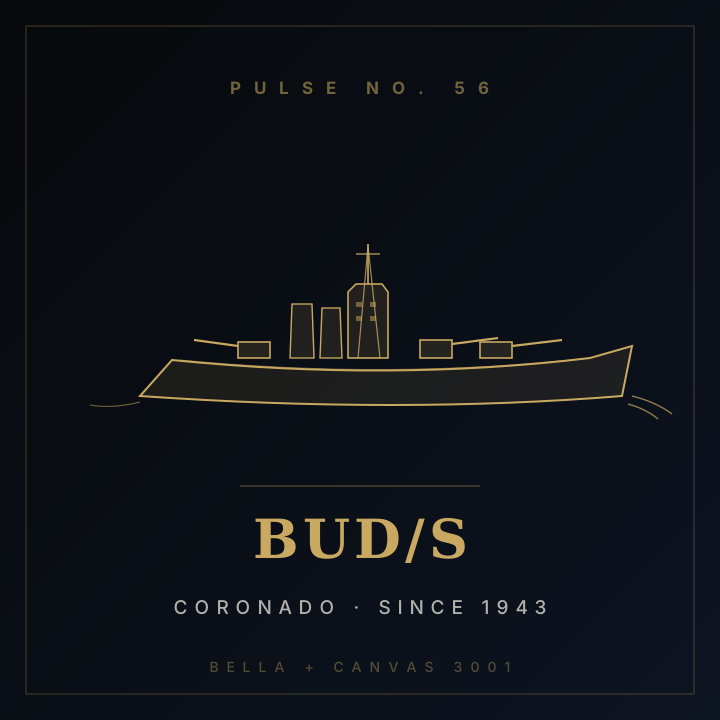
SEAL Tee
BUD/S · CORONADO · SINCE 1943
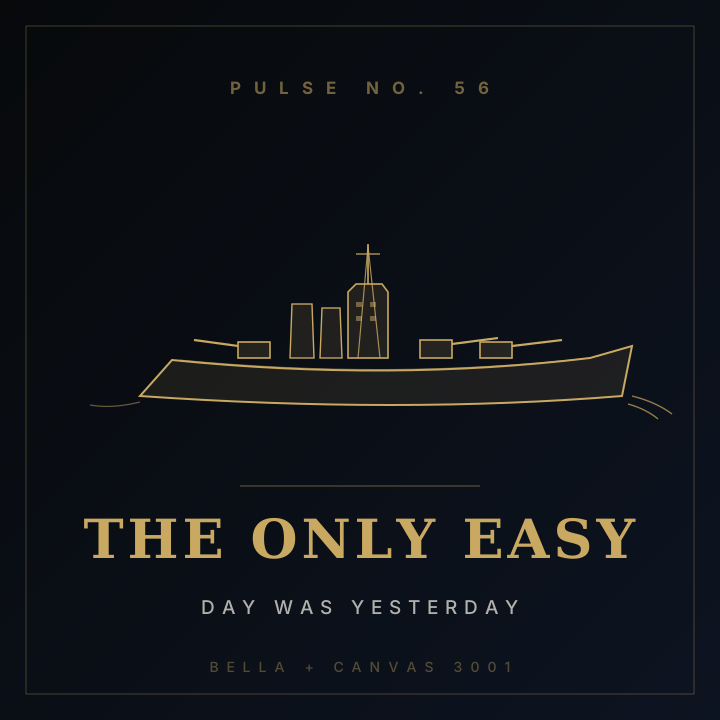
The Only Easy Day Was Yesterday
The BUD/S motto.