Gallipoli — the naval campaign Churchill planned, Kitchener commanded, and nobody executed.
1915: the plan was to force the Dardanelles with warships and take Constantinople. The warships hit mines. Then the infantry landed on the wrong beaches.
In the winter of 1914, the Western Front had already congealed into the mud and wire that would consume a generation. Winston Churchill, then First Lord of the Admiralty, believed he could see the back door. The Ottoman Empire — which had entered the war on Germany's side in November — controlled the Dardanelles Strait, the forty-mile throat of water connecting the Aegean to the Sea of Marmara and, beyond it, Constantinople. Force that passage with warships, Churchill argued, and the Ottoman capital would fall, Russia's southern supply line would reopen, the Balkan states would rally to the Allies, and the war might be shortened by years. The logic was elegant. The execution would become the century's most studied catastrophe.
The plan rested on a premise that the Royal Navy's own gunnery officers found questionable: that modern pre-dreadnought battleships, supplemented by the superdreadnought HMS Queen Elizabeth and her eight 15-inch guns, could systematically silence shore fortifications while navigating a mined, current-swept channel under fire. Vice Admiral Sackville Carden, commanding the Eastern Mediterranean Squadron, submitted a phased proposal in January 1915: first destroy the outer forts, then neutralize the inner defenses, then sweep mines under gunfire suppression, then sail through. On February 19, the fleet opened its bombardment, silencing the outer batteries at Cape Helles and Kum Kale. For a brief, deceptive moment, the operation appeared to be proceeding exactly as Churchill had described it to the Cabinet.
The illusion broke on March 18. By then Carden had collapsed from nervous exhaustion and been replaced by Vice Admiral John de Robeck, who launched the climactic assault: eighteen Allied battleships in three lines, including the French vessels Bouvet, Gaulois, Suffren, and Charlemagne, the British battlecruiser HMS Inflexible, and the pre-dreadnoughts HMS Irresistible, HMS Majestic, and HMS Ocean. They bombarded the Narrows forts for hours, and the Ottoman batteries, running critically low on ammunition, began to fall silent. From the bridge of the flagship, British officers allowed themselves to believe the passage was opening. What they did not know was that on the night of March 8, the Ottoman minelayer Nusret had slipped out and laid a fresh row of twenty-six contact mines parallel to the Asiatic shore — precisely the line where Allied ships had been maneuvering safely for weeks.
The Bouvet was the first to find them. At 1:54 p.m., a mine detonated under her magazine. She rolled onto her side and vanished in less than three minutes, carrying 639 of her crew to the bottom of the strait. Allied observers on the cliffs above initially mistook the explosion for an ammunition hit. Within the hour, Inflexible struck a mine and listed heavily to port; Irresistible struck another and went dead in the water, her crew abandoning ship under fire from the shore batteries, which had resumed firing as soon as the fleet's attention fractured. HMS Ocean, sent to take Irresistible in tow, struck a mine herself and sank before nightfall. Three capital ships lost in a single afternoon; three more seriously damaged. De Robeck pulled the fleet back and, in a decision that would reverberate through the war's entire strategic arc, never sent them in again.
Churchill urged de Robeck to renew the attack — the Ottoman forts were nearly out of shells, a fact the Allies did not then know but that postwar records would confirm — but the admiral and his superiors in London had already concluded that the Navy could not force the strait alone. The operation transferred from the Admiralty to the War Office, from Churchill's strategic imagination to the more reluctant custody of Field Marshal Lord Kitchener, who dispatched the Mediterranean Expeditionary Force under General Sir Ian Hamilton — five divisions of British, Australian, New Zealand, French, and Indian troops assembled at Alexandria with incomplete maps, no functioning intelligence network, and orders vague enough to have been written in watercolor. The six weeks spent assembling the force gave the Germans' best commander on the Turkish front, General Liman von Sanders, time to reorganize the peninsula's defenses entirely.
The landings came at dawn on April 25, 1915, and began going wrong before the first boat touched shore. The ANZAC Corps — Australians and New Zealanders who would transform this beach into the founding myth of two nations — were carried by current or navigational error roughly a mile north of their intended landing at Gaba Tepe, depositing 16,000 men at the base of a maze of steep ravines that the battle maps had shown as open ground. Mustafa Kemal, commanding the Ottoman 19th Division, recognized the crisis instantly. Riding to the high ground of Chunuk Bair, he reportedly told his men they could not retreat — they had no ammunition left to hold with — and ordered them to fix bayonets and lie down, buying time until reinforcements arrived. The Australians and New Zealanders clawed into the cliffs and held a perimeter measured in hundreds of yards. They would hold it, essentially unchanged, for eight months.
At Cape Helles, the southern tip of the peninsula, the British 29th Division landed across five beaches designated X, W, V, S, and Y. At V Beach, planners had converted an old coal collier, the SS River Clyde, into a crude landing ship — holes cut in her sides, lighters strung bow-to-beach — and ran her deliberately aground to disgorge two thousand troops directly onto the shore. The Turkish defenders let her ground herself, then opened fire on the sally ports. The men pouring through were shot before they reached the lighters; the lighters drifted apart under the weight of the dead. A beach that should have been taken in minutes remained contested until nightfall, at a cost that haunted the commanders who had ordered it. Only at Y Beach, where 2,000 men landed unopposed against no opposition whatsoever, did the attack succeed — and there, receiving no orders and no reinforcement, they re-embarked the following day without being told why.
The Gallipoli campaign dragged on until January 1916. Total Allied casualties exceeded 250,000; Ottoman losses were comparable. The one operation executed with genuine competence was the final evacuation, conducted over two nights in December and January without the loss of a single man — a masterpiece of deception that stands in bitter irony against everything that preceded it. Churchill resigned from the Admiralty in May 1915, requested a combat command in France, and spent years under the shadow of the Dardanelles before history revised its verdict. What the campaign established, at savage cost, was the doctrine that naval gunfire alone cannot subdue a defended strait, and that amphibious landings require unified command, precise intelligence, and the capacity to exploit surprise in the first hours — lessons that would not be formally codified until the next world war, when American planners at Coronado, in San Diego Bay, built the Naval Amphibious Base that still trains Marine and Navy SEAL forces today. The ghost of ANZAC Cove and V Beach lives in every amphibious exercise run from those shores.
Two designs for Pulse No. 58.
Bella + Canvas 3001 unisex tee. Printed on demand and shipped from the U.S. $34.99 + tax + shipping.
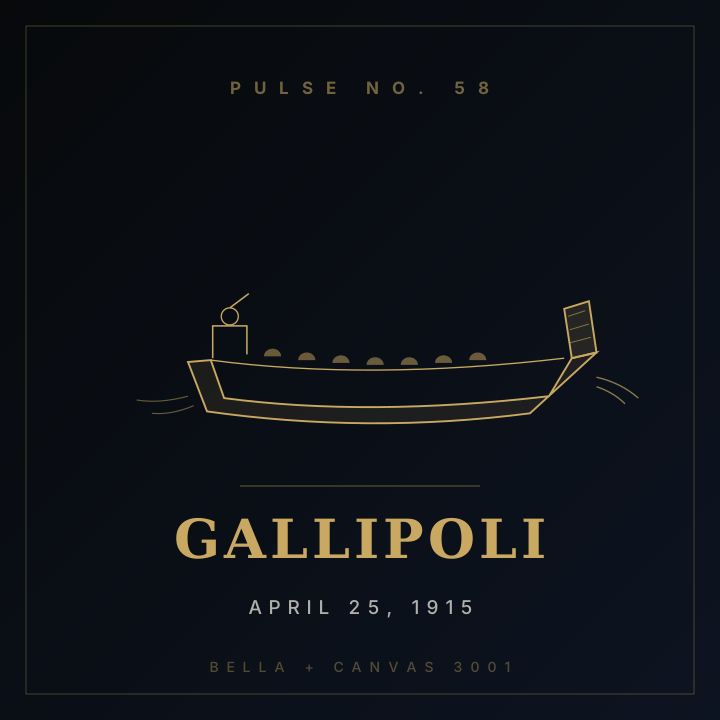
ANZAC Tee
GALLIPOLI · APRIL 25, 1915
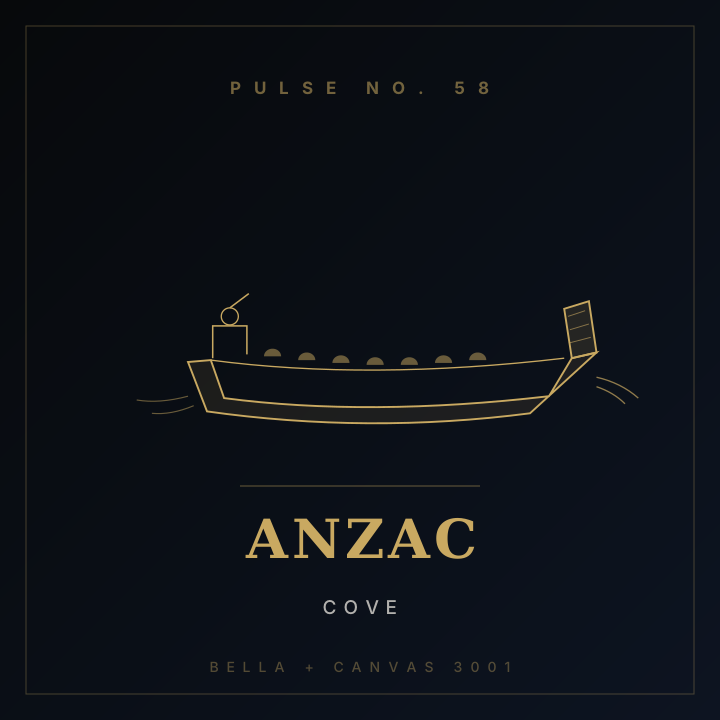
ANZAC Cove
The beach where Australian and New Zealand troops landed under fire.