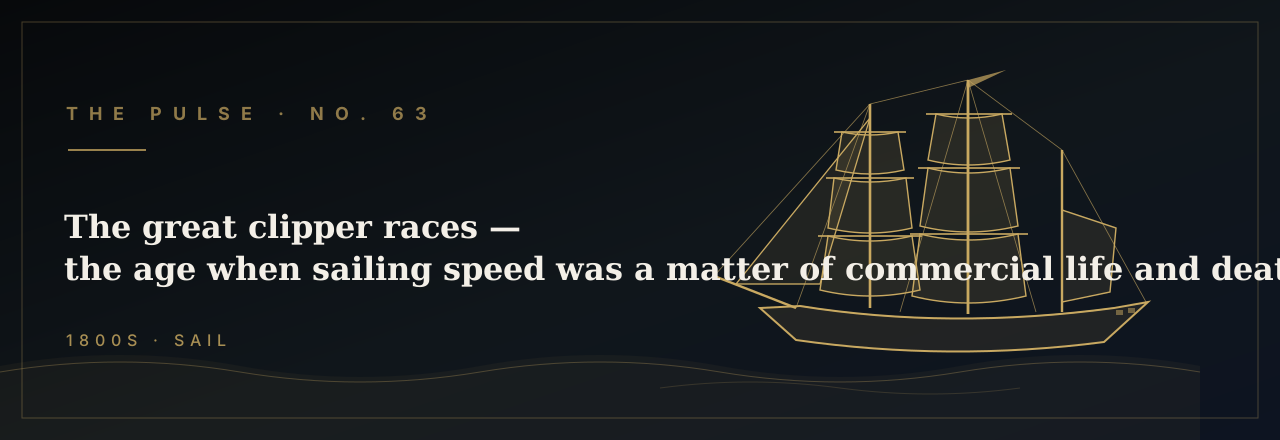
The great clipper races — the age when sailing speed was a matter of commercial life and death.
1850s: the clipper ships raced from China to London with the new tea harvest. The first to arrive got the best price. Speed was money. Cutty Sark and Thermopylae were the measure of it.
On the morning of May 30, 1866, five clipper ships cleared the anchorage at Foochow on the same tide. Their hulls loaded to the marks with the first chests of the season's Fujian tea, their captains were playing a game with rules that had governed the China trade for two decades: the ship that docked first in London would command a premium of up to six pence per pound over those that followed. With a typical cargo running to a million and a half pounds of leaf, the difference between first and second place was not a trophy — it was a fortune. The tea clipper era was the closest thing the Victorian age produced to a Formula One season, and every yard of canvas was a lap advantage.
The mechanics of the premium were straightforward and ruthless. London's tea brokers assembled each autumn at the dockside warehouses along the Thames, and the auction house that received the first shipment of the new season — that year's Congou, Souchong, or Oolong — set the price for every chest that followed. Major buyers paid extra for freshness, for the commercial signal that their supplier commanded the swiftest ships, and for the bragging rights of serving the new harvest before any rival's cup was poured. A captain who shaved a week off his passage could deliver both a premium cargo and a reputation that attracted commissions for seasons to come. The East India Company had lost its monopoly on the China trade in 1833; what filled the vacuum was pure competition, and speed was its only currency.
The ships built to win that competition were among the most sophisticated structures ever produced by Victorian engineering. The Aberdeen clippers pioneered the form: sharp hollow bows, concave waterlines forward, a hull profile that sacrificed cargo volume for hydrodynamic knife-work through a sea. By the 1860s, builders like Alexander Hall & Sons in Aberdeen and Robert Steele & Co. in Greenock had refined composite construction — iron frames clad in teak planking — that gave the new generation of clippers the rigidity of metal and the smooth copper-sheathed bottom that resisted marine growth on the long equatorial passages. Ariel, launched from Steele's yard in 1865, measured 197 feet on deck and 853 tons register; her lines were considered so fine that sailors said she seemed to lean away from the water, impatient to fly.
What followed that May morning became the most celebrated passage in clipper history. Ariel, Taeping, Serica, Fiery Cross, and Taitsing raced together across sixteen thousand miles of open ocean — around the Cape of Good Hope, north through the South Atlantic, and into the English Channel. Ninety-nine days later, after a passage that had carried all five ships through the same weather systems for three months, Ariel and Taeping crossed the Thames estuary within twenty minutes of each other. Taeping, drawing less water, docked first at Pagoda Wharf; Ariel's captain, John Keay, had arrived at the river's mouth ahead of her and could only watch as the tide settled the question. Serica berthed the same afternoon. Their owners, confronted with an unprecedented dead heat across sixteen thousand miles, divided the premium equally — a resolution as extraordinary as the race itself.
Three years later came the ships that would define the era's final chapter. Thermopylae, launched at Aberdeen in 1868, immediately proved herself the most gifted passage-maker alive: on her maiden voyage she ran from the Thames to Melbourne in 60 days, beating the standing record by two full days, then delivered Foochow to London in 91 days — a mark that would hold for years. She was iron-framed, teak-planked, 212 feet long, and her figurehead was Leonidas of Sparta; her record boards were painted green, the color reserved for a ship that had never been beaten on any passage. Into this legend sailed Cutty Sark in 1869, built at Dumbarton for shipowner John Willis specifically to out-sail her. The two ships raced side by side on the 1872 China passage until a mid-Indian Ocean storm tore away Cutty Sark's rudder entirely. Her captain, George Moodie, jury-rigged a replacement from spare timbers and iron fittings and brought her home — a week behind Thermopylae, but the seamanship of the crippled passage became its own kind of legend.
What ended the clipper races was not a faster sailing ship but a ditch. The Suez Canal, opened by the Khedive of Egypt on November 17, 1869, shortened the route from London to the Far East by roughly four thousand miles — but only for steamships. The canal's sheltered water was useless to sailing vessels that needed open sea and a working breeze; a clipper in the Suez Canal was a greyhound on a leash. Within a decade, steam-powered cargo liners running via Suez had undercut the clipper on both price and schedule. The tea that had demanded ninety-day sailing passages was now delivered in fifty days by ships that burned coal regardless of the wind. Thermopylae was eventually sold out of the China trade, repurposed for the rice run between Rangoon and Calcutta, and finally acquired by the Portuguese Navy as the training vessel Pedro Nunes; she was towed out and sunk as a gunnery target in the Bay of Lisbon on October 13, 1907. Cutty Sark spent her final sailing decades in the Australian wool trade before being retired, preserved, and eventually restored at Greenwich, where she survives today as the last of the breed.
What the clipper captains had collectively discovered — and what their era bequeathed to every professional mariner who followed — was the systematic exploitation of global wind patterns as competitive infrastructure. The routing decisions that sent Ariel south to find the Roaring Forties, or drove Thermopylae through the Agulhas Current at full press, were built on the wind-and-current charts assembled by Matthew Fontaine Maury — an American naval officer who spent two decades collecting thousands of ship's logbooks and distilling them into the first scientific atlas of the ocean's energy. The clippers didn't just sail fast; they sailed smart. Their captains treated the sea as a map of forces to be harvested, and the discipline they established became the direct ancestor of the weather routing used by ocean racers and commercial shipping to this day.
San Diego has its own material witness to that vanished world. The Star of India, berthed at the foot of Harbor Drive at the Maritime Museum of San Diego, was launched the same year as Taeping — 1863 — and worked the same global trade routes that the tea clippers dominated. She is the oldest active sailing ship in the world and still goes to sea under canvas, a living artifact of the age when the question of who arrived first was not sport but survival. Standing on her deck, looking out across the bay that tall ships have used since 1769, it is not difficult to imagine the watch officer scanning the horizon for a rival's topsails — knowing that somewhere out there, another captain was reading the same sky, making the same calculations, and pressing every stitch of canvas his rigging could bear.
Two designs for Pulse No. 63.
Bella + Canvas 3001 unisex tee. Printed on demand and shipped from the U.S. $34.99 + tax + shipping.
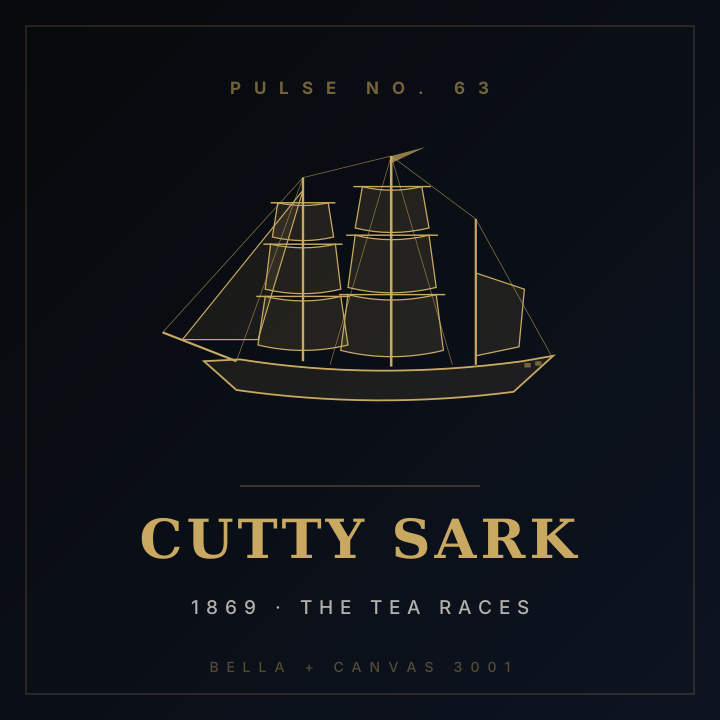
Clipper Tee
CUTTY SARK · 1869 · THE TEA RACES
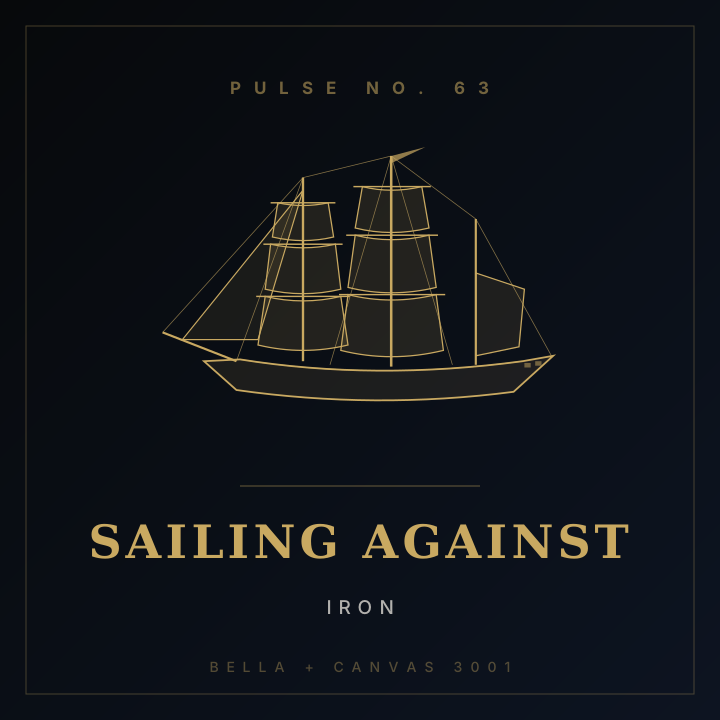
Sailing Against Iron
The last years when a sailing ship could beat a steamship to the dock.