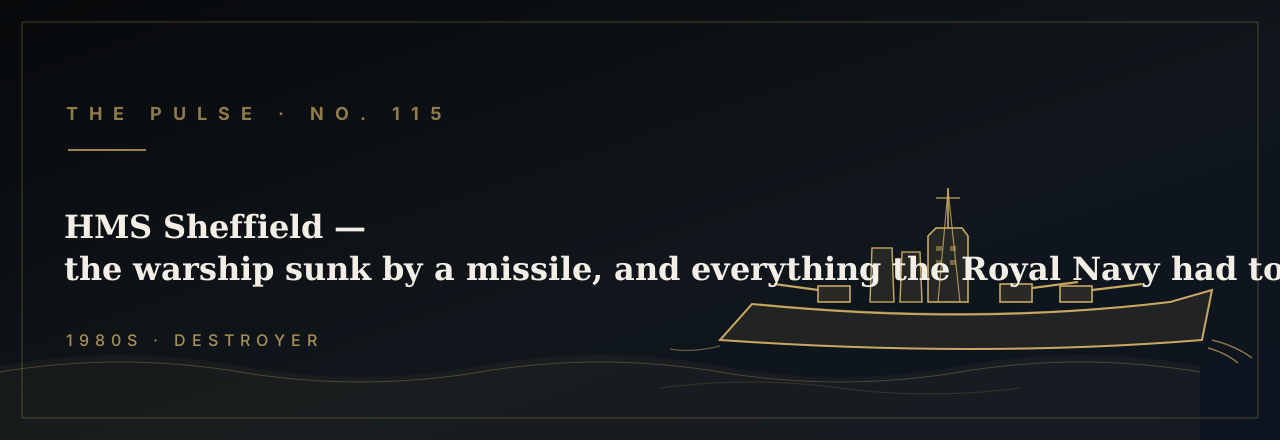
HMS Sheffield — the warship sunk by a missile, and everything the Royal Navy had to relearn.
May 4, 1982: an Argentine Exocet missile hit HMS Sheffield and she burned for six days before sinking. She was the first Royal Navy warship sunk in combat since WWII and the first ever lost to a sea-skimming missile.
On the morning of 4 May 1982, HMS Sheffield sat 60 miles south of the Falkland Islands in the grey, heaving swells of the South Atlantic, her crew going about the routines of a ship at war that had not yet been tested by war. A Type 42 guided-missile destroyer commissioned in 1975, she was one of the most capable air-defense ships in the Royal Navy — built to carry the long-range Sea Dart surface-to-air missile system and, in theory, the sensors to give Task Force 317 critical minutes of warning against any incoming threat. At 10:04 local time, something arrived that gave them twenty seconds.
Argentina had spent years building a single lethal card it knew could redraw the calculus of any naval confrontation. Between 1979 and 1981, the Argentine Navy acquired five Super Étendard carrier-capable strike aircraft from France along with five AM.39 Exocet air-launched anti-ship missiles — sea-skimming weapons designed to fly between five and fifteen meters above the wave tops, ducking beneath radar coverage. When Britain dispatched Task Force 317 south in April 1982, those five missiles became among the most consequential weapons on earth. On 4 May, two Super Étendards lifted off from Río Grande air base in Tierra del Fuego, refueled in flight, dropped to ultra-low altitude, and acquired a radar contact at 30 miles. One missile was fired. The other's launch system failed.
The single Exocet that left its rail that morning traveled at roughly 1,100 feet per second, its active radar seeker pinging the sea surface to hold altitude. Sheffield's primary search radar had been switched off to reduce electromagnetic interference with the ship's SCOT satellite communications terminal, which was conducting a routine data link to Northwood Fleet Headquarters in England. The ship's electronic warfare system did detect the Exocet's seeker in its terminal phase — the alarm sounded on the bridge — but the warning was neither understood nor acted upon in time. Twenty seconds after the alarm, the missile struck Sheffield on her starboard side amidships, just above the waterline. The warhead appears to have failed to detonate. The unburnt rocket propellant did not need to.
The fire that followed consumed Sheffield from within. Burning propellant ignited diesel fuel in the forward machinery space, and the blaze spread rapidly through cable runs lined with PVC insulation that produced dense, toxic black smoke as it burned. Captain James "Sam" Salt ordered his crew to fight the fire, but within minutes the main fire mains had lost pressure — the missile's impact had severed the pumps. Men threw handheld CO₂ extinguishers at a blaze that was already racing through compartments that damage-control doctrine had not prepared them to fight. Salt gave the order to abandon ship barely four hours after the strike. Twenty sailors were dead, twenty-six injured, and a ship that had cost £200 million to build was an orange inferno drifting on a cold and indifferent sea.
Sheffield burned for six days. The Royal Navy attempted to take her under tow toward South Georgia, desperate to preserve the hulk for intelligence purposes and, perhaps more honestly, to keep photographs of a sunken British destroyer off the front pages of the world's newspapers. On 10 May, the sea settled the question: she foundered under tow, the first Royal Navy warship lost in combat since 1945, going down by the stern in near-freezing water. She would not be the last. Before the Falklands War ended, HMS Coventry, HMS Ardent, HMS Antelope, and the container ship Atlantic Conveyor would also be destroyed by air attack — a casualty rate that shocked a generation of Western naval planners who had quietly assumed that sophisticated surface combatants would simply survive a real shooting war.
The post-war board of inquiry produced a catalog of failures that read, in retrospect, as a comprehensive indictment of how the Royal Navy had prepared for modern combat. Sheffield carried Sea Dart — an excellent area-defense missile designed to kill aircraft at range — but had no close-in weapon system to engage a missile in its final seconds of flight. The crew's damage-control training had been built around Cold War scenarios involving nuclear and chemical threats; it had not prepared them for a high-speed fuel fire in a ship whose fire mains had been severed. Medical investigators discovered that synthetic-fiber uniforms — nylon and polyester — had melted onto burned sailors' skin, compounding injuries catastrophically. The Royal Navy issued guidance almost immediately: wool and cotton only, underway, in combat zones. The deeper failure was electronic: the gap between detecting a threat and understanding it had proven fatal, and the Royal Navy had no doctrine for closing that gap in seconds rather than minutes.
The response was swift and thorough. The Phalanx close-in weapon system — a radar-directed 20mm Gatling gun already in service on American warships — was rush-fitted to British vessels while the war was still being fought. Chaff launchers, upgraded electronic warfare suites, and redundant fire-main systems followed. Damage control was rebuilt from first principles, with exercises designed to replicate actual combat conditions rather than peacetime approximations. The U.S. Navy, watching from the Naval War College and from its Pacific Fleet headquarters in San Diego, drew the same conclusions: American surface combatants needed to be better at surviving hits, not only at delivering them. The Falklands became required study for a generation of officers who had inherited a fleet optimized for deterrence and suddenly found themselves thinking, seriously, about the morning a missile arrives with twenty seconds of warning.
What Sheffield ultimately proved — at the cost of twenty lives and a burning hull on the South Atlantic floor — is that confidence in a system is not the same as understanding its limits, and that the gap between peacetime routine and combat reality is precisely where ships are lost. Her wreck lies at roughly 52°S, 56°W, in water cold enough that she will rest there for centuries. But her real legacy is in every drill schedule revised afterward, every synthetic uniform replaced with cotton, every CIWS mount bolted to a weather deck because a navy decided never again. The same blue water that swallowed Sheffield connects, without interruption, to San Diego Bay. The same gap between routine and readiness opens every time a crew leaves the harbor. You could be on it tonight.
Two designs for Pulse No. 115.
Bella + Canvas 3001 unisex tee. Printed on demand and shipped from the U.S. $34.99 + tax + shipping.
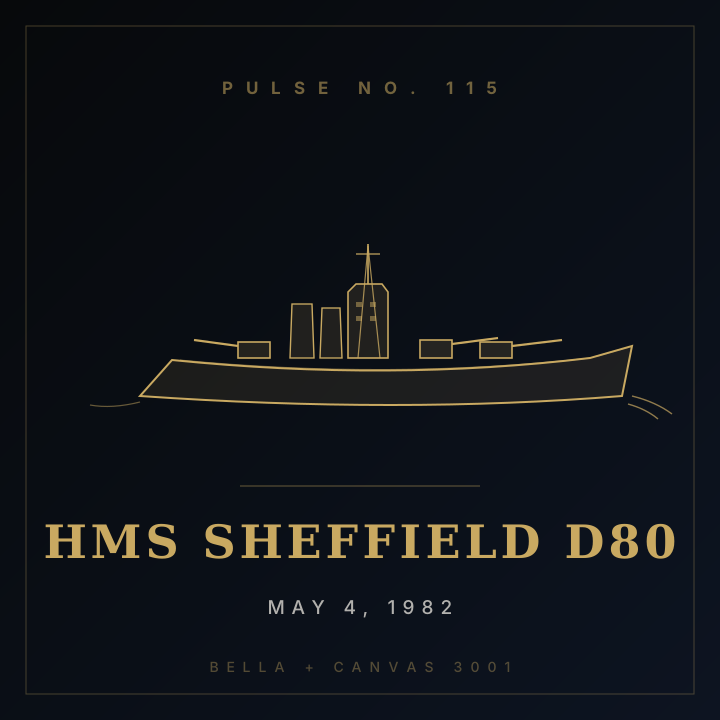
Sheffield Tee
HMS SHEFFIELD D80 · MAY 4, 1982
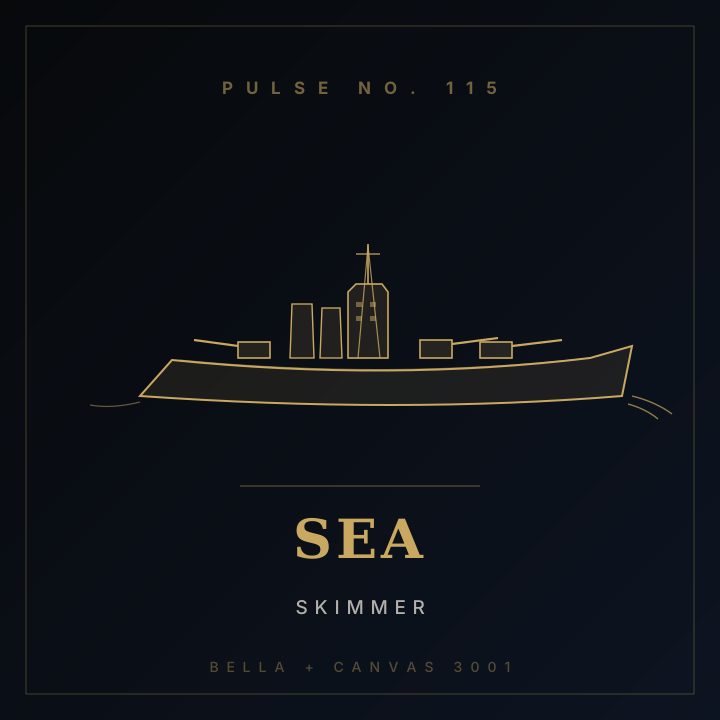
Sea Skimmer
The Exocet's flight profile — below radar coverage.