Joshua Slocum and Spray — the first solo circumnavigation.
Between 1895 and 1898, Joshua Slocum sailed a 36-foot sloop alone around the world. He was 51 years old. He rebuilt the boat himself from a rotting hull. He is the reason single-handed offshore sailing exists as a sport.
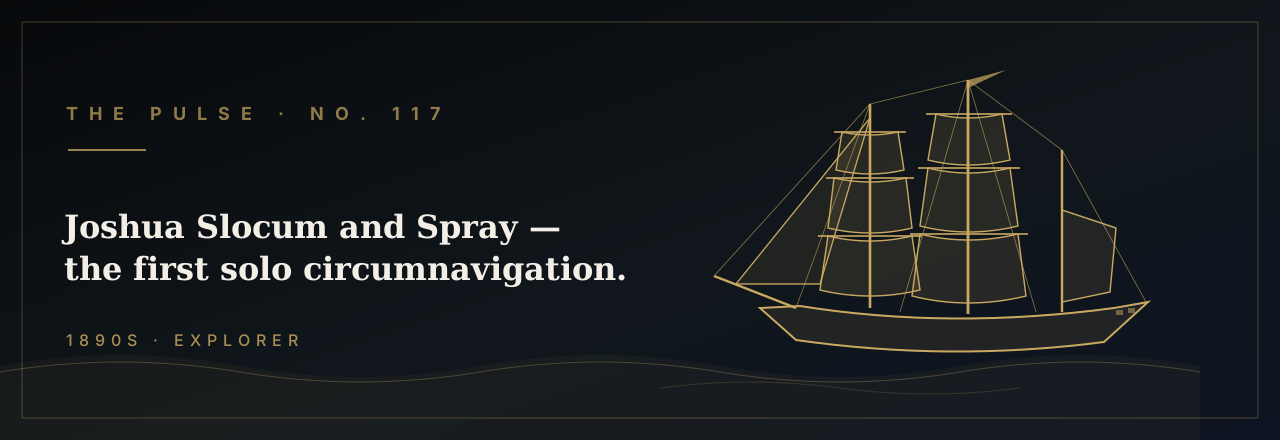
On the morning of April 24, 1895, a weathered sloop nosed out of Gloucester harbor and pointed her bowsprit toward the open Atlantic. She was 36 feet, 9 inches at the waterline, broad-beamed and ungainly by the standards of any racing yacht, and she carried a single sailor who had rebuilt her with his own hands from a hull so rotten the shipwrights laughed. Joshua Slocum was fifty-one years old, broke, and at the precise moment history would remember him, utterly unknown. When Spray cleared the last headland and fell off onto a starboard tack, she began the first solo circumnavigation of the globe — a voyage of 46,000 miles that would take three years, two months, and two days, and that would permanently change what human beings believed themselves capable of on the sea.
Slocum had not begun life as a man accustomed to failure. Born in Nova Scotia in 1844, he had gone to sea at sixteen, worked his way through the ranks of the Pacific merchant trade, and by his mid-thirties commanded some of the finest vessels on the trans-Pacific and coastal American runs. He had sailed Northern Light from San Francisco to New York — at the time considered the finest American ship afloat — and had captained Aquidneck through the hazardous grain routes off Brazil. The sea was not a romance to him; it was a trade, practiced with the same hard arithmetic a carpenter applied to timber or a blacksmith to iron. But the age of sail was ending. Steam was devouring the cargo routes, and Slocum, who had no patience for engine rooms and less for the financiers displacing the old merchant captains, found himself ashore in the 1890s with his career in ruins and very little money.
The boat came to him as a kind of joke. His old friend Captain Eben Pierce of Fairhaven, Massachusetts, offered Slocum a "ship" that turned out to be a century-old oyster sloop rotting in a pasture. The hull had not touched water in years. Her planking was sponge, her frames were punky, and her keel had settled unevenly into the earth. A lesser man would have seen firewood. Slocum saw a voyage. Working alone through the winter of 1892–93 in Fairhaven, he sawed new frames, steam-bent new planks, recaulked every seam with cotton and pitch, and fashioned a new keel from a single piece of Georgia pine. He spent $553.62 on materials — a figure he recorded with a sea captain's precision — and two years of labor. When Spray finally went back in the water she was, in almost every structural sense, a new vessel wearing an old name.
The early Atlantic passage was relatively gentle, but the voyage's character declared itself off Gibraltar, where Moorish pirates closed on Spray in the night, drawn by her lights and the news of a single-handed sailor. Slocum stood them off, made Gibraltar, and received well-intentioned but disastrous advice from the Royal Navy garrison to cross the Mediterranean. He turned south instead, running down the coast of Africa to Brazil, a detour that added thousands of miles but placed him on a route he knew. In Pernambuco he was feted. In Buenos Aires he loaded supplies for the hardest section of the voyage: the Strait of Magellan. He noted in his log that the Strait had been the graveyard of fleets. He was about to take it alone, in a sloop that would fit comfortably in the cabin of a modern container ship.
The Strait nearly killed him anyway — not by storm, but by the indigenous Fuegian Yaghan, who had raided ships since Magellan's own passage in 1520. Slocum anchored at night and was jolted awake by the sound of bare feet on the deck. He drove the boarders off, but they returned. His solution was characteristically practical: he spread carpet tacks, points up, across the deck before sleeping. In the dark, a dozen barefoot raiders hit the tacks simultaneously — Slocum awoke to howling, scrambling bodies, and the sound of a canoe retreating at speed. He logged the incident with dry satisfaction and continued west. He transited the Strait three times before the weather relented, battered by the westerlies that had shattered San Agustín, Cuyler, and scores of other vessels, but Spray — with her wide beam and heavy displacement — proved almost impossible to capsize, a characteristic Slocum had come to trust completely.
The Pacific crossing was the voyage's long middle passage: 72 days from Juan Fernández Island to Samoa, with no land and no other ship. Slocum slept in short intervals, set Spray on a self-steering course using the sails — a technique he had developed by experiment — and read Don Quixote and Dickens and whatever else he had aboard. His navigation was improvised: his chronometer had failed before departure and he had replaced it with a tin alarm clock bought for a dollar, correcting it daily for drift. He calculated longitude by lunar distances when he could, and by dead reckoning the rest of the time. He made landfall at Samoa within miles of his predicted position. Robert Louis Stevenson's widow, Fanny, met him there and later wrote that he was "the most interesting man she had ever met." He stayed a few weeks, took on provisions, and sailed on. He rounded the Cape of Good Hope in the southern winter of 1897 and turned north at last.
Spray crossed the bar at Newport, Rhode Island on the morning of June 27, 1898, completing a circuit of the globe that no solo sailor had ever attempted, let alone finished. Slocum was met by a customs official who asked where he was from. "From the last port," he answered. He had been at sea, with harbor stops, for 1,152 days. He was fifty-four years old and in excellent health. The book he wrote about the voyage — Sailing Alone Around the World, published in 1900 — sold steadily for decades and has never gone out of print. It is the founding document of single-handed offshore sailing, the text from which every solo ocean race, every bluewater passage, every singlehanded crossing of the Pacific derives its lineage. Slocum himself disappeared in November 1909, sailing Spray toward the Amazon on yet another voyage. No wreckage was ever found.
Joshua Slocum matters not as a curiosity but as a proof of concept. He demonstrated — with a rebuilt century-old hull, a dollar alarm clock, and no support vessel — that one person with sufficient knowledge and nerve could take a small boat anywhere on earth. Every sailor who has since left a harbor alone, whether for Catalina or Cape Horn, inherits that proof. The same Pacific swells that rolled under Spray's hull still lift the bow off Point Loma. The same stars Slocum shot with his sextant still hang over San Diego Bay on a clear September night. You could point a sloop west tonight and follow the same water to the same horizon he did — the proof is already in the wake.
Two designs for Pulse No. 117.
Bella + Canvas 3001 unisex tee. Printed on demand and shipped from the U.S. $34.99 + tax + shipping.
Spray Tee
SPRAY · JOSHUA SLOCUM · 1895–1898
The Rebuilt Sloop
Slocum rebuilt Spray from a rotting hull before he sailed her around the world.