SS Normandie — the greatest liner ever built, burned at her own pier.
The fastest ship in the Atlantic was being converted to a troopship when a welder's torch ignited a bale of kapok life preservers on February 9, 1942. She capsized in New York Harbor from the weight of firefighting water. The Navy had spent four months converting her.
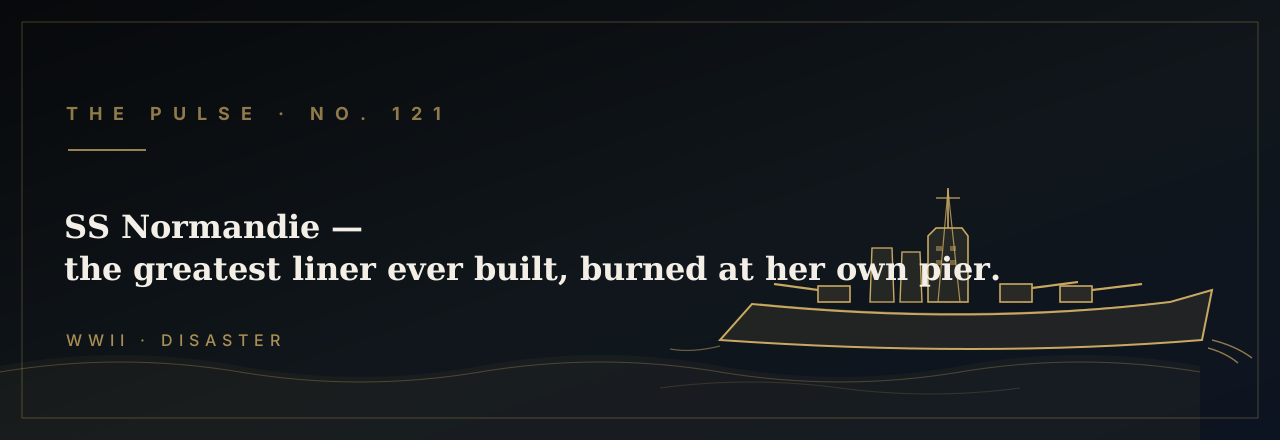
She was the most beautiful ship the world had ever launched, and she never carried a single soldier to war. The SS Normandie entered service on May 29, 1935, built at Chantiers de l'Atlantique in Saint-Nazaire for the Compagnie Générale Transatlantique — the French Line — measuring 1,029 feet at the waterline and 83,423 gross tons, the first ocean liner in history to exceed a thousand feet. Her turbo-electric propulsion system, fed by 29 boilers driving four propeller shafts, pushed her across the Atlantic on her maiden voyage in four days, three hours, and two minutes, fast enough to claim the Blue Riband at a sustained 29.98 knots. But her engines were only half the story. Her first-class dining salon ran 300 feet — longer than the Hall of Mirrors at Versailles — lit by twelve soaring glass towers designed by René Lalique and hung with Jean Dunand lacquer panels, seating 700 guests beneath ceilings that climbed nearly thirty feet. No ocean liner before or since has combined that class of engineering with that density of commissioned art. She was, by almost universal agreement, the greatest ship the world had ever produced.
When the German advance collapsed France in June 1940, the Normandie was moored at Pier 88 on Manhattan's West Side, 3,000 miles from home and stranded. The CGT's New York office locked her gangways and reduced the crew to a skeleton watch; there was no safe harbor to return to and no route through occupied Europe. For eighteen months the great ship sat idle in the Hudson while her rivals RMS Queen Mary and RMS Queen Elizabeth had been converted and pressed into Allied troopship service. The $56 million spent building the Normandie now yielded nothing but dock fees. Her turbines cooled. Her Lalique glass gathered grime. The ghost crew that tended her had little to do but watch the river and wait for a war that had not yet decided to use her.
The attack on Pearl Harbor on December 7, 1941, ended her idleness in five days. The United States government seized the Normandie on December 12, renamed her USS Lafayette (AP-53), and contracted Robins Dry Dock and Repair Company of Brooklyn to convert her into a troopship capable of carrying 15,000 soldiers per crossing. The plan was to strip the Art Deco interiors, install triple-tiered military bunks, mount anti-aircraft guns on her decks, and have her ready by mid-February. By early 1942, some 3,000 workers were swarming her in three shifts around the clock — welders, carpenters, electricians, plumbers — cutting through Lalique glass and Dunand lacquer to make room for cafeteria galleys and bunk-frame steel. The conversion was running ahead of schedule. Everyone understood the urgency. Urgency was precisely the problem.
At roughly 2:35 in the afternoon of February 9, 1942, a welder working in what had been the first-class lounge touched his arc torch to a steel stanchion and ignited a bale of kapok life preservers stacked against the bulkhead. The Navy had staged 2,000 bales of the material in the salon as a matter of convenience — the room was large, the kapok was needed for the conversion, and no one had paused to consider the consequences of filling a workspace with compressed vegetable fiber while open-flame tools operated continuously and no fire watch stood station. Kapok is essentially tinder. One bale caught its neighbors, the neighbors caught the row beyond, and within minutes the entire lounge was fully involved — dense black smoke pouring from the ship's portholes in columns visible from the far bank of the Hudson, driving the workers out of every compartment and up every companionway in a running stampede to the deck.
The New York City Fire Department responded with more than thirty companies, training their hoses on the Lafayette from the pier and from fireboats in the river. Mayor Fiorello La Guardia arrived at the dock and stood watching in his overcoat. The water the companies poured in went where water always goes — downward, pooling in the lowest compartments of a ship whose internal watertight systems had been partially disassembled and altered beyond easy recognition over four months of conversion. Neither the naval oversight officers nor the contractor crews had reliable schematics for the Lafayette's watertight subdivisions; they had inherited a vessel they didn't fully understand and had been rebuilding it at speed. As the lower decks filled, the ship's center of gravity climbed. The Lafayette listed to port. By midnight the lean was visible from the pier. At 2:45 in the morning of February 10, she rolled onto her side, her four great funnels swinging down to bury themselves in the mud of the Hudson, her keel rising into the February sky above Pier 88. Dozens were injured; by some grace, only one man died.
The investigation produced the expected theory of sabotage. J. Edgar Hoover floated the enemy-agent narrative publicly, and American newspapers were glad to print it — the country was at war, the story was satisfying, and the alternative was too humiliating to contemplate. A formal Naval Court of Inquiry convened over the following weeks and reached a less dramatic conclusion: gross negligence, specifically the placement of 2,000 bales of highly flammable material in an active welding zone without fire suppression or fire watch, by a conversion apparatus that had prioritized speed over system. The oversight structure had been poorly designed, coordination between naval officers and civilian contractors had been inadequate, and the ship's complex systems had never been properly documented for the workforce responsible for rebuilding them. The enemy had done nothing. The Navy had destroyed the greatest ocean liner in history through the accumulated institutional failures of haste.
Recovering the capsized Lafayette proved to be among the most demanding harbor engineering operations in American history. Navy salvage teams spent fourteen months constructing watertight cofferdams around the submerged hull, pumping compartments, cutting away sections of the upper superstructure to reduce topside weight, and rotating the ship incrementally upright through sequences of deliberate flooding and pumping. She came upright in August 1943. Naval engineers inspected what remained and made the rational calculation: the damage was too extensive to repair at any cost a wartime budget could justify. She was towed to Port Newark, placed in reserve, and sold for scrapping in 1946. Her four bronze propellers — each twenty feet across and weighing more than twenty tons — went for scrap metal, not to a museum. The company that cut her apart paid less for her entire hull than a single first-class stateroom had once cost per crossing.
The destruction of the Normandie is a particular species of naval catastrophe — not the tragedy of battle, where ships are taken by an enemy's skill or the hard mathematics of war, but the tragedy of bureaucratic carelessness applied to something irreplaceable. She was not sunk by the Kriegsmarine. She was destroyed by a welder's arc, 2,000 bales of kapok, and the compounding failures of an institution mobilizing faster than it could think. In February 1942, San Diego's harbor was alive with the same electricity: destroyers fitting out at the 32nd Street Naval Base, transports loading at the military piers, thousands of workers swarming vessels whose systems half of them had never touched. Every American port that winter was operating at the outer edge of its competence, and the outer edge of competence is where catastrophe makes its home. The Normandie is the ledger entry for what happens when the margin collapses — when the greatest ship ever built meets the institutional limits of wartime haste, and no one notices until the keel is rising from the water. The same harbor urgency. The same channel opening out to sea. You could push off from these docks tonight and feel it all still running beneath the surface.
Two designs for Pulse No. 121.
Bella + Canvas 3001 unisex tee. Printed on demand and shipped from the U.S. $34.99 + tax + shipping.
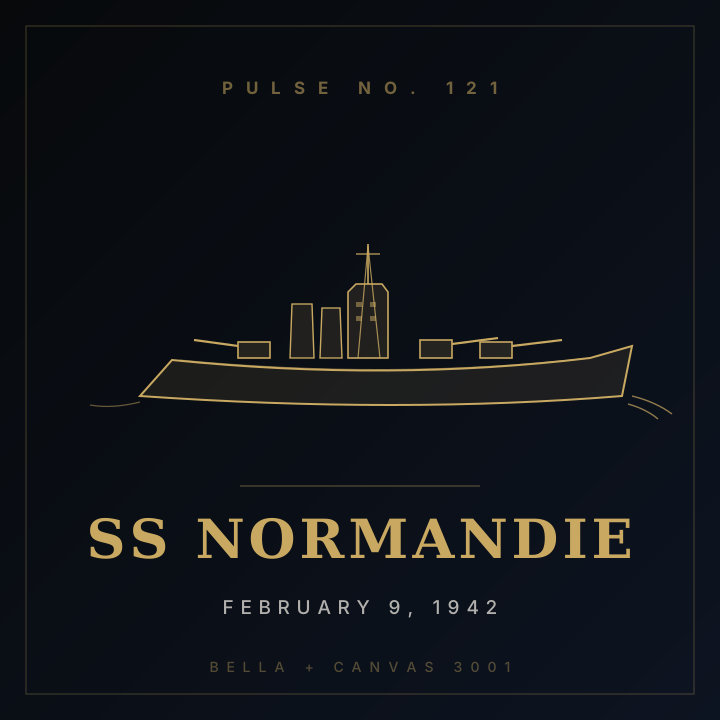
Normandie Tee
SS NORMANDIE · FEBRUARY 9, 1942
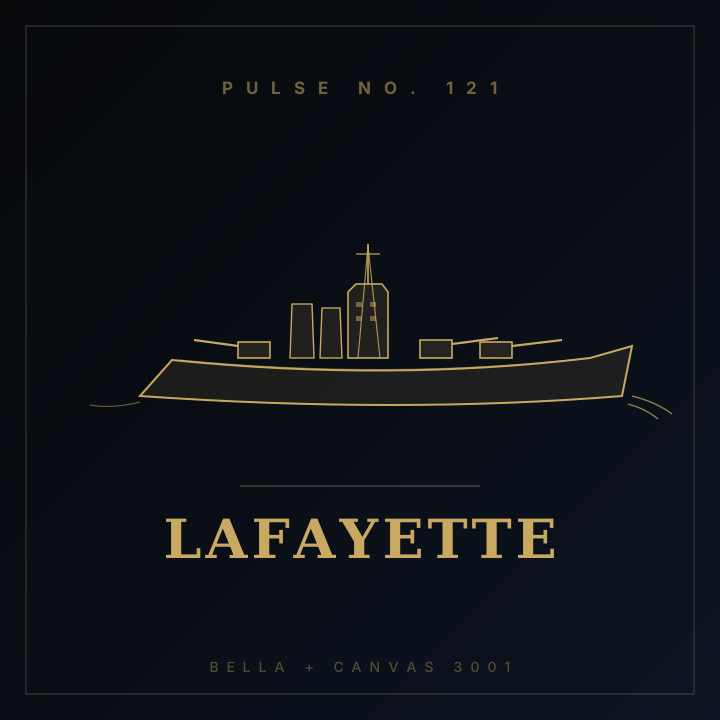
Lafayette
Normandie's new Navy name — she never sailed under it.