Pilot — the little boat that met every big ship in San Diego for 82 years.
Built in San Diego in 1914, Pilot carried harbor pilots out to incoming ships until 1996. She served the Coast Guard in World War II and still takes passengers around the bay from the Maritime Museum.
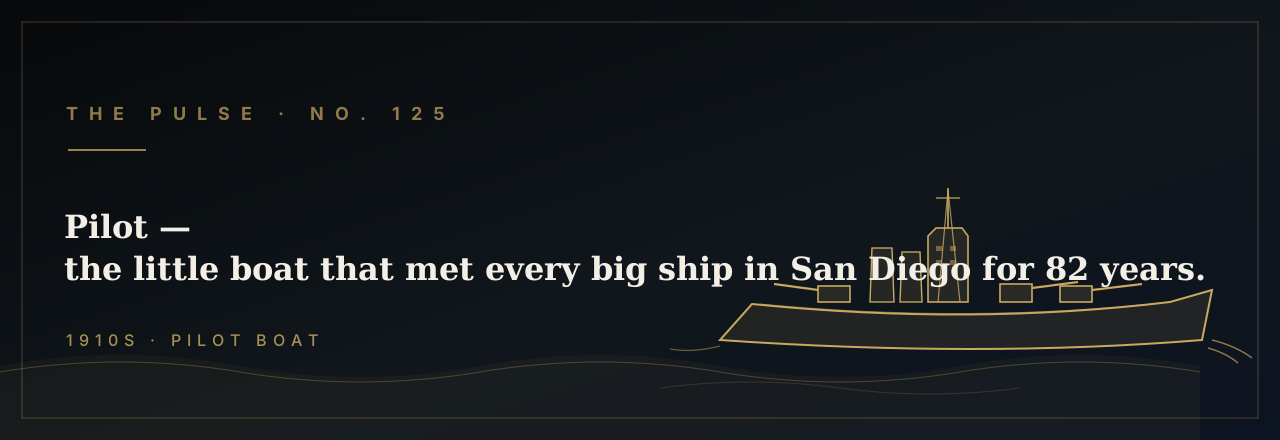
Every ship entering San Diego Bay had to wait for a small boat to come out and meet it. Long before a freighter or warship could cross the bar and make for the wharves, it would slow its engines and hold position while a 52-foot wooden vessel drove across the swells toward its hull, carrying the one person authorized to guide it inside the harbor: a licensed harbor pilot. From 1914 until 1996, that small boat was Pilot — the vessel that met every ship San Diego ever had, for 82 unbroken years.
She was built in 1914 at the boatyard of Manuel Goularte on Atlantic Avenue — the waterfront street that would later be widened and renamed Harbor Drive — at the foot of Hawthorne Street in San Diego. At 52 feet and 19 gross tons, she was a diesel-powered wooden hull designed for a single purpose: to run at 8 to 10 knots, reach an incoming vessel in open water, and then come home and do it again. She was the first powered pilot boat in the port's history — predecessors had relied on sail — and her construction reflected the job's demands. Captain Ed Silva, who knew the vessel well, described her as built strong enough "to slam into every ship." That was not an exaggeration. It was the operating standard.
The work she performed is among the oldest in organized seamanship. Harbor pilotage — placing a licensed local navigator aboard an inbound vessel — was being regulated by colonial legislatures in North America as early as the 1700s; the logic has never changed. A ship's master might be the finest blue-water navigator alive, but local waters require local knowledge: the depth of the channel after a winter storm, the behavior of tidal currents at the Point Loma narrows, the placement of anchorages rearranged since the last visit. Under California's harbor pilotage statutes, a vessel master who refused a licensed pilot still owed half the pilotage fee — recognition, in law, that the harbor's knowledge belonged to the harbor. To transfer that knowledge from a small boat to a large one, a pilot traditionally climbed a Jacob's ladder, a rope ladder dropped over the side of a vessel underway, sometimes miles offshore. Pilot's job was to hold station long enough for the transfer to happen.
She held station, and she kept returning. Over eight decades, Pilot recorded no more than three consecutive days out of service — a figure that captures both the boat's mechanical durability and the relentless pace of commerce entering San Diego Bay. Cargo ships from Australia, Japan, and Chile; passenger steamers; lumber schooners from the Pacific Northwest; tank vessels laden with oil for the growing city — they all waited at the outer harbor while the small wooden boat crossed to deliver a pilot. The bay's commercial rhythm ran on Pilot's schedule as much as on the tides, and the San Diego Bay Pilots Association, which kept logs documenting every movement, recorded a steady accumulation of ship names, tonnages, and fees stretching across the decades.
The demands of World War II reached Pilot quickly. After Pearl Harbor in December 1941, San Diego became one of the principal staging bases for the American war effort in the Pacific, and the U.S. Coast Guard assumed control of the vessel, operating her as both pilot boat and harbor patrol craft. The pilot logs maintained from 1942 to 1946 — now preserved in the San Diego Harbor Pilots Collection at the San Diego History Center — record the names and drafts of warships, liberty ships, victory ships, and Allied naval vessels cycling through the harbor in a near-continuous procession. Pilot earned six service chevrons during the war, one for each six-month period of active duty authorized by the Secretary of War. The pilots who worked that harbor alongside the Coast Guard — Captains H. N. Krog, Hilton C. Johnson, John T. Larsen, F. D. Pennoyer, and K. J. Sorensen — guided a channel that never quieted and never emptied.
The war's end did not slow the bay. San Diego had spent the previous half-century growing into the Navy's primary Pacific Coast installation, and the Cold War deepened that relationship. Naval Station San Diego expanded through the 1950s and into the 1960s until it was the largest surface warfare complex on the West Coast; the harbor that had received coal barges and fishing trawlers in Pilot's early years was now berthing aircraft carriers, guided-missile cruisers, and submarine tenders displacing tens of thousands of tons. The vessels changed. The small wooden boat that went out to meet them did not. Through the Berlin crisis and the Korean War and Vietnam and the long years of Cold War patrols, Pilot kept her schedule.
In 1996, after 82 years of continuous service, Pilot was retired from active duty and donated to the Maritime Museum of San Diego, where she underwent a full restoration before relaunching in 2002. She now carries public passengers on 45-minute tours of the harbor, tracing the same water she worked for eight decades. She remains available to port pilots when the museum's historic vessels require assistance — and the Star of India, built in 1863 and the oldest active sailing ship in the world, still sometimes receives her pilot courtesy of Pilot.
What Pilot's 82-year record makes plain is that every great navy and every busy port is ultimately dependent on a small boat and the licensed mariner it carries — a chain of irreplaceable local knowledge that never made headlines but never stopped working either. That chain runs through this water still. The same channel past Point Loma. The same Pacific swells rolling into the bay. You could be out there tonight.
Two designs for Pulse No. 125.
Bella + Canvas 3001 unisex tee. Printed on demand and shipped from the U.S. $34.99 + tax + shipping.
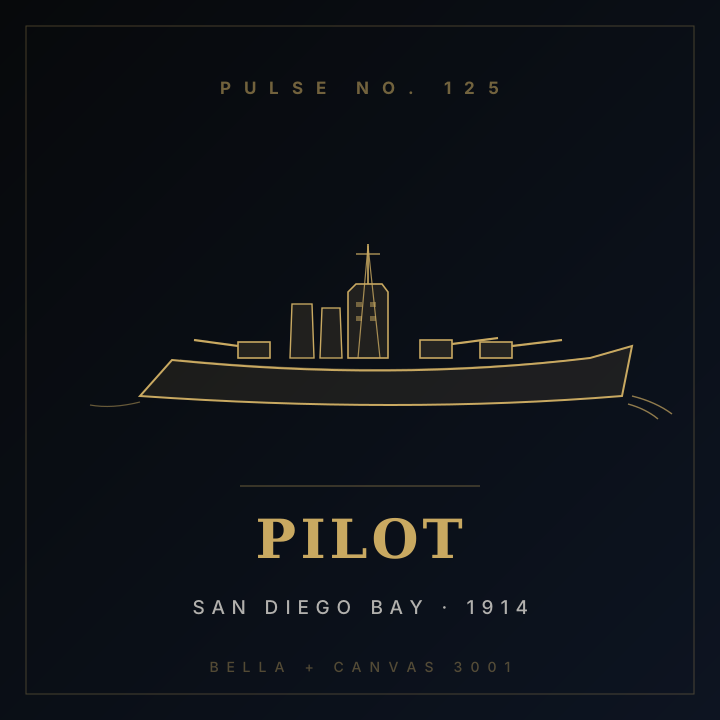
Pilot Tee
PILOT · SAN DIEGO BAY · 1914
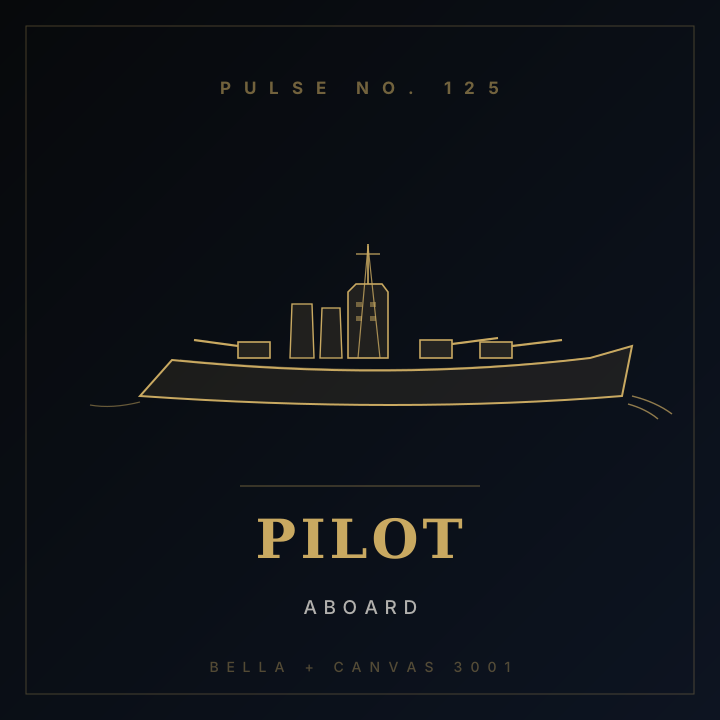
Pilot Aboard
The words every captain coming into San Diego wanted to hear.