Medea — the Edwardian steam yacht that went to war twice.
Built on the Clyde in 1904 for a Scottish landowner, Medea hunted submarines for the French Navy in World War I and served the Royal Navy and Norwegian sailors in World War II. She came to the Maritime Museum of San Diego in 1973 and still steams on the bay.
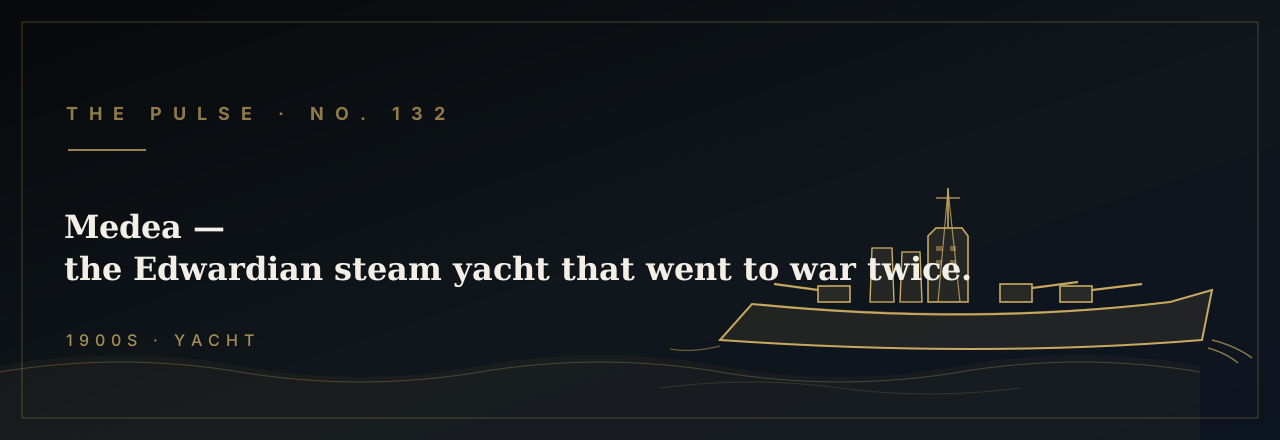
She was built in fifty-one days. That was the boast of Alexander Stephen and Sons at their Linthouse yard on the Clyde, and the yard delivered: keel laid, frames set, hull plated, engine seated, every inch of paneling fitted and varnished — a 134-foot steam yacht complete and afloat on the twenty-ninth of August, 1904. Her new owner was William Macalister Hall, British Army officer and laird of Torrisdale Castle in Kintyre, and he received a vessel of 143 gross tons, driven by a two-cylinder compound steam engine producing 254 horsepower, sheathed in teak above the waterline and in steel below it — built to a standard a private owner would never fully need, and that two navies would eventually find indispensable. He named her Medea.
The Edwardian era was the last great age of the private steam yacht. Coal was cheap, professional crews were cheaper, and the men who had made fortunes in industry and land spent them on vessels that required engineers, stewards, and a cook just to move down the loch for a day's shooting. Hall used Medea for exactly this: hunting excursions among the Scottish islands, skeet shooting off her stern, parties that floated rather than stood still. The Clyde yards that built the world's cargo fleet turned out these confections of teak and polished brass on the side — and built them, in the case of Alexander Stephen, with a speed and precision that amounted to its own kind of industrial pride. Medea was delivered in seven weeks. She would outlast the era that created her by more than a century.
In the summer of 1914, the French Navy was requisitioning everything that floated. Medea was purchased, renamed Corneille — the French word for crow — and fitted for war. A 75mm deck gun went in forward. Depth charges went aboard. A captive observation balloon was added aft, a gas bag on a tether used to watch for the shapes of enemy submarines beneath the surface. The vessel that had carried a Scottish laird among the islands was now an anti-submarine picket.
The war in the Channel was not a war of spectacular fleet engagements. It was patrol work: cold Atlantic swells, gray water, the ceaseless anxiety of the U-boat campaign that was strangling Allied shipping. German submarines sank more than five thousand Allied vessels between 1914 and 1918 — not warships, mostly, but the freighters and tankers and colliers that kept Britain in food and France in steel. The Allied answer was to arm anything capable of carrying a gun and send it out in convoy escort. Corneille was not a warship by design. She was a pleasure yacht with a gun bolted to her foredeck and depth charges racked at her stern. She served for the duration of the war — the kind of unglamorous, necessary naval work that history books seldom record but shipping ledgers always do.
Two decades of private ownership followed — the usual postwar wandering of requisitioned vessels returned to civilian life. Then, in 1939, the second war came, and Medea went back into uniform. The Royal Navy put her first to work at the mouth of the River Thames, where she anchored barrage balloons — steel cables strung skyward on gas bags to shred the wings of German aircraft coming in low over the estuary. Her second assignment was Scotland, where she served as an accommodation ship for officers of the Norwegian Navy in exile — men who had sailed their vessels out of occupied harbors in 1940 to continue the fight from British ports, who planned commando raids along the Norwegian coast from the saloon of a Clyde-built yacht that had once been a laird's hunting lodge afloat.
After the armistice, Medea passed through Norwegian, British, and Swedish ownership before a California oilman named Paul Whittier found her, bought her in 1971, and spent two years returning her to something close to the Edwardian original. In 1973 he donated her to the Maritime Museum of San Diego, where she took her berth at the Embarcadero alongside the ferryboat Berkeley and the iron sailing ship Star of India. San Diego has always been a Navy town — Naval Base San Diego, three miles up the bay, is the largest surface fleet installation in the world — but Medea represents something the destroyers and amphibious ships do not: a vessel that crossed a century of naval war not as a combatant, but as a survivor, finding use in every conflict she encountered and emerging, each time, still afloat.
The same compound engine. The same teak. You could sail out on her tonight.
Two designs for Pulse No. 132.
Bella + Canvas 3001 unisex tee. Printed on demand and shipped from the U.S. $34.99 + tax + shipping.
Medea Tee
STEAM YACHT MEDEA · 1904
Corneille
Her French Navy name in 1917.