USS Constitution — "Old Ironsides" and the birth of American sea power.
She was built to fight Barbary pirates. She ended up defining the country's idea of itself.
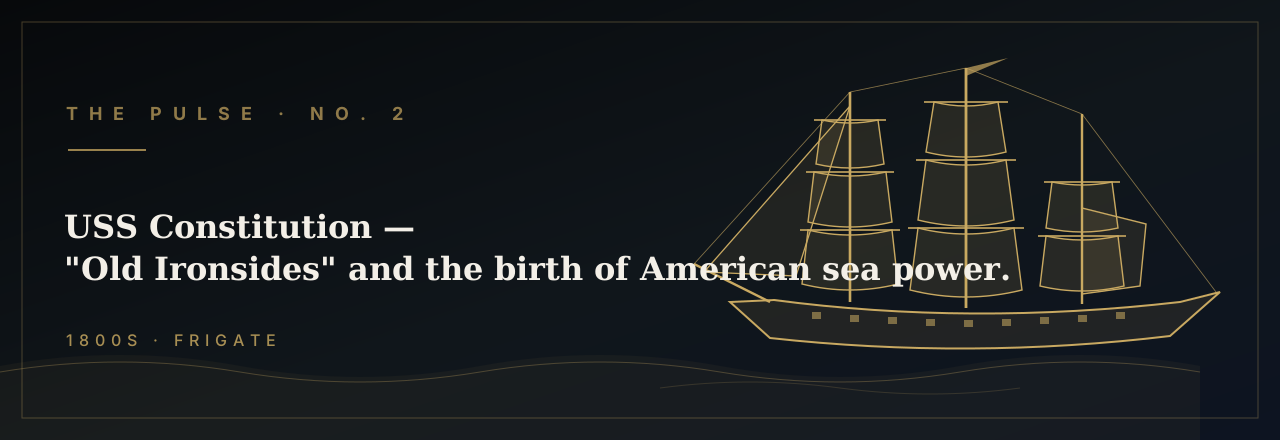
She was laid down on November 1, 1795, in Edmund Hartt's shipyard at Constitution Wharf in Boston — a city that had not yet decided whether its new republic needed a navy at all. Congress had authorized her construction the previous year under the Naval Act of 1794, which called for six frigates to end the humiliation of American merchant ships being seized by Barbary corsairs in the Mediterranean. She was named by President Washington himself. Her builder used live oak from Georgia — the densest, most rot-resistant timber in North America — and copper bolts and sheathing supplied by Paul Revere's foundry in Canton. By the time she was launched, October 21, 1797, the nation that built her had begun arguing about whether her kind should exist.
The man who designed her understood the argument and overbuilt her against it. Joshua Humphreys of Philadelphia was the young republic's first naval architect of consequence, and his solution to America's strategic problem — a small nation that could not afford a standing fleet — was a class of ships that would outfight anything they couldn't outrun and outrun anything they couldn't outfight. Where a standard British or French frigate of the period mounted 32 to 38 guns on a narrow hull, Humphreys gave his six ships 44 guns on a beam two feet wider, with three feet of live oak forming the hull strakes where a European frigate used softer timber. He did not build a frigate. He built something the Royal Navy had no tactical category for.
Constitution's first war was not with the Barbary States but with France. During the Quasi-War of 1798–1800, she patrolled the Caribbean under Captains Silas Talbot and Samuel Nicholson, capturing French privateers and escorting American merchant convoys. Then came the First Barbary War, and under Commodore Edward Preble she blockaded Tripoli, bombarded its harbor batteries five times across the summer of 1804, and established the principle — which American diplomats had struggled to articulate for twenty years — that the United States would not pay tribute. Preble was forty-three, tubercular, and not gentle with subordinates. He was the officer who trained the generation that would fight the War of 1812.
That war began badly for American arms on land. On water it was something else. On August 19, 1812, Captain Isaac Hull brought Constitution alongside HMS Guerriere, 38 guns, Captain James Dacres commanding, four hundred miles southeast of Halifax. The engagement lasted thirty-five minutes. Guerriere's 18-pound shot struck Constitution's live oak sides and dropped into the sea; a sailor on the American gun deck reportedly shouted "Huzza! Her sides are made of iron!" — and the name stuck. When Hull broke off to re-rig a damaged brace, Dacres attempted to reload and found that his mizzen mast, his bowsprit, and most of his forward rigging were gone. He struck his colors. Guerriere was so badly damaged she was burned at sea. It was the first time a British frigate had been defeated in single-ship action in twenty years of nearly continuous war, and the news reached London before it reached Washington.
She was not finished. On December 29, 1812, under Captain William Bainbridge, she took HMS Java, 38 guns, off the coast of Brazil in a two-hour fight that left the British ship dismasted and burning. Then on February 20, 1815 — two months after the Treaty of Ghent had technically ended the war, though the news hadn't reached the Atlantic — Captain Charles Stewart fought the most tactically elaborate action of her career, maneuvering alone against two British vessels simultaneously: HMS Cyane and HMS Levant. He took both. Three frigates and a sloop-of-war in three years: the record of no other American warship in that conflict came close. The Admiralty quietly banned single-ship engagements with American super-frigates for the remainder of the war.
What nearly killed her was not enemy shot. By 1830 she was rotting at the dock in Charlestown, and the Navy Department issued a report recommending she be broken up as unfit for service. A twenty-one-year-old Boston physician named Oliver Wendell Holmes read the notice in the Boston Daily Advertiser and in two hours wrote a thirteen-stanza poem — "Old Ironsides" — that was reprinted in newspapers from Boston to the frontier. "Ay, tear her tattered ensign down! / Long has it waved on high." Public outrage was immediate and overwhelming. The Navy reversed itself. She was rebuilt. Holmes, who would go on to become dean of Harvard Medical School and one of the great American essayists, later called it the only poem he'd written that had any practical effect. It is the most consequential broadside in American literary history — a twenty-one-year-old arguing with Congress in verse, and winning.
She is still a commissioned vessel of the United States Navy — the oldest commissioned warship afloat in the world — moored at the Charlestown Navy Yard in Boston, where she has been preserved since 1897. Every Fourth of July she is towed into the harbor and turned, so that both sides of her hull weather evenly. Active-duty Navy sailors serve aboard her. Tourists walk her gun decks. She is, in a very literal sense, still in service — an operational commission unbroken since 1798, two hundred and twenty-seven years and counting, flying the same broad pendant she flew when Isaac Hull cleared for action off Halifax.
San Diego did not exist as a naval city in 1812 — it was a Spanish colonial outpost, a presidio on a hill above a bay the Americans wouldn't reach for another thirty years. But the argument Constitution settled echoes in every ship that sails out of Naval Base San Diego today. The question she answered was whether the United States had the will and the craft to build warships that were not merely adequate but genuinely superior — designed from first principles to win rather than survive. NASSCO, on the tidal flats of San Diego Bay, now builds the Constellation-class frigates — the first American frigates in a generation — in the same tradition: purpose-built warships intended to outfight and outlast their class. Joshua Humphreys would have recognized the brief.
Constitution was built to defeat a pirate threat in the Mediterranean. She ended up defining what American sea power meant — not the borrowed doctrine of European line-of-battle fleets, but something faster, more aggressive, and more independently capable. Her three consecutive victories in the War of 1812 forced Britain, the world's pre-eminent naval power, to change its single-ship engagement policy. They also changed the way Americans understood their own republic: as a nation that did not simply endure its oceans, but commanded them. The ship is a symbol, yes — but she earned the symbolism the hard way, thirty-five minutes at a time, live oak against the North Atlantic.
Two designs for Pulse No. 2.
Bella + Canvas 3001 unisex tee. Printed on demand and shipped from the U.S. $34.99 + tax + shipping.
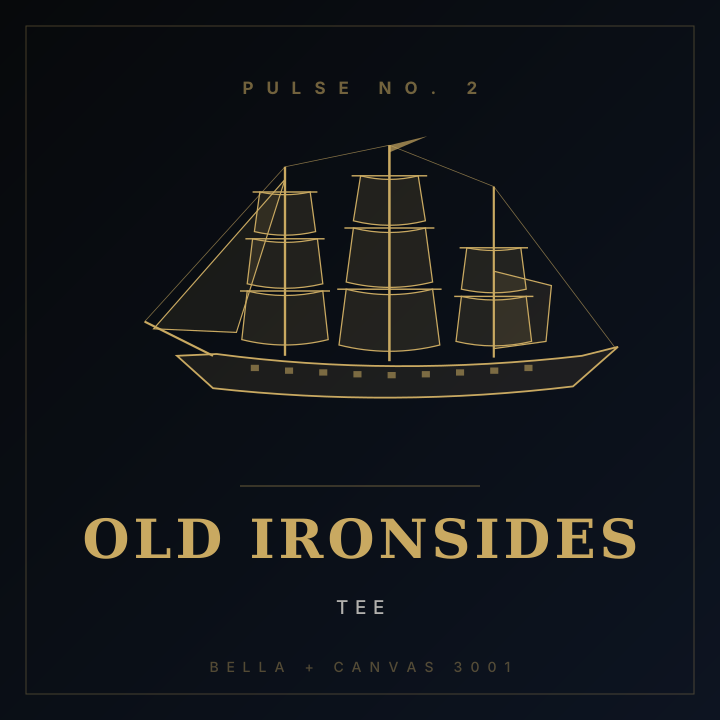
Old Ironsides Tee
USS CONSTITUTION · 1797 · Never Surrendered
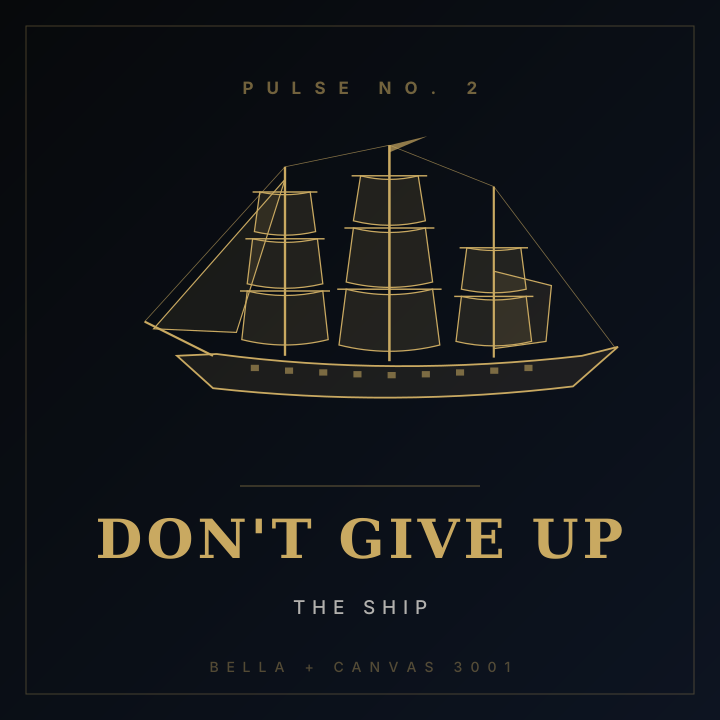
Don't Give Up the Ship
The order that launched a navy.