The Battle of Trafalgar — twenty-seven British ships and a dead admiral who won anyway.
Nelson cut the French line in two and changed the shape of the world. He did not live to see it.
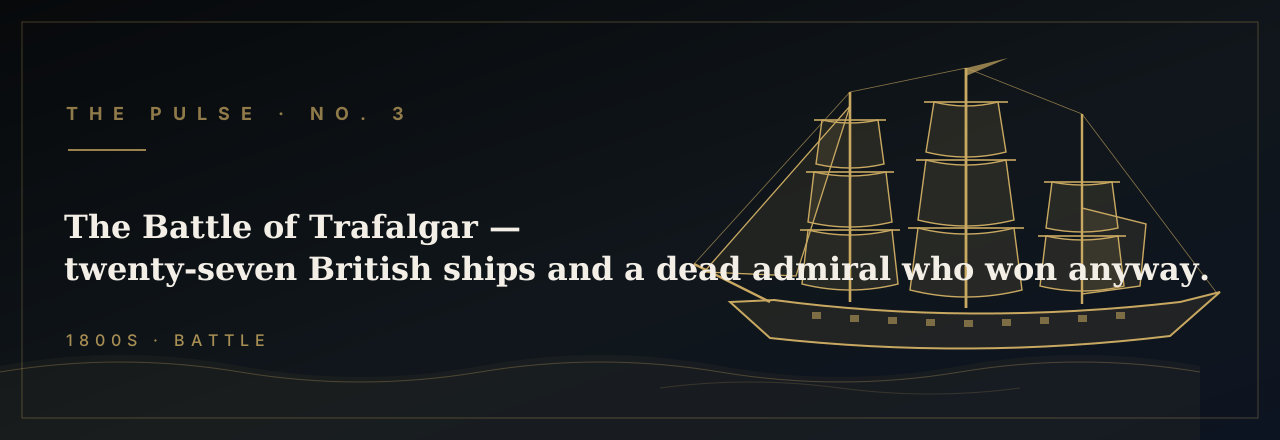
On the morning of 21 October 1805, off Cape Trafalgar on the southwestern coast of Spain, thirty-three ships of the Combined Franco-Spanish fleet sat in a ragged crescent formation stretching nearly five miles across a glassy Atlantic swell. Aboard HMS Victory, a four-decked first-rate carrying 104 guns and the flag of Vice-Admiral Horatio Nelson, the crew was piped to breakfast at dawn. Nelson had given his men time to eat before they killed. By four o'clock that afternoon he would be dead, preserved in a cask of brandy for the voyage home, and the naval balance of the world would be permanently, irrevocably, altered in Britain's favor.
The battle's roots ran back to Napoleon's invasion scheme, which required his fleet to clear the English Channel for long enough to ferry 167,000 soldiers across in flat-bottomed barges. The plan had consumed three years of French strategic energy and had twice come to nothing. Vice-Admiral Pierre-Charles Villeneuve, commanding the Combined Fleet from his 80-gun flagship Bucentaure, had spent much of the summer hiding in Cádiz under orders he dreaded executing. He knew his fleet — 18 French ships and 15 Spanish, many poorly manned and lightly drilled — was outmatched by the British in gunnery, seamanship, and morale. When Napoleon, furious at Villeneuve's inaction, sent a replacement commander to Cádiz, Villeneuve put to sea on October 19 rather than suffer the shame of being relieved in port. He sailed directly into Nelson's trap.
Nelson's tactical plan was elegantly aggressive and, to conventional minds, alarming. Rather than form a parallel line and pound the enemy broadside for broadside in the traditional fashion, he would drive two columns directly into the enemy formation, slicing it into three segments and forcing a close-quarters melee where British gunnery speed — a well-drilled British crew could fire three rounds per gun per minute — would be decisive. The opening minutes would be brutal: approaching bow-on, the lead ships of each column would absorb raking fire without being able to reply. Nelson accepted this as the price of breaking the line. At 11:45 a.m., he hoisted his most famous signal from Victory's halyards: "England expects that every man will do his duty." The fleet acknowledged it and continued their silent approach.
The southern column, led by Vice-Admiral Cuthbert Collingwood aboard HMS Royal Sovereign, struck first. Royal Sovereign had just come out of copper-sheathing refit and was the fastest ship in the fleet; she outran her consorts and arrived at the enemy line alone, absorbing five minutes of concentrated fire before crashing through the gap between the Spanish flagship Santa Ana and the French Fougueux. Collingwood fired both broadsides simultaneously as he passed — the port guns into Santa Ana, the starboard into Fougueux — then remarked calmly to his captain: "What would Nelson give to be here?" Behind him, HMS Belleisle, HMS Mars, and HMS Colossus tore into the allied rear, and the southern segment of the Franco-Spanish fleet became a grinding, smoke-choked killing ground.
Nelson's column struck the center twenty minutes later. Victory, steering for Bucentaure, was raked savagely on approach — fifty men were cut down in a single broadside before she fired a shot. She came alongside the stern of Bucentaure and fired a single round from a 68-pound carronade loaded with a keg of 500 musket balls, followed immediately by her entire double-shotted starboard battery, all firing through the same gaping stern window. Four hundred men fell aboard Bucentaure in that one pass. Then Victory locked yardarms with the 74-gun Redoutable, and the two ships ground together in a private war of their own while the rest of the fleet swirled around them. It was from the mizzen-top of Redoutable, at approximately 1:25 p.m., that a French marine sharpshooter sent a musket ball through Nelson's left shoulder, down through his lung, and into his spine. He crumpled to the quarterdeck, covering his decorations with his hand so the crew would not recognize him and lose heart. They recognized him anyway.
Nelson was carried below to the orlop deck, the lowest and darkest space in the ship, where the surgeon worked by lantern light among the wounded. He lay for three hours knowing he was dying, issuing observations to his flag captain about the progress of the battle overhead — by the sounds of the guns, he could tell the fleet was winning — and repeating, near the end, "Thank God I have done my duty." He died at 4:30 p.m., some minutes after Redoutable had struck her colors and as Santísima Trinidad, the largest warship in the world at 136 guns and the pride of the Spanish navy, was surrendering to HMS Neptune. Command passed to Collingwood, who had no way to signal the fleet the news and did not tell them for hours.
The final tally was staggering. Twenty-two Combined Fleet ships were captured or destroyed; not one British ship was lost, though many were badly damaged. French and Spanish casualties exceeded 13,000 killed, wounded, or taken prisoner; the British lost 458 killed and 1,208 wounded. Villeneuve was captured aboard his own flagship and later died under ambiguous circumstances in a Rennes hotel room, officially by his own hand. A savage storm struck the fleet in the days after the battle, and many of the prizes were lost at sea or had to be burned, but Napoleon would never again seriously threaten to cross the Channel. The invasion barges rotted at Boulogne. Within weeks, Napoleon had turned his Grande Armée east toward Austerlitz and a different kind of conquest — but the sea, permanently, belonged to Britain.
The implications of that October afternoon compounded for a century. The Pax Britannica that followed Trafalgar rested on the simple fact that no power on earth could challenge the Royal Navy, and the Royal Navy chose to police the world's sea-lanes rather than control them — opening commerce, suppressing piracy, and eventually forcing open the Pacific to trade and exploration. The ships that charted the California coast, that anchored in San Diego Bay in the years before American settlement, sailed in a world that Trafalgar had made. Nelson never saw it. He was below decks with the dead, wrapped in a Union Jack, already becoming something larger than any admiral could be in life: a fixed point in the story of how the sea was won. When HMS Victory finally limped into Gibraltar under jury rig, she flew no flag. The custom, in the age of sail, was to fly no colors over a flagship when the admiral was gone.
Two designs for Pulse No. 3.
Bella + Canvas 3001 unisex tee. Printed on demand and shipped from the U.S. $34.99 + tax + shipping.
Victory Tee
HMS VICTORY · TRAFALGAR · 21 OCT 1805
England Expects
The signal that flew before the guns opened.