Guadalcanal — the campaign where the U.S. Navy learned to fight.
August 1942: the Marines landed on Guadalcanal. The Navy lost five cruisers in the first surface engagement. Six months later, the island was won, and the Navy knew what it was doing.
On the morning of 7 August 1942, nineteen thousand Marines of the 1st Marine Division went ashore on an island most of them had never heard of. Guadalcanal. The name meant nothing. The airfield the Japanese were building there meant everything. Major General Alexander Vandegrift had been given six weeks to plan the first American offensive operation of the Pacific War — an operation his commanders called "Operation Watchtower" and his men called "Operation Shoestring." The Marines took the airfield by noon. What followed was six months of some of the most savage fighting in American military history, on land, in the air, and above all at sea — a campaign in which the United States Navy was repeatedly beaten, learned from every defeat, and emerged, if not reborn, then forged.
The reckoning came fast. The night of August 8–9 brought catastrophe. Vice Admiral Gunichi Mikawa led a column of seven Japanese cruisers and a destroyer — Chōkai, Aoba, Kako, Kinugasa, Furutaka, Tenryū, and Yūbari — down the sound between Guadalcanal and Florida Island at thirty knots. The American and Australian cruisers guarding the transport anchorage were caught in two separate groups, their crews inattentive, their radar returns dismissed as noise. In thirty-seven minutes of blazing night action, Mikawa's force sent USS Quincy, USS Vincennes, USS Astoria, and HMAS Canberra to the bottom; a fifth cruiser, USS Chicago, staggered away with her bow blown off. More than 1,077 Allied sailors died. The Japanese lost not a single ship. It was, in the measured verdict of naval historian Samuel Eliot Morison, "the worst defeat inflicted on the United States Navy in a fair fight in all its history."
What saved the Marines — barely — was the airfield they had captured. Renamed Henderson Field for Major Lofton Henderson, killed at Midway, it became the pivot of the entire campaign. Whoever controlled the air over the Slot — the New Georgia Sound running northwest through the Solomon chain — controlled the sea around Guadalcanal. By day, the Cactus Air Force flew from Henderson's cratered runway in Grumman Wildcats and Douglas Dauntlesses, punishing any Japanese surface force that dared approach in daylight. By night, the Japanese owned the water. Admiral Richmond Kelly Turner's transports, exposed and underprotected after Savo Island, withdrew. Vandegrift's Marines were on half rations, clinging to a fever-ridden perimeter while the jungle pressed in from all sides.
The Japanese response was the Tokyo Express — fast destroyer runs down the Slot under cover of darkness to land troops and supplies. Night after night, Rear Admiral Raizo Tanaka's destroyers made the run: sleek, fast, and armed with the Type 93 Long Lance torpedo, an oxygen-fueled weapon whose range and destructive power American naval intelligence had catastrophically underestimated. The U.S. Navy scored its first surface victory of the campaign at the Battle of Cape Esperance on October 11–12, catching a Japanese reinforcement group in the dark and sinking one cruiser and a destroyer. It was a welcome result, and a misleading one. Three nights later, battleships Kongō and Haruna shelled Henderson Field with 918 fourteen-inch rounds, destroying ninety aircraft and leaving the runway a smoking ruin. Admiral Robert Ghormley, commanding the South Pacific theater, had grown so pessimistic that Admiral Chester Nimitz relieved him on October 18 and replaced him with Vice Admiral William "Bull" Halsey. Halsey's first fleet order contained three words: Kill Japs. Kill Japs. Kill more Japs.
The decisive test came in November. The Naval Battle of Guadalcanal, fought in three furious actions between the 12th and 15th, was the largest surface engagement of the campaign. Rear Admiral Daniel Callaghan, with thirteen ships, steamed directly into a Japanese bombardment force of two battleships, a cruiser, and fourteen destroyers in the darkness of Iron Bottom Sound. The resulting melee was so close and chaotic that ships fired on their own countrymen. Callaghan and Rear Admiral Norman Scott were both killed on their bridges within minutes of each other. The light cruiser USS Juneau — carrying all five of the Sullivan brothers of Waterloo, Iowa — was struck by a single torpedo from the submarine I-26 and vanished in twenty seconds, taking 687 of her 700-man crew to the bottom. Yet the sacrifice held: the Japanese bombardment force turned back. The following two days, carrier aircraft and Army B-17s caught the Japanese troop convoy in daylight and destroyed eleven of twelve transports. Of the eleven thousand soldiers embarked, fewer than four thousand reached the beach, most without weapons or supplies. The strategic tide had turned.
The Navy's education was still not complete. On the night of November 30 at Tassafaronga Point, Rear Admiral Carleton Wright intercepted Tanaka's destroyers with a numerically superior force and lost four heavy cruisers crippled — to a single spread of Long Lance torpedoes fired by destroyers that never even paused their supply run. The exchange was humiliating. But the Navy took its humiliations seriously now. Tacticians began writing doctrine. Radar operators were trained to interpret their returns as fire-control data rather than mere warning. Communications procedures were tightened. The magnetic exploder defects that had plagued American torpedoes since the opening of the war were reluctantly acknowledged and sent back to the drawing board. The institution was doing something it had never been good at: learning quickly, in combat, from failure.
San Diego felt the weight of Guadalcanal before the first shot was fired and long after the last. The 1st Marine Division had trained at Camp Elliott — the sprawling training ground north of the city that would evolve into today's MCAS Miramar — before shipping west in the spring of 1942. The cruisers and destroyers that steamed into Iron Bottom Sound had been fitted out at Naval Station San Diego, the Pacific Fleet's primary West Coast base since the 1920s. When ships came back damaged — and many did — they returned to San Diego's repair yards trailing oil and bearing the marks of Long Lance hits. The loss of the five Sullivan brothers prompted the War Department to formalize the Sole Survivor Policy, protecting the last surviving son of a family with multiple combat losses from front-line assignment. It was a policy with quiet resonance in every military family in this city, then and now.
The Guadalcanal campaign cost the United States Navy twenty-four warships and roughly five thousand sailors. It cost Japan nearly the same in ships — and something it could not replace: a generation of trained naval aviators, bled away in the skies above the Slot in aircraft that could not be recalled once committed. The Americans lost ships and built more. Japan lost men and could not. By February 7, 1943, when the last Japanese troops slipped away under cover of darkness in a withdrawal so skillfully executed that American commanders initially mistook it for a fresh landing, the Navy that steamed home from the Solomons was categorically different from the one that had entered Savo Sound in August. It knew the terrain. It knew its weaknesses. It knew that radar, aggressively used, could unmake an enemy fleet in a moonless strait before a single torpedo was launched. The price of that knowledge — paid in sailors and cruisers and the five boys from Waterloo, Iowa — had been catastrophic. What it purchased was the competence to do what came next: drive west, island by island, toward the bay where it would all end.
Two designs for Pulse No. 29.
Bella + Canvas 3001 unisex tee. Printed on demand and shipped from the U.S. $34.99 + tax + shipping.
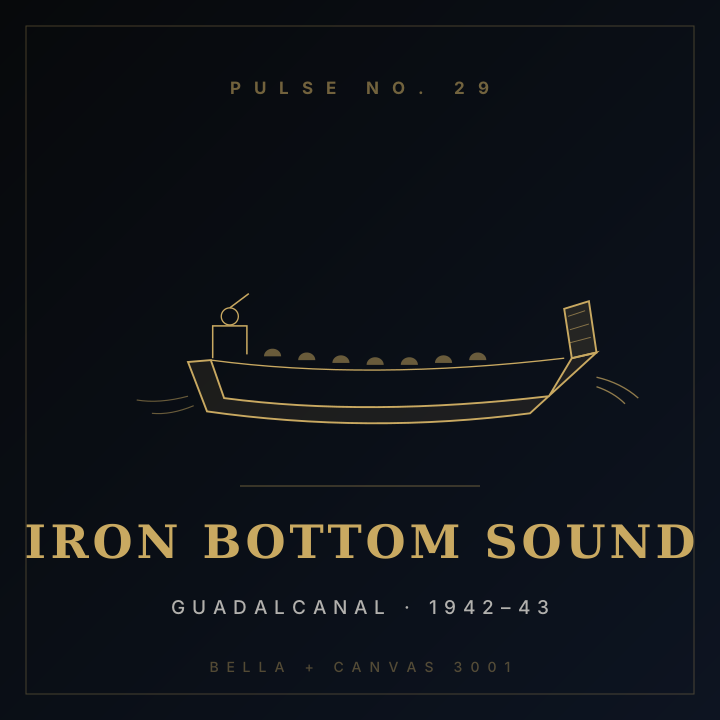
Iron Bottom Sound Tee
IRON BOTTOM SOUND · GUADALCANAL · 1942–43
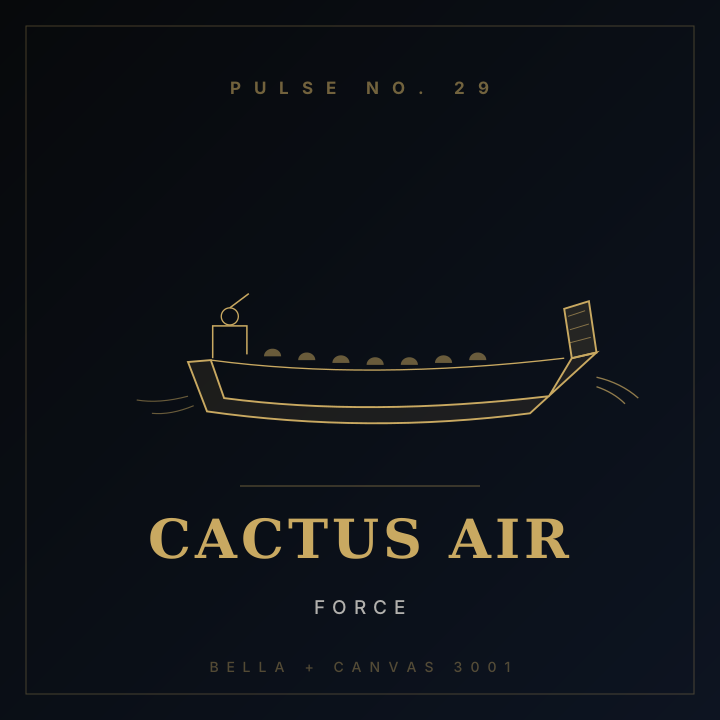
Cactus Air Force
The dive bombers flying from Henderson Field.