The America's Cup — 172 years of competitive sailing and the oldest trophy in international sport.
1851: the schooner America sailed from New York, won a race around the Isle of Wight, and started the oldest trophy in international sport. San Diego has hosted it twice.
On the morning of 22 August 1851, a sharp-bowed American schooner slipped out of the anchorage at Cowes Roads and settled into line with fifteen of the finest racing yachts the British Empire had ever produced. She was America — 101 feet on deck, 170 tons, her hollow bow and raked masts the product of New York naval architect George Steers, whose genius lay in understanding that a yacht's greatest enemy at sea was not displacement but drag. Commissioned by a syndicate led by Commodore John Cox Stevens of the New York Yacht Club, she had crossed the Atlantic in 21 days and scandalized the Royal Yacht Squadron by sailing circles around every British challenger sent to test her in the informal races that preceded the main event. The prize that morning was a silver ewer worth a hundred guineas. What she won instead was the oldest international sporting trophy in history.
The Isle of Wight circuit covered 53 miles of tidal waters, sandbanks, and headlands capable of producing every variety of wind condition in a single afternoon. America rounded the Nab lightship to leeward while several competitors took the supposedly faster inside passage, and in the light, shifty breezes of a summer evening she drew steadily clear of the fleet, her cotton sails cut taut and flat in the American fashion against the ballooning canvas preferred by Royal Yacht Squadron men. She crossed the finish at 8:37 in the evening — ten hours and thirty-seven minutes after the gun — with the schooner Aurora trailing by eighteen minutes and the rest of the fleet scattered across the Solent. Queen Victoria, watching from the royal yacht Victoria and Albert, reportedly asked a signal officer who was second. The answer, now engraved in the mythology of competitive sailing: "Your Majesty, there is no second." The exchange may be apocryphal, but the margin was not.
Commodore Stevens and his partners returned to New York as heroes, sold America to an English nobleman for £5,000, and in 1857 donated the trophy to the New York Yacht Club under a Deed of Gift establishing it as a perpetual challenge — open to any recognized yacht club in the world, defended by the current holder in match racing on the waters of the defending club. The New York Yacht Club would exploit every advantage those terms afforded over the next 132 years. Through the Gilded Age, the Edwardian era, and two world wars, the club staved off challenger after challenger — sixteen successful defenses in all — turning the silver ewer from a one-time wager into the sport's supreme institution. The Deed's language was deliberately tilted toward the defender; the NYYC never forgot it.
No challenger pressed harder, or more publicly, than the Irish-born tea merchant Sir Thomas Lipton, who mounted five campaigns between 1899 and 1930 aboard a succession of cutters named Shamrock I through Shamrock V and lost every one — earning himself a gold cup from the American public in 1930 as "the best loser in the world." The interwar decade that followed brought the Cup's most visually spectacular era: enormous J-Class sloops stretching 130 feet on the waterline and carrying nearly 8,000 square feet of sail, crewed by professionals who lived aboard and worked for wages, racing off Newport against British yachts like Endeavour and Endeavour II designed by the formidable Charles Ernest Nicholson. The last and greatest of the American J-boats, Ranger — drawn by Starling Burgess and Olin Stephens — defended in 1937 without losing a single race of consequence, then was scrapped for her aluminum when the war came and the Cup went into storage for a decade.
Postwar competition resumed in the smaller International 12-Meter class, and it was in a 12-Meter that the NYYC's great streak finally broke. In September 1983, off Newport, the Australian challenger Australia II — funded by entrepreneur Alan Bond, skippered by John Bertrand — arrived carrying a secret: a radical upside-down winged keel designed by Ben Lexcen that moved ballast low and outward, allowing a shorter, lighter hull to point higher and foot faster than the rules had anticipated. Down three races to one, the Australians won three consecutive races. On 26 September, Australia II crossed the finish 41 seconds ahead of the American defender Liberty, ending 132 years of unbroken American custody. New York Yacht Club members wept in the hallways of their Newport clubhouse. The silver ewer — the Hundred Guinea Cup, the America's Cup — was heading to Perth.
Dennis Conner, the San Diego native who had skippered Liberty to that defeat, did not accept the loss passively — which in yacht racing meant he spent four years doing almost nothing else. He moved to Fremantle, Australia, learned the mechanics of the Fremantle Doctor, the powerful afternoon sea breeze that would drive the 1987 races, and persuaded a San Diego-based syndicate to underwrite the campaign. His boat, Stars & Stripes, was designed by Johan Valentijn and relentlessly optimized for the heavy-air reaching legs the course demanded. In February 1987, Conner swept the Australian defender Kookaburra III — skippered by Iain Murray — four races to none, the most lopsided final since Ranger's reign fifty years earlier. He became the first American skipper to win the Cup back after losing it. The trophy, and the right to host the next challenge, came home with him to California.
San Diego Yacht Club hosted the Cup in waters its members had sailed their entire lives — the sheltered reach off Point Loma, the kelp beds of La Jolla, the 15-knot sea breeze that builds by midday along the coast of the Southern California Bight. The 1988 match was immediately controversial: New Zealand's Michael Fay invoked the Deed of Gift's original language to challenge with a 90-foot monohull, and Conner responded by fielding a 60-foot catamaran — a vessel so fast it was practically sailing a different race. Stars & Stripes the catamaran won both races and the legal battles that followed, but the spectacle strained the sport's credibility. Four years later, the 1992 edition restored order: Bill Koch's America³, the first Cup yacht designed with significant computational fluid dynamics input, defeated Italy's Il Moro di Venezia four races to one in a proper 75-foot IACC class match, the downtown San Diego skyline rising behind the starting line for a second consecutive Cup. Only a handful of cities in the history of the sport have twice hosted sailing's oldest prize.
The America's Cup has not stood still since San Diego. The competition has moved through Auckland, Valencia, San Francisco, Bermuda, and Barcelona, each venue reshaping the technological arms race that now defines the event. The AC75 foiling monohulls that raced in the 2024 edition lift entirely clear of the water on hydrofoil wings and sustain speeds that routinely exceed 40 knots — roughly eight times what America managed rounding the Nab lightship on that August evening in 1851. The boats are now as much aeronautical as nautical objects, their crews managing angle-of-attack on underwater foils with the precision of flight controllers. Yet the structure beneath all of it — a perpetual challenge, defender's waters, match racing between nations — remains the one John Cox Stevens inscribed in the Deed of Gift 167 years ago. From Cowes to Newport to the harbor at San Diego, the America's Cup has always been the same argument: who builds the faster hull, and who finds the faster wind. America answered it first. Everyone since has been chasing her.
Two designs for Pulse No. 30.
Bella + Canvas 3001 unisex tee. Printed on demand and shipped from the U.S. $34.99 + tax + shipping.
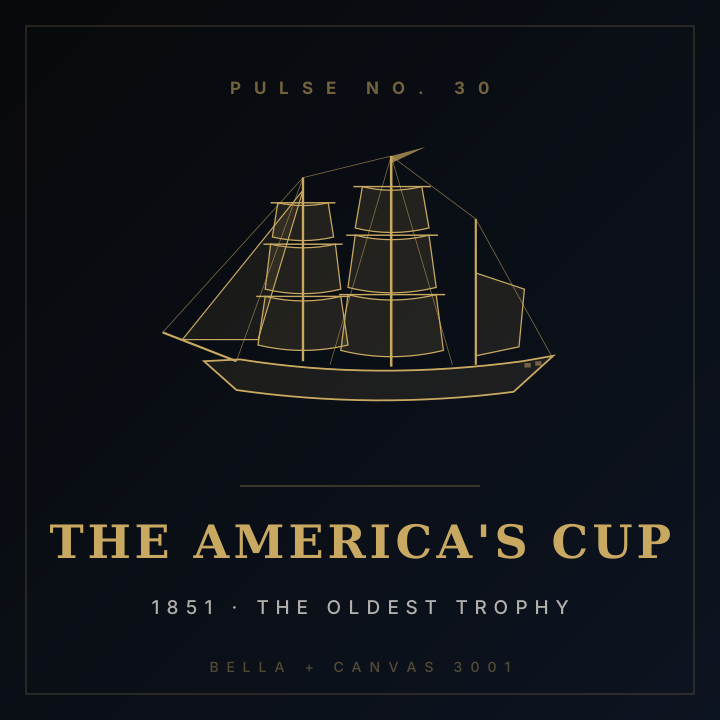
America's Cup Tee
THE AMERICA'S CUP · 1851 · THE OLDEST TROPHY

There is No Second Place
The Queen of England's reported comment at the America's Cup awards.