RMS Lusitania — 1,198 lives and the warning nobody read.
May 7, 1915: a German submarine sank the Lusitania in 18 minutes. A German newspaper had published a warning the morning of her sailing.
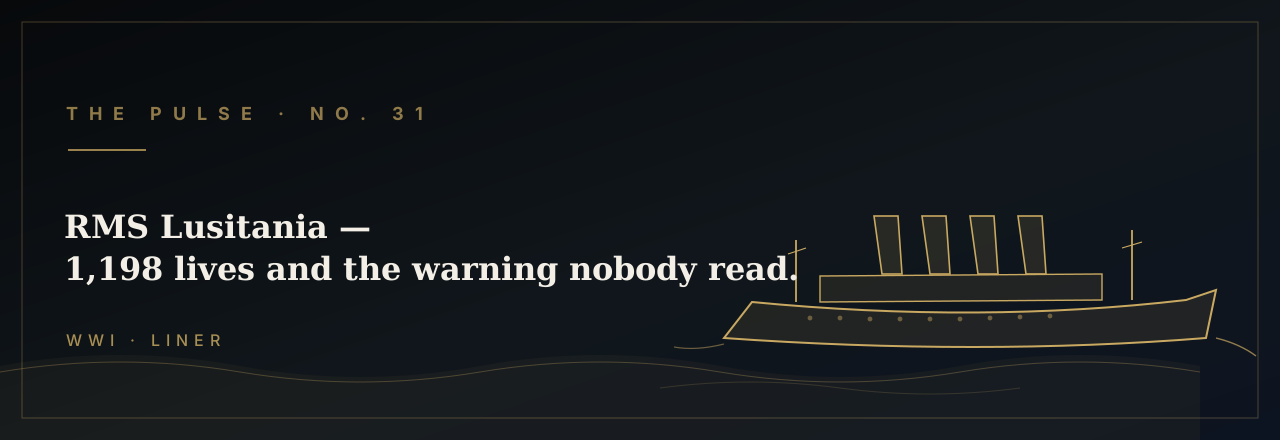
On the morning of May 1, 1915, passengers boarding the RMS Lusitania at New York's Pier 54 could have read a notice placed by the Imperial German Embassy in fifty American newspapers — running in some editions directly beside Cunard's own sailing advertisement. It warned, with bureaucratic bluntness, that vessels flying the flag of Great Britain or her allies were "liable to destruction" in the waters around the British Isles, and that travelers sailing in such zones did so "at their own risk." Passengers who carried the clipping to Cunard's offices were reassured by officials that no German submarine would dare attack the world's fastest ocean liner. Most boarded without a second thought. Six days later, 1,198 of the 1,959 souls aboard were dead.
The Lusitania was, in the spring of 1915, one of the most celebrated ships afloat. Launched at John Brown's shipyard on the Clyde in June 1906 and entering service the following year, she measured 787 feet from stem to stern and displaced 44,767 gross tons — a four-funneled Cunard greyhound capable of sustaining nearly 26 knots in fair weather. On her maiden voyage she shattered the transatlantic speed record, capturing the Blue Riband with a crossing of four days, nineteen hours, and fifty-two minutes. War had reduced her to a fraction of her boiler capacity — she crossed on just 21 knots — and stripped her of peacetime luxury, but she was still Lusitania, and the confidence her name inspired ran deep among the 1,257 passengers and 702 crew who sailed that Friday morning up the Hudson and out past Sandy Hook.
That confidence had been tested by events unfolding beneath the North Atlantic's surface. In February 1915, the German Admiralty declared the waters surrounding the British Isles a war zone and announced that enemy merchant vessels would be sunk without warning — neutrals could not be guaranteed safety either. It was a radical departure from the prize rules that had governed naval warfare for centuries, which required a warship to surface, inspect a vessel's papers, and allow its crew to abandon ship before firing. The German Unterseeboote could not surface and follow those rules without exposing themselves to being rammed or shelled. Unrestricted submarine warfare was militarily logical and morally catastrophic in equal measure, and the spring of 1915 was teaching the Atlantic world exactly what that combination meant.
The newspaper warning was no idle threat. SM U-20, a Type U-19 submarine displacing 650 tons submerged, had departed Emden on April 30th under the command of thirty-year-old Kapitänleutnant Walther Schwieger, slipped around the north of Scotland, and was working south through the Irish Sea. In the three days before May 7th, Schwieger had already sunk three British vessels: the Candidate, the Centurion, and the schooner Earl of Lathom. The British Admiralty knew U-20 was operating in those waters. Coded wireless intercepts from Room 40 — the Royal Navy's signals intelligence unit — had tracked her movements with considerable confidence. General submarine warnings had been broadcast to shipping in the danger zone. Whether those warnings were specific enough, and whether they reached the right officers in time to change the Lusitania's course, would become the defining question of the inquiry that followed.
Captain William Turner, a veteran Cunard master making his second Atlantic crossing in command of the Lusitania, received several Admiralty advisories during the voyage warning of submarine activity off the southern Irish coast. Standing orders directed captains to zigzag at irregular intervals, to stay in mid-channel well clear of headlands, and to maintain maximum speed through declared danger zones. Turner followed none of them. He had throttled back to 15 knots — timing his arrival at the Liverpool bar to coincide with the tide — and had chosen to hug the coast of County Cork rather than take the broader, safer arc of open water. At 1:40 PM on May 7th, the Old Head of Kinsale was visible through his binoculars; he ordered a four-point bearing fix that required the ship to hold a steady course at steady speed for the better part of an hour. Eleven miles offshore, a periscope broke the surface and turned toward him.
Schwieger observed the approaching liner through his attack periscope, identified her in his war diary as a large passenger ship of the Lusitania or Mauretania class, and at precisely 2:10 PM fired a single G-type torpedo from a distance of 700 meters. It struck the starboard bow just forward of the bridge at the waterline. The explosion was heard aboard as a dull, concussive blow — and then, seconds later, a second detonation erupted from somewhere deep in the hull, vastly more violent than the first. The cause of that second blast has fueled argument for more than a century: forensic analysis has pointed variously to a steam pipe rupture, an explosion of coal dust in a nearly empty forward bunker, and — most controversially — to the munitions cargo that the British government spent decades denying the ship carried. Whatever its source, the second explosion tore Lusitania open below the waterline. She began listing to starboard immediately, and settling fast at the bow.
She sank in eighteen minutes. The hard list to starboard made launching port-side lifeboats nearly impossible; boats on the starboard side swung out over open water and were rushed in chaos, many capsizing or being crushed against the hull as the ship went down. Of 48 lifeboats carried, only 6 were successfully deployed. The Lusitania drove under bow-first at 2:28 PM, her stern lifting briefly from the Celtic Sea before she disappeared into 305 feet of cold green water. Of the 1,959 persons aboard, only 761 were rescued — many pulled from the water by fishing trawlers and harbor tenders out of Queenstown and the village of Kinsale. Among the 1,198 dead were 128 American citizens, 94 children under the age of twelve, and nearly every stoker and fireman in the engine rooms, who never made it to the decks. Schwieger, watching through his periscope as survivors struggled in the oil-slicked water, wrote in his war diary that the sight was "too horrible to watch" and submerged before the stern went under.
The sinking of the Lusitania struck the Atlantic world with a force no single naval action had equaled since the ironclads traded shells at Hampton Roads. In San Diego, where the Panama-California Exposition was drawing hundreds of thousands of visitors to celebrate the opening of the Panama Canal, the news arrived like a cold front across a fair — a reminder that the celebrating world and the killing one occupied the same ocean. The disaster prompted a temporary German suspension of unrestricted submarine warfare against passenger ships under American diplomatic pressure, but the policy was reinstated in January 1917 and would become, more than any other single factor, the instrument that brought the United States into the First World War — and that transformed San Diego from a Pacific outpost into one of the Navy's most consequential home ports. The Lusitania still rests off the Old Head of Kinsale, her cargo manifests disputed, her warning notice long preserved. Fifty newspapers ran it. The tragedy was not that the warning was hidden. The tragedy was that reading it, on a bright May morning at Pier 54, still felt like something that could not possibly mean you.
Two designs for Pulse No. 31.
Bella + Canvas 3001 unisex tee. Printed on demand and shipped from the U.S. $34.99 + tax + shipping.
Lusitania Tee
RMS LUSITANIA · MAY 7, 1915
The Warning
Germany published an announcement before the Lusitania sailed.