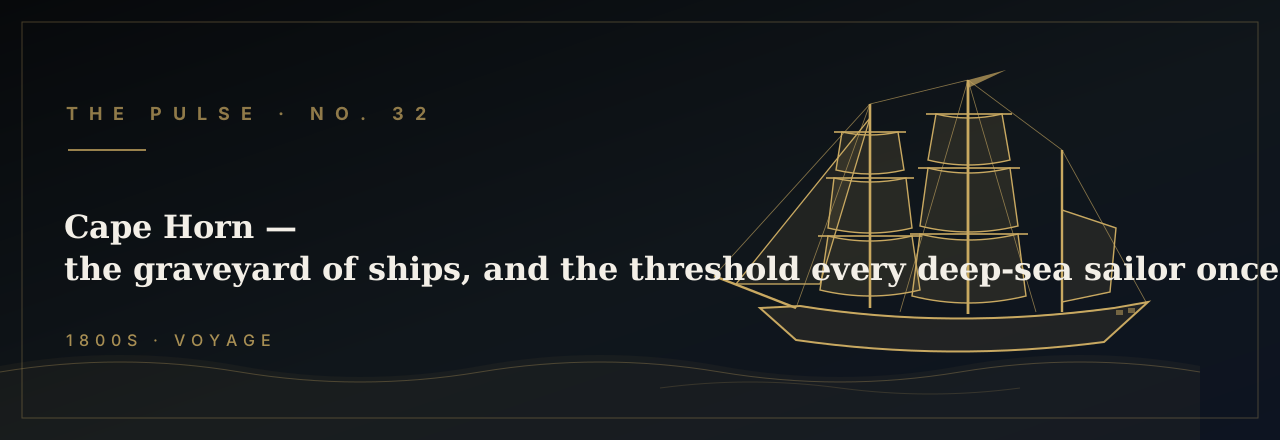
Cape Horn — the graveyard of ships, and the threshold every deep-sea sailor once had to cross.
Before Panama, there was no other way. Ten thousand ships have rounded Cape Horn. The number that didn't make it has never been counted.
At 55°58' south latitude, where the Pacific and Atlantic Oceans collide in a permanent war of water and wind, a wedge of black rock called Cape Horn juts from the Chilean archipelago like the broken tooth of the world. It is not the southernmost point on earth, but it might as well be — the next landmass south is Antarctica, and between them lies 500 miles of open sea called the Drake Passage, the widest, deepest, and most violent stretch of ocean on the planet. For three centuries, every ship that moved cargo or men between the Atlantic world and the Pacific had to face it. There was no other way. The canal would not come until 1914. Until that morning, Cape Horn was not merely a navigation hazard — it was a toll gate, and the currency was sometimes the ship itself.
The Horn was first rounded in January 1616 by two Dutch mariners, Willem Cornelisz Schouten and Jacob Le Maire, sailing the Eendracht — literally "Concord" — out of the Dutch port of Hoorn. They named the cape for their home city, though nothing about the passage matched the civility of that name. Schouten's log recorded seas running forty feet, winds that stripped canvas from yards before men could reach them, and temperatures that turned rigging to iron. He had rounded from east to west — with the winds, the favorable direction — and it still took three weeks of clawing south before the cape was safely behind him. Captains who followed him for the next three centuries learned what Schouten had learned in the winter of 1616: the Horn does not grant passage, it sells it, and the price is always negotiable upward.
The mechanics of the Horn's violence begin in physics. The Roaring Forties give way to the Furious Fifties and then the Screaming Sixties — latitude bands where the Southern Ocean's westerly winds blow unimpeded around the entire globe, building fetch of 10,000 miles before they strike anything solid. At Cape Horn that anything solid is your ship. Waves regularly reach sixty feet. In storm conditions, documented rogue waves have been measured above ninety. The water temperature hovers near freezing year-round, which means a man overboard was almost always a man lost — hypothermia set in within minutes, and no sailing ship in the 1800s could maneuver quickly enough to return for him. Captains bound westward — eastward was always the easier direction — sometimes spent sixty days hammering into headwinds without gaining a single mile of longitude. The record for a failed westward attempt belongs to a grain ship that fought the Horn for 99 days before her captain finally put the helm over and ran east, circling the entire globe to arrive at his destination from the opposite direction.
The California Gold Rush of 1849 turned the Horn from a navigational ordeal into an industrial pipeline. Within months of James Marshall's discovery at Sutter's Mill, 777 ships had arrived in San Francisco harbor — nearly all of them having made the 15,000-mile passage around South America's tip. It was this gold-rush traffic that created the golden age of the clipper ship, the greyhound of sail: narrow, tall-sparred, built for speed over cargo capacity. The Flying Cloud, launched in 1851 from the yard of Boston builder Donald McKay, set a record in 1853 that stood for 135 years — New York to San Francisco in 89 days, 8 hours, rounding the Horn in winter, logging 374 nautical miles in a single day under command of Captain Josiah Perkins Creesy and his wife Eleanor, who served as navigator. She was not the ship's officer of record; she was simply the better celestial navigator on board, and Creesy was wise enough to know it.
The wrecks accumulated. Lloyd's of London kept partial records; the Chilean navy kept others; most were never recorded at all — a ship departed some port in England or New York or Hamburg, and was simply never heard from again. Estimates of total losses on the Horn route since Schouten's first passage run from 800 to more than 1,000 vessels. The Wager, a British naval ship, broke apart on an island just north of the Horn in 1741, stranding 145 men in one of the 18th century's great survival ordeals. The clipper Cospatrick burned in 1874 with 473 souls aboard; only three survived. The four-masted barque Kobenhavn, 3,900 tons, departed Buenos Aires for Australia on December 14, 1928, with 45 sailors and 60 naval cadets aboard. She was never seen again. No wreckage was ever found. The Horn swallowed her as completely as if she had never been built.
Those who survived developed a culture as specific as any guild. A sailor who had rounded Cape Horn — a true Cape Horner — earned privileges recognized in every port on earth. He could wear a gold earring in his left ear, the ear that faced the Horn on a westbound passage. He could put one foot on the table at dinner. He could urinate against the wind. These were not merely customs; they were a taxonomy of experience, a way of sorting the men who had been tested from those who had not. The International Association of Cape Horners, founded in 1937, was restricted to sailors who had rounded under sail, and by the time the organization dissolved in the 1990s, its membership had dwindled to a handful of very old men. The last commercial sailing ship to round the Horn under canvas was the German barque Pamir in 1949. She sank in a hurricane in the North Atlantic in 1957, taking 80 of her 86 crew with her.
The Panama Canal opened on August 15, 1914, and the Horn's reign over global shipping ended almost overnight. The 15,000-mile Cape Horn passage from New York to San Francisco became a 5,000-mile run through Central America. Freight rates collapsed. The great sailing ships that had been built around the Horn route — the four- and five-masted barques, the last working descendants of the clipper ships — were sold off, left to rot at anchor, or scrapped for steel. The Cutty Sark, which had raced the Thermopylae on the wool run between Australia and England through the 1880s, ended her working life hauling coal out of Portugal. The men who had served on her retired to shoreside jobs, or signed on the early steamers, or simply disappeared from the maritime record. The Horn did not become less dangerous — it is exactly as violent today as it was in 1616. It simply became, for the first time in three centuries, optional.
San Diego sat at the far end of the Cape Horn pipeline. Every ship that rounded the Horn northward up the Pacific coast passed within a few hundred miles of this harbor. During the Gold Rush years, vessels making the long haul from Atlantic ports sometimes put in at San Diego Bay for water and repairs before the final push to San Francisco — the bay's deep, sheltered anchorage offering the first real rest after weeks of Southern Ocean punishment. The Yankee whalers who worked the Pacific grounds in the 1820s and 1830s had learned the route before the gold seekers; they were the first to establish the knowledge that the California coast, after the Horn, was a place a sailor could finally breathe. That history runs deeper than most passengers stepping aboard a vessel in San Diego today have reason to think about: this harbor was once the finish line of one of the most dangerous voyages in the world, and every ship that made it arrived carrying the particular quiet of men who had been to the edge of something and come back.
Two designs for Pulse No. 32.
Bella + Canvas 3001 unisex tee. Printed on demand and shipped from the U.S. $34.99 + tax + shipping.
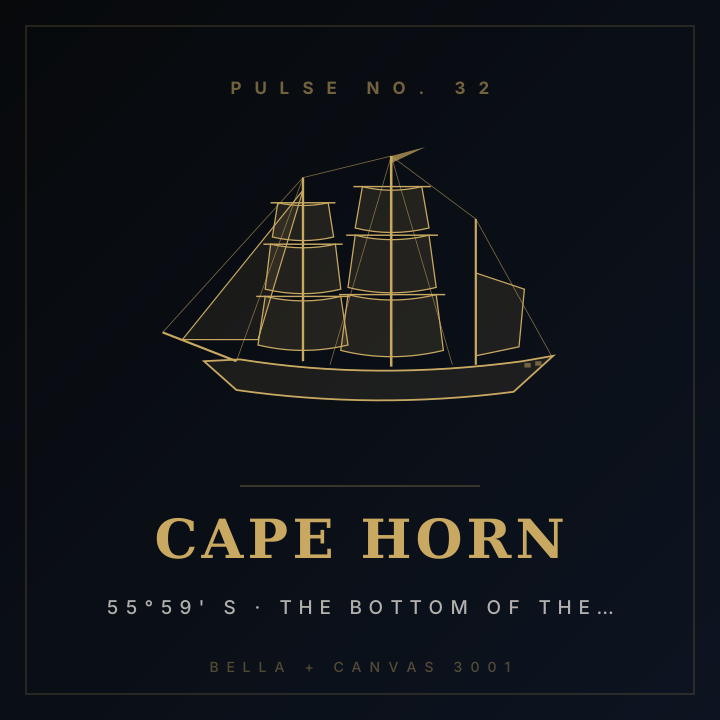
Cape Horn Tee
CAPE HORN · 55°59' S · THE BOTTOM OF THE WORLD
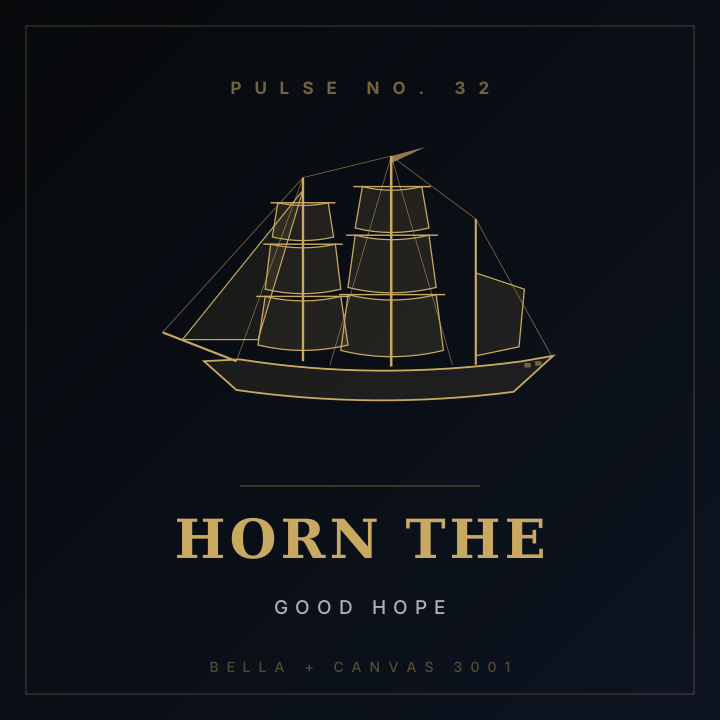
Horn The Good Hope
Sailors who rounded Cape Horn wore a gold earring.