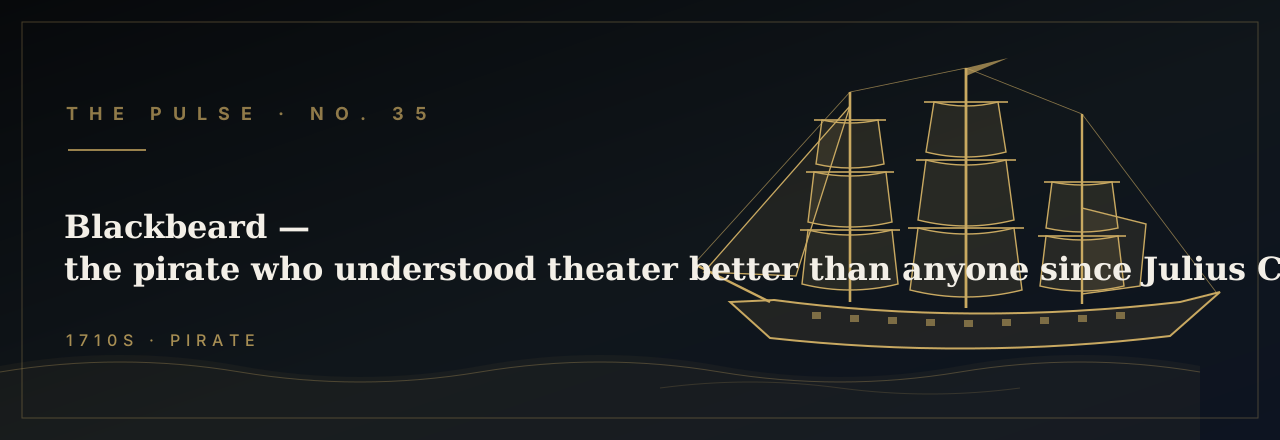
Blackbeard — the pirate who understood theater better than anyone since Julius Caesar.
His real name was probably Edward Teach. He lit slow matches in his beard before boarding, so smoke rose from his face in battle. He died in hand-to-hand combat at 39.
The most dangerous men in history have rarely been the strongest or the most heavily armed. They have been the ones who understood that war is, at its root, a performance — that the image of destruction can be as decisive as destruction itself. Edward Teach, the pirate known as Blackbeard, grasped this principle as intuitively as any admiral who ever flew a flag, and he exploited it across two years of Atlantic predation with a showman's precision. That a semi-literate privateer-turned-buccaneer could so thoroughly dominate the colonial seaboard — not through tonnage or broadsides, but through pure, calculated theater — remains one of the strangest and most instructive stories in naval history.
Teach was probably born in Bristol, England, around 1680, though the historical record on his origins is thin enough that even his name survives in multiple spellings: Thatch, Thache, Drummond. What is certain is that he served as a privateer during Queen Anne's War (1702–1713), the North American theater of the War of the Spanish Succession, raiding French and Spanish shipping under a letter of marque from the Crown. When the Treaty of Utrecht ended that war in 1713, thousands of experienced seamen found themselves suddenly without employment — skilled in violence, accustomed to prize money, and released onto an Atlantic economy that had no use for them. Many turned pirate. Teach was among the sharpest of them.
He came under the tutelage of Benjamin Hornigold, an established pirate captain operating out of the lawless haven of Nassau in the Bahamas, where an estimated 1,000 buccaneers sheltered under near-total absence of royal authority. Hornigold gave Teach command of a captured sloop, and by late 1717 Teach had claimed his own prize: a 200-ton French slave ship named La Concorde de Nantes, seized off Martinique with 516 enslaved people still below decks. He freed the crew, redistributed the enslaved among his prizes, mounted fourteen additional cannon onto the ship's existing twenty-six, and renamed her Queen Anne's Revenge — a forty-gun warship that made him the most heavily armed pirate captain in the Atlantic.
But firepower never fully explained Blackbeard's particular genius. He understood something most naval commanders only grasped in retrospect: a battle won before the first shot is fired costs nothing. Teach cultivated his appearance with deliberate, choreographic care. His beard was extraordinary — thick, coal-black, grown long enough to be twisted into braids and tied with ribbons — but it was what he did with it in the moments before boarding that made grown men surrender without resistance. He wove slow match — hemp cord soaked in saltpeter and limewater — into the braids and lit them before combat, so that his face emerged from the gun smoke trailing its own separate smoke, his eyes burning through the haze, the smell of sulfur rising from his cheeks. He wore a brace of six cocked flintlock pistols on a bandolier across his chest. Captain Charles Johnson, whose 1724 A General History of the Pyrates remains the primary contemporary source, wrote that Teach "made himself such a Figure, that Imagination cannot form an Idea of a Fury from Hell to look more frightful."
By the spring of 1718, Teach had assembled a small fleet and an operational reach that embarrassed the Royal Navy. In May of that year he executed the most audacious act of his career: a full blockade of Charleston, South Carolina, then one of the wealthiest ports in British America. With Queen Anne's Revenge and three consort vessels, he stopped every ship entering or leaving the harbor for approximately a week, seized eight merchant vessels, and took several prominent citizens hostage — including a member of the Governor's Council named Samuel Wragg. His ransom demand was not gold. It was medicine: a chest of drugs for his crew, riddled with syphilis contracted in port. The Governor paid. A pirate had placed one of the most important cities in the British Empire under effective siege, and the Crown's response had been a medicine chest.
The collapse came partly by design. In June 1718, Teach grounded Queen Anne's Revenge and a consort sloop at Beaufort Inlet, North Carolina — almost certainly deliberately, a way of shedding crew and concentrating plunder among fewer men. He then sailed to Bath, North Carolina, where Governor Charles Eden accepted his surrender under the King's Act of Grace pardon. Teach settled briefly into respectable life, even marrying a local girl — reportedly his fourteenth wife — but the retirement was a fiction. He was raiding again within months, working out of Ocracoke Inlet and maintaining a comfortable arrangement with the corrupt Eden, who received a cut of the prizes.
It was Governor Alexander Spotswood of Virginia who finally moved against him, impatient with Eden's complicity and alarmed by continued predations on Virginian trade. In November 1718, Spotswood covertly dispatched two shallow-draft hired sloops — Jane and Ranger — under Lieutenant Robert Maynard of HMS Pearl, chosen precisely because they could navigate the inlets Teach favored. On the morning of November 22, 1718, Maynard found him at anchor in Ocracoke. The Battle of Ocracoke Inlet was savage and close. Teach's crew numbered only about fourteen men against Maynard's sixty, but he opened fire with swivel guns loaded with shot and nails, killing or wounding a third of Maynard's men in a single broadside. Maynard ordered his surviving crew below decks, leaving the upper deck apparently empty. Teach, convinced the fight was over, boarded. What followed was hand-to-hand combat at point-blank range, and Teach was at the center of it — shot five times with pistol balls and slashed more than twenty times with cutlasses before he finally fell. His head was cut off and hung from the bowsprit of Maynard's sloop for the return voyage to port.
The Queen Anne's Revenge, lost in the sands of Beaufort Inlet for nearly three centuries, was rediscovered in 1996 by the survey firm Intersal, Inc., and excavations have since recovered more than 400,000 artifacts — cannon, navigational instruments, a surgeon's kit, and the detritus of violent maritime life in exacting material detail. What the wreck confirms is the scale: Blackbeard commanded a genuine warship, not a coastal raider, and he very nearly carved out something resembling a pirate state on the North American seaboard. His career in earnest lasted barely two years. And yet the theater of it — the burning beard, the six pistols, the decision to board Maynard's deck rather than run — seeded a mythology that western culture has never quite set aside. San Diego, which would become home to the largest concentration of naval power in the world, sits at the far end of the same arc: the suppression of men like Blackbeard was the necessary precondition for the maritime order that made a Pacific fleet possible. The oceans were made safe for commerce, and eventually for carriers and destroyers, because men like Maynard were willing to follow men like Teach into the shallow water and finish it.
Two designs for Pulse No. 35.
Bella + Canvas 3001 unisex tee. Printed on demand and shipped from the U.S. $34.99 + tax + shipping.
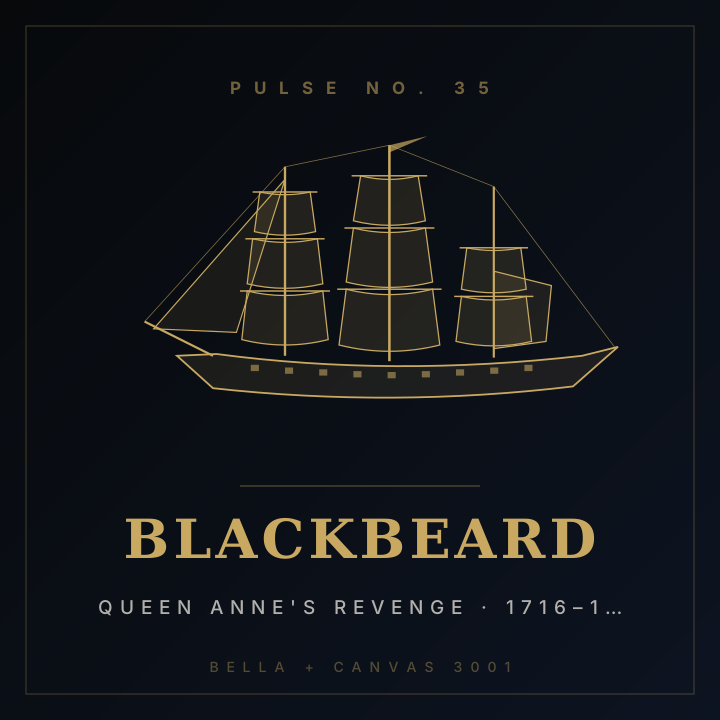
Blackbeard Tee
BLACKBEARD · QUEEN ANNE'S REVENGE · 1716–1718
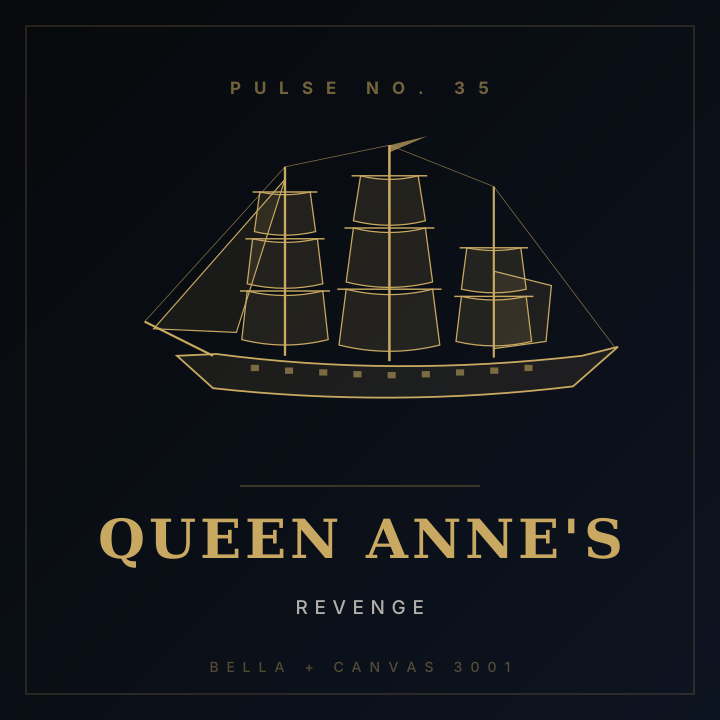
Queen Anne's Revenge
Blackbeard's flagship, a French slave ship he captured and armed with 40 guns.