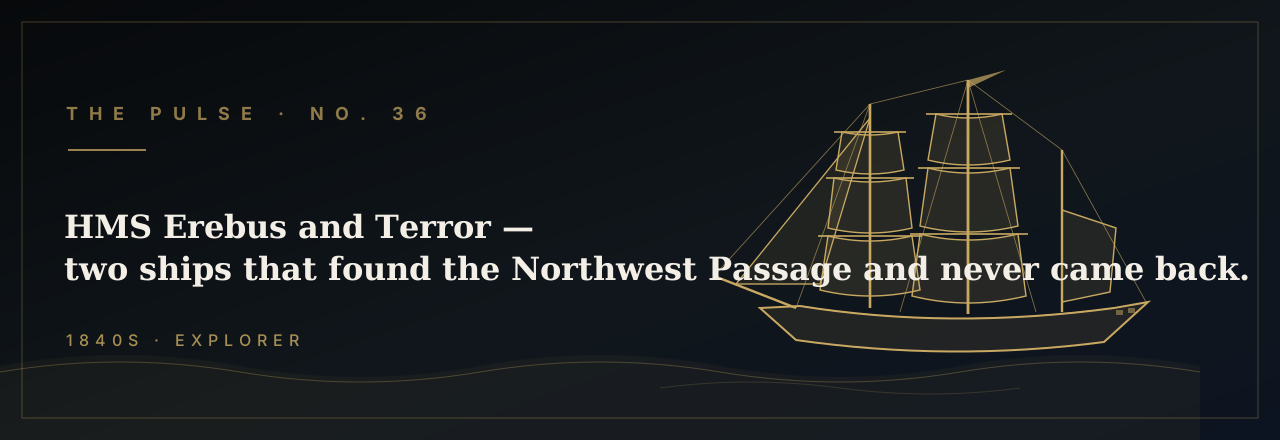
HMS Erebus and Terror — two ships that found the Northwest Passage and never came back.
Sir John Franklin led 128 men into the Canadian Arctic in 1845. They found the passage. None of them survived. The ships weren't found for 168 years.
On the nineteenth of May, 1845, Sir John Franklin stood at the quarterdeck of HMS Erebus and watched the Kent coast dissolve into gray North Sea mist. Behind him, on a parallel course out of Greenhithe on the Thames, followed HMS Terror — and between the two vessels sailed 129 officers and men, enough coal for twelve days of steaming, 8,000 tins of preserved meat and soup, a hand-organ that played fifty tunes, and the collective confidence of a Royal Navy at the peak of its power. Their mission was the Northwest Passage — the sea route threading through the Canadian Arctic Archipelago that European navigators had been searching for since the reign of Henry VII — and the Admiralty believed that with the right ships, the right commander, and the right provisions, the question could finally be put to rest. Franklin was fifty-nine years old and had spent thirty years proving himself in ice. He expected to return in triumph within two years. The last European eyes to see him alive watched his flagship round the northern headland of Baffin Island in late July and disappear. The Arctic took him, took all of them, and did not give them back for a century and a half.
The ships themselves were extraordinary instruments. Both Erebus and HMS Terror were purpose-built bomb ships — designed to absorb the catastrophic recoil of naval mortars — which gave their frames a structural massiveness that made them uniquely suited to the ice. They had already earned their Arctic credentials: between 1839 and 1843, under Sir James Clark Ross, both vessels had pushed farther south than any ships in history, charting the coastline of Antarctica and lending their names to the geography they discovered — the Ross Sea, the Ross Ice Shelf, and the two great volcanoes that still stand on the Antarctic coast, one called Erebus and one called Terror. For the 1845 expedition, the Admiralty had them refitted at Woolwich with steam locomotive engines, iron-plated prows, heated berth decks, and retractable screw propellers — the most advanced Arctic conversion the Royal Navy had yet attempted. Captain Francis Rawdon Moira Crozier, who commanded Terror and had sailed polar waters four times before, privately wrote to his friend James Ross that he was uneasy about the mission — about the commander's age, the compressed timeline, and a foreboding he could not precisely articulate. He went anyway.
The expedition's provisions were contracted through a London supplier named Stephan Goldner, who had won the Admiralty contract on the strength of a low bid and who delivered thousands of tins sealed with a lead-based solder applied in such haste that many were later found to have been improperly processed — some so poorly preserved that the meat inside had rotted before it left England. The expedition also carried roughly 1,200 books for the ship's libraries, navigational charts of every known Arctic sound and strait, and enough optimism to sustain two winters in the ice if necessary. They entered Lancaster Sound — the eastern gate of the passage — in early August 1845, after the crew of two British whalers spotted both ships moored to a drifting iceberg in Baffin Bay, the men healthy and in good spirits. Franklin told the whalers he had provisions for five to seven years. Then he pushed west and the ice closed behind him, and the record goes silent for nearly three years.
What happened in that silence was reconstructed, painfully and incompletely, over the following decade and a half. The expedition wintered safely at Beechey Island in 1845–46, leaving behind three graves — John Torrington, William Braine, and John Hartnell, dead of what appeared to be pneumonia and tuberculosis — and then pushed south through Peel Sound in the summer of 1846, threading toward the mainland coast of northern Canada. In early September the ice returned ahead of schedule, sealing both ships fast in Victoria Strait at a position just above King William Island. They would remain there for the next twenty-two months. Franklin died on June 11, 1847 — cause unrecorded. On April 22, 1848, with nine officers and fifteen men already dead, Crozier led the 105 surviving souls off the ships and onto the ice, abandoning Erebus and Terror and beginning a 600-mile march toward the Back River on the Canadian mainland. Everything we know of this decision comes from a single document: the Victory Point note, a standard Admiralty form left in a cairn on King William Island, found eleven years later by a search party under Captain Francis Leopold McClintock. It gives coordinates: 69°37′42″N, 98°41′W. That position is the western outlet of the Northwest Passage. They had found it. They were dying when they wrote it down.
No man in that column of 105 reached help. The search that followed became one of the greatest sustained operations in naval history — more than forty separate expeditions, funded partly by the Admiralty and driven relentlessly by Lady Jane Franklin, who spent her fortune, lobbied Parliament, and leveraged every connection in Victorian society to keep the search alive long after the Admiralty had quietly accepted her husband's death. The bitter irony was that the searchers mapped more of the Canadian Arctic than Franklin ever did: in trying to find one lost expedition, the Royal Navy essentially charted an entire continent's northern coast. It was Captain Robert McClure, pushing east through the Bering Strait in 1850 aboard HMS Investigator, who finally completed the Northwest Passage himself — partly by ship, partly by sled over the frozen sea when his vessel became icebound — confirming what Franklin's men had died proving. The passage existed. It had always existed. It was, as both expeditions discovered, essentially impassable by ordinary ships.
The human evidence surfaced slowly. In 1854, the Scottish explorer John Rae returned from the Arctic with silver cutlery engraved with Franklin's crest, a gold watch, and testimony from the Inuit of King William Island — testimony describing gaunt men dragging a boat across the ice, and bones found scattered across the tundra the following season, some of them showing marks consistent with cannibalism. The Victorian public refused to believe it. Lady Franklin used her influence to discredit Rae, and the establishment closed ranks. A century later the physical record settled the argument. In the 1980s, forensic anthropologist Owen Beattie of the University of Alberta received permission to exhume the three sailors buried at Beechey Island — Torrington, Braine, and Hartnell, preserved almost perfectly by the permafrost, their faces still intact after 138 years in the ice. Analysis of bone and tissue samples revealed lead concentrations ten times above normal background levels, almost certainly from Goldner's badly soldered tins. The men had been slowly poisoned before the ice ever closed around them — their cognition impaired, their immune systems compromised, their physical reserves depleted — at the precise moment the expedition demanded everything they had.
The ships themselves remained the unreachable mystery until the autumn of 2014, when a Parks Canada archaeological team located HMS Erebus on the floor of Queen Maud Gulf, sitting upright in eleven meters of water with its decks largely intact. HMS Terror followed in September 2016, found in Terror Bay off the southern coast of King William Island in a state of astonishing preservation — hatches dogged shut, the captain's cabin undisturbed, bottles still in the rack, a desk still standing in the great cabin where Crozier had written his last dispatches. The key to locating both wrecks was not sonar technology or satellite imagery but something far older: Inuit oral tradition, which had preserved the approximate positions of both ships across seven generations, passed from elder to child in stories the Royal Navy had been too confident to ask about. The 168 years beneath the Arctic had kept the ships the way the permafrost kept the sailors on Beechey Island — as evidence, as testimony, as artifacts of what the cold preserves when human memory cannot.
The Franklin Expedition endures not as a story of failure but as the dark mirror of every great voyage — the cost that exploration sometimes extracts and that history tends to bury beneath the names of those who returned. The Northwest Passage that 129 men died confirming finally opened to regular commercial shipping in the 21st century, not by human ingenuity but by the retreat of the same Arctic ice that stopped Franklin's ships in Victoria Strait. The wreck of HMS Erebus, now an official Canadian National Historic Site, is tended by the Inuit of Nunavut — the people whose knowledge was dismissed for a century and who were right all along. San Diego, home to the largest naval fleet on earth, understands something of the calculus these expeditions represent: ships departing under flags and fanfare into waters that offer no guarantees, carrying men who believe the preparation is sufficient and the mission achievable. The sea has never renegotiated those terms. It simply decides, in its own time, what it will return.
Two designs for Pulse No. 36.
Bella + Canvas 3001 unisex tee. Printed on demand and shipped from the U.S. $34.99 + tax + shipping.
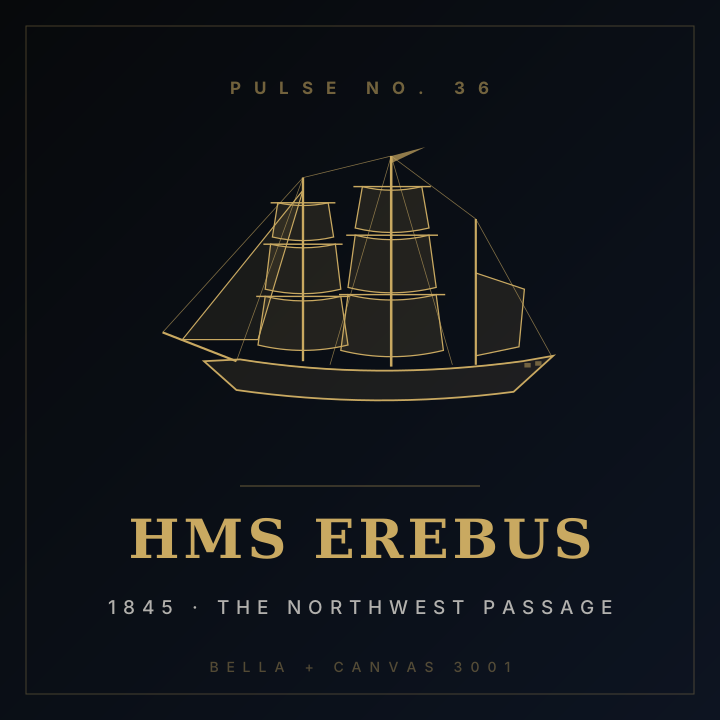
Erebus Tee
HMS EREBUS · 1845 · THE NORTHWEST PASSAGE
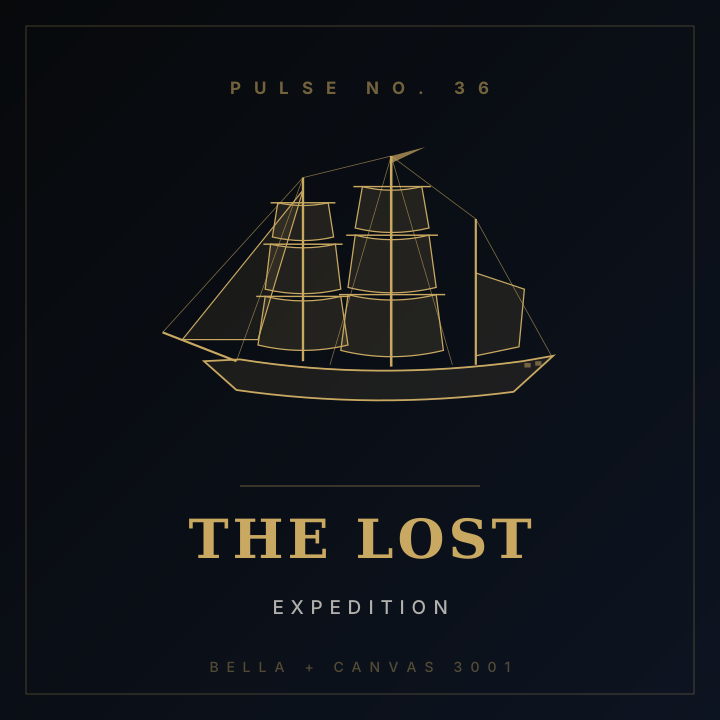
The Lost Expedition
128 men, 2 ships, the Northwest Passage, and 168 years before the ships were found.