The Lelia Byrd — the day Fort Guijarros fired on an American ship.
In March 1803 the Boston brig Lelia Byrd was caught smuggling sea otter pelts in San Diego Bay. Her crew locked up the Spanish guards and ran for the harbor mouth under the guns of Ballast Point. The fort fired; the brig fired back. Nobody died, and she got away.
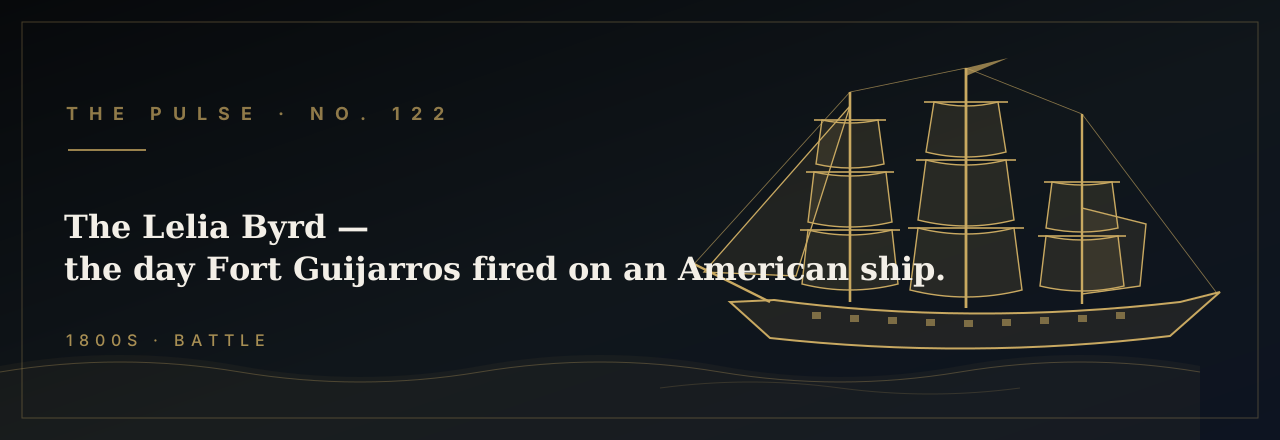
In March of 1803, a two-masted brig stood into San Diego Bay under easy sail, her decks stacked with contraband. She was the Lelia Byrd, out of Boston, and her owners — William Shaler and Richard J. Cleveland — had spent the better part of two years working the Pacific coast of the Americas, collecting sea otter pelts and selling them to every California presidio willing to look the other way. In doing so they were breaking Spanish imperial law with every transaction. San Diego, they had been told, was a friendly port. They were half right.
By 1803, Alta California was a colony running on fumes. The annual supply ship from San Blas was unreliable, the missions and presidios were chronically short of goods, and the soldiers guarding the empire's Pacific rim had not been paid in months. Spain's trade reglamento prohibited commerce with foreign vessels — but the men enforcing that law were also the men who desperately needed canvas, iron, and flour. American and British ships had learned to exploit this contradiction quietly, making port on pretexts of distress, bartering under the table, and departing before officialdom could react. The Lelia Byrd came in openly, with a cargo of sea otter pelts worth a fortune in Canton and a story about needing water and repairs.
Shaler and Cleveland were not novice traders. Shaler, who later served as American consul in Havana and left a detailed published account of the voyage, understood the risks. Cleveland, who had already circumnavigated the globe twice by his thirtieth year, understood them better still. They anchored, made contact with the local population, and were doing brisk business with mission and presidio alike when the San Diego Presidio sent soldiers aboard to inspect the cargo. What the inspectors found was exactly what they suspected: a hold full of pelts that had no business being on a foreign vessel in a Spanish port. A portion of the cargo was seized. The brig was ordered to remain at anchor.
The Americans had no intention of remaining at anchor. Before the soldiers could be put ashore, the Lelia Byrd's crew detained them — exactly how many guards were locked below decks Shaler does not specify in his account, though he was careful to report they were not harmed — and the brig began making ready to sail. Anchors came up. Sails were loosed from the yards. The detained soldiers' shipmates on shore watched from the presidio landing as the vessel swung her bow toward the harbor mouth. The commandant sent word ahead to the one installation that could stop her: the battery at Ballast Point.
Fort Guijarros — Castillo Guijarros, named for the rounded cobblestones of its construction, built in 1797 on the southern tip of Point Loma to command the channel entrance — was the only fortification in California that had ever been intended to stop a ship. In practice it was poorly manned, its guns intermittently serviceable, and its garrison a skeleton. When the Lelia Byrd came abreast of the battery making for open water, the fort opened fire. The brig fired back. Shaler's account records the exchange without drama: shots were fired by both parties; the brig was hulled at least once; no one was killed. By the time the smoke cleared, she was past the point and standing out into the Pacific, the blue hills of Point Loma falling astern, the seized pelts apparently still in her hold. It was the only engagement Fort Guijarros ever fought.
The incident was brief and, in the ledger of military history, trivial — a skirmish between a colonial garrison and a Yankee trading brig, ending with no casualties and no lasting consequence for either party. But it was a symptom. Spain in 1803 could not supply its California outposts, could not pay its soldiers, and could not — when the moment came — keep a single foreign brig from sailing out of its principal southern anchorage under direct gunfire. Within eighteen years, the Mexican War of Independence would end Spanish rule entirely. Within another twenty-six, the Mexican-American War would make the bay American. Shaler understood what he had seen. In his published account he noted, with the bluntness of a man who had just been shot at, that California would one day fall to whoever wanted it badly enough to take it.
The site where Fort Guijarros once stood is now within Naval Base Point Loma, the same headland, the same cobblestone bluffs above the channel where the Lelia Byrd ran the gauntlet. Archaeological excavations in the 1990s uncovered the fort's foundations, gun emplacements, and domestic debris — fragments of the garrison that fired on the brig and missed. A small museum preserves what was found. A mile and a half north across the water, the modern port of San Diego handles the largest surface fleet base in the world; the harbor mouth the Lelia Byrd slipped through now watches guided-missile destroyers and amphibious assault ships transit daily on their way to the open Pacific.
The channel is no wider than it was in 1803. The headland is the same shape. The cobblestone bluffs still drop to the same waterline where the fort's guns once ran out. You could sail it tonight — through that same narrow mouth, past the same point, out into the same dark Pacific where Shaler and Cleveland ran with their pelts and their stolen liberty and a few holes in their hull.
Two designs for Pulse No. 122.
Bella + Canvas 3001 unisex tee. Printed on demand and shipped from the U.S. $34.99 + tax + shipping.
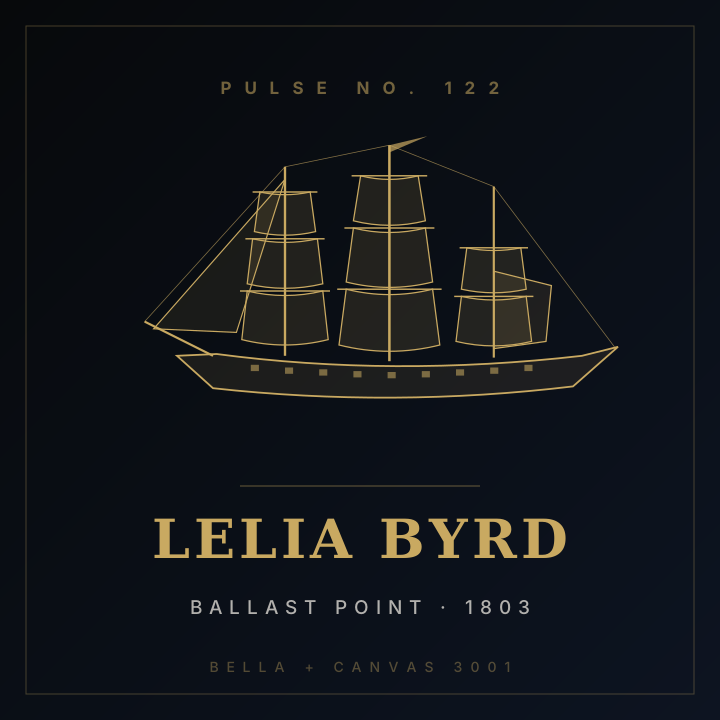
Lelia Byrd Tee
LELIA BYRD · BALLAST POINT · 1803
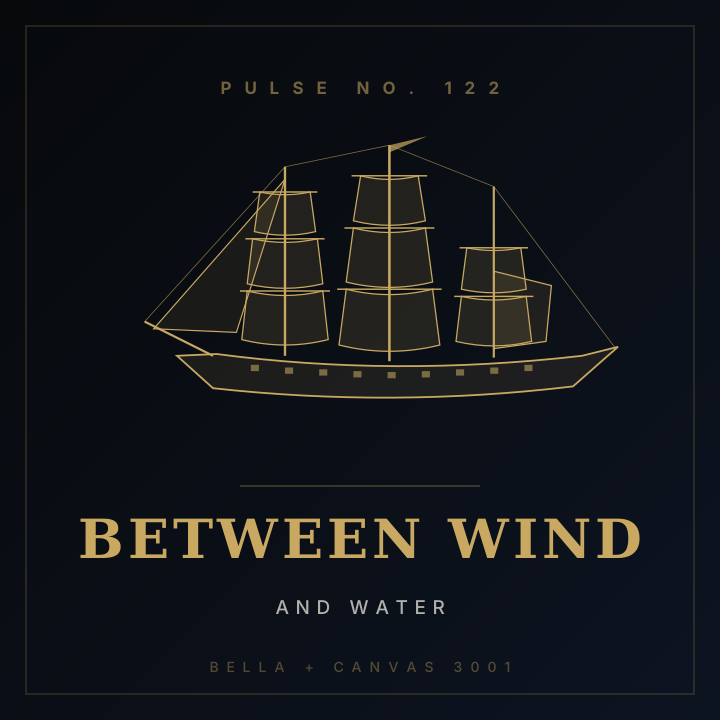
Between Wind and Water
Where the fort's shot hit the brig.