Juan Pérez and the Santiago — from San Diego to the edge of the known world.
In 1774 the frigate Santiago put in at San Diego for about 25 days, landed Fray Junípero Serra, then sailed north on Spain's first voyage to the Pacific Northwest. Pérez met the Haida off what is now British Columbia before scurvy turned him back.
By the winter of 1773, Spain had governed the Pacific coast of North America in theory for two centuries and in practice almost not at all. Russian fur hunters were pressing steadily south from their Alaskan outposts; the threat was less military than legal — first documented possession, in the law of nations as Spain understood it, would eventually carry weight in any argument over sovereignty. Viceroy Antonio María de Bucareli y Ursúa, governing New Spain from Mexico City, drafted orders for a voyage that would test whether Spain could actually back its claims: a frigate would sail north from the Pacific naval station at San Blas, Nayarit, work up past every Spanish settlement on the California coast, and press on until it found either a Russian competitor or the limit of manageable sea. The officer chosen to command it was Juan José Pérez Hernández, a veteran pilot of the Manila Galleon run whose seamanship was widely trusted and whose northern ambitions were about to be tested beyond anything the Pacific trade had demanded of him.
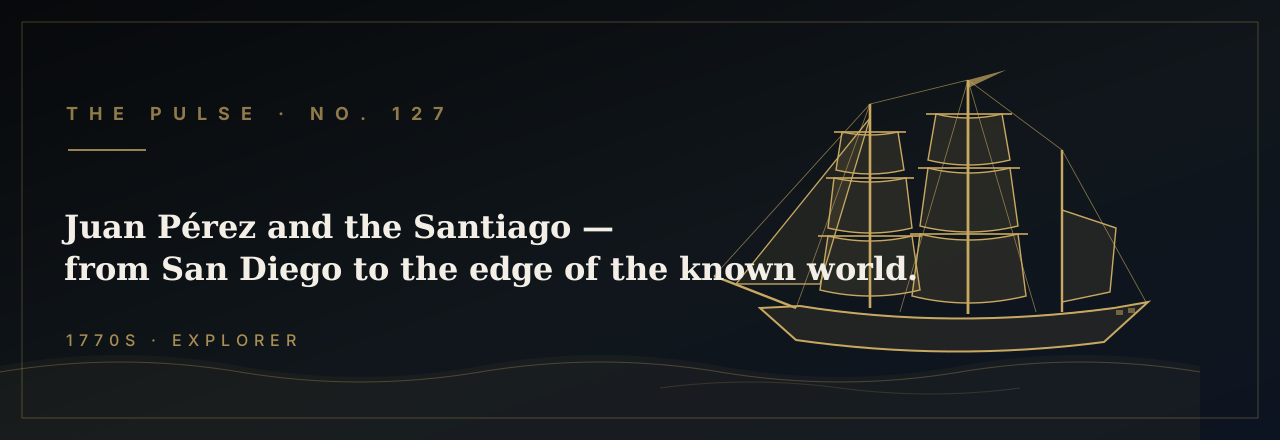
The frigate chosen for the voyage was the Santiago, also registered as Nueva Galicia, a recently completed vessel built for the supply traffic between San Blas and the California missions. She cleared the harbor at San Blas on January 24, 1774, carrying eighty-eight officers and men and twenty-four passengers. Among those passengers was Fray Junípero Serra, president of the Alta California missions, heading home after nearly two years in Mexico City where he had argued — successfully — before the Viceroy for better conditions at the missions and the replacement of the governor who had opposed him. Serra was bound for his headquarters at Mission San Carlos Borroméo at Carmel; the Santiago was working the same supply route that made the entire California missionary enterprise possible, and the friar was, for the moment, simply another passenger on a working vessel.
The Santiago worked into San Diego Bay on March 11, 1774, and did not leave for twenty-six days. Structural problems that had accumulated during the passage north — serious enough to require a carpenter's sustained attention — forced an extended layover that no one had planned for. Pérez chose to use the time thoroughly, and the repair work that followed made the rest of the voyage possible. The delay changed Serra's calculations. Rather than waiting for a frigate under repair, the friar disembarked, visited Mission San Diego de Alcalá — scarcely five years old, a garrison-mission compound that had barely taken root — and set out overland toward Monterey. When the Santiago finally departed on April 6, Serra was already walking north through the coastal scrub, and Pérez was one chaplain short for the voyage ahead.
After a final resupply stop at Monterey, the Santiago sailed for the unknown in June 1774 with two Franciscans serving as chaplains and official diarists: Fray Juan Crespí, who had marched with Portolá on the overland expedition of 1769 and whose meticulous journals had already made him the most important natural historian on the California coast, and his assistant Fray Tomás de la Peña y Saravia. Pérez carried written orders from Viceroy Bucareli to reach sixty degrees north latitude — a point well above present-day Anchorage — to make formal acts of possession at intervals along the way, and to gather intelligence on any foreign vessels or settlements he encountered. The Northwest Coast ahead was, to every European cartographer of the era, a blankness threaded with hopeful conjecture. No vessel from any European nation had sailed it and returned with a reliable account of what lay there.
In July 1774, the Santiago reached fifty-four degrees and forty minutes north latitude, arriving off the northwestern tip of Langara Island, the northernmost of the islands of Haida Gwaii. It was the first documented European encounter with the Haida. Canoes came out from the island to the anchored frigate; Pérez, under orders not to make unauthorized landings, held his position. His crew and the Haida conducted a trade across the ship's rail — cloth, beads, and pieces of copper passed one way, sea-otter pelts the other — the first recorded exchange of European trade goods on the Northwest Coast. The encounter lasted hours. Pérez never went ashore, and Langara Island went unclaimed. It was the first, and not the last, time on this voyage that the ceremony Bucareli had ordered — the cross, the parchment, the formal words of possession — was left undone.
Turning south, Pérez brought the Santiago to Nootka Sound, on the west coast of what is now Vancouver Island, on August 7 — the first European contact with the Nuu-chah-nulth people. The encounter was extended; Crespí's journal recorded observations on the population, the canoes, the surrounding landscape. A handful of Spanish items, including silver spoons, passed into indigenous hands during the visit. When James Cook anchored in the same sound in 1778, he recognized the silver objects he found among the Nuu-chah-nulth as Spanish manufacture — the ghost-print of the Santiago's visit four years before. By the time the expedition sighted the snow-capped peak on August 11 that Crespí's journal recorded as Cerro Nevado de Santa Rosalía — the mountain that English speakers would later rename Mount Olympus — scurvy had taken firm hold of the crew. Pérez had never reached his ordered latitude of sixty degrees north. He had made no formal acts of possession anywhere on the coast. He turned for home, reached Monterey on August 28, and completed the voyage at San Blas on November 5, 1774. Viceroy Bucareli, reading the journals, ordered a second voyage. Pérez did not survive it; he died at sea in November 1775, a pilot on the next expedition, his name absent from the formal honors that accrued to the commanders who came after him.
San Diego's role in this story was practical and decisive. Without the twenty-six days of repair work performed in its bay in the spring of 1774, the Santiago would not have reached Haida Gwaii or Nootka Sound at all. The harbor that Portolá's party had first described only five years earlier was already functioning as a maintenance base for Pacific ambitions no one in Madrid had yet fully imagined — a logistics node before there was a logistics doctrine. That logic has held for two and a half centuries. Naval Station San Diego, today the largest surface naval station in the world and home port for more than fifty ships, sits a few miles north of where Pérez's frigate was careened for inspection. The chain of Pacific command that now runs from San Diego to Hawaii to Guam to Japan has one of its earliest articulations in that unremarkable spring of 1774, when a carpenter's hammer echoed off the hills above a harbor that would one day become the logistical spine of an ocean fleet.
Pérez returned without the ceremony he had been sent to perform — no crosses planted, no parchments sealed, no territory formally claimed in the name of the Crown. What he left instead were the journals of Crespí and de la Peña, the first sustained European record of the Northwest Coast, and a demonstrated track that proved the coast was reachable, knowable, there. Spain would follow him north in force. Britain would follow Spain. The United States would inherit the argument. All of it traces back, in part, to a June morning when a supply frigate stood out of Monterey Bay on a northward heading, and to the harbor three weeks' sail to the south where the voyage was made possible. The same bay. The same summer swells at the harbor mouth. You could take a northward bearing tonight and sail the same Pacific Pérez sailed.
Two designs for Pulse No. 127.
Bella + Canvas 3001 unisex tee. Printed on demand and shipped from the U.S. $34.99 + tax + shipping.
Santiago Tee
SANTIAGO · JUAN PÉREZ · 1774
Haida Gwaii, 1774
Where the Santiago met the Haida.