Mighty Mary — the women who nearly won the right to defend the America's Cup.
In 1995, off San Diego, America3 fielded the first all-women team in America's Cup history. In the deciding race of the defender trials, Mighty Mary led Dennis Conner by about four minutes at the start of the last leg. She lost by 52 seconds.
Off Point Loma on the morning of April 21, 1995, the IACC sloop Mighty Mary led Dennis Conner's Stars & Stripes by more than four minutes as the two boats rounded the final mark of the Citizen Cup final and squared away for the finish. The defender selection series — the race that would decide which American syndicate earned the right to defend the America's Cup — had come down to a single last leg: roughly a mile and a half of open Pacific water, a fading westerly, and a crew of women who had spent three months proving that the argument against them was wrong.
The America's Cup is the oldest trophy in international sport. The schooner America lifted it from the Royal Yacht Squadron regatta at Cowes in 1851 and carried it back across the Atlantic; for the next 132 years no foreign challenger could take it. By the spring of 1995 the event was in its thirty-second defense, and in one hundred and forty-four years of racing — off the Isle of Wight, off Newport, off San Diego — it had not once fielded an all-women crew. That changed because Bill Koch, the Kansas-born industrialist who had won the 1992 Cup with his syndicate's America³, decided to enter the 1995 defender trials on a different premise. He organized the America3 Foundation Women's Team, opened applications to any woman who could sail, drew more than six hundred candidates for twenty-four berths, and named the new boat Mighty Mary after his mother.
The team Koch assembled was built around credentials rather than symbolism. Dawn Riley — who had crewed aboard America³ in 1992 in one of the few active roles then open to a woman — took the position of team captain and chief executive. The helm went to Leslie Egnot, a New Zealander who had won silver at the 1992 Barcelona Olympics in the women's 470 class; in steering Mighty Mary through the Citizen Cup, Egnot became the first woman to helm an America's Cup boat in competitive racing. J.J. Isler, herself an Olympic dinghy sailor, served as tactician and starting helmsman for most of the series. In March 1995, Koch introduced the one decision that drew immediate criticism: Dave Dellenbaugh, a sailing coach and experienced tactician who had worked with the program, joined the crew as Isler's replacement for the final decisive races. He was the only man on board. The hull Koch put them on was USA-43 — a seventy-five-foot IACC monohull designed by Doug Peterson and Jim Taylor and built at Eric Goetz Custom Sailboats in Bristol, Rhode Island.
The Citizen Cup ran through the winter and spring of 1995 on an eighteen-nautical-mile, six-leg windward-leeward course off Point Loma. Three syndicates raced: Mighty Mary, Conner's Stars & Stripes (USA-34), and PACT 95's Young America (USA-36). A structural incident during the semi-finals — Stars & Stripes nearly shed its keel ballast bulb mid-race — triggered a protest that ended in a compromise admitting all three syndicates to the finals. By the time those finals began, the coverage had shifted: commentators were writing not about whether the women's crew belonged there but about whether they might win.
The decisive final race seemed to confirm that they would. Mighty Mary led through five of the six legs, and by the time the boats rounded the last mark, Conner's Stars & Stripes trailed by more than four minutes — what Newsweek described at the time as "42 seemingly insurmountable boat lengths." On the final run to the line, Dellenbaugh aimed Mighty Mary directly at the finish rather than covering Conner's position. Stars & Stripes split away to the edge of the course and found pressure in a seam of moving air. Mighty Mary sailed into a patch of dead wind and came nearly to a standstill. The gap closed. Stars & Stripes crossed the finish line 52 seconds ahead.
The defeat carried a bitter coda. Conner was permitted to swap Stars & Stripes for the faster Young America in the Cup match itself. It made no difference: Team New Zealand's Black Magic (NZL-32), skippered by Russell Coutts, swept the match 5–0 in May 1995, taking the Cup from American hands for only the second time in history. The crew that had won the right to sail for America had not come as close as the crew that nearly won the right to try. Dawn Riley went on to skipper her own Cup entry, America True, in Auckland in 2000. J.J. Isler won silver at the 2000 Sydney Olympics in the women's 470 and was inducted into the National Sailing Hall of Fame in 2015. Leslie Egnot remained, for years, the only woman to have held a competitive helm position in the America's Cup.
The race course itself was San Diego's front yard. Point Loma — the granite headland that closes the bay on the west — had watched America's Cup racing from these waters since 1988, when Conner defended against a New Zealand catamaran, and again in 1992, when Koch's America³ won on this same stretch of open Pacific. The 1995 trials were the third consecutive Cup series in San Diego. Naval Base San Diego, five miles east across the bay, is the largest surface fleet installation in the world — a city of destroyers and amphibious ships commissioned from the same water that, on a spring morning in 1995, watched twenty-four women come within a tactical error of changing who gets to race for the oldest trophy in sport.
The 52 seconds have never been recovered. The question Mighty Mary came closest to answering — whether an all-women crew could defend the America's Cup — has not been answered in the thirty years since. The same Point Loma headland. The same afternoon westerlies pressing in off the open Pacific. You could sail it tonight.
Two designs for Pulse No. 128.
Bella + Canvas 3001 unisex tee. Printed on demand and shipped from the U.S. $34.99 + tax + shipping.
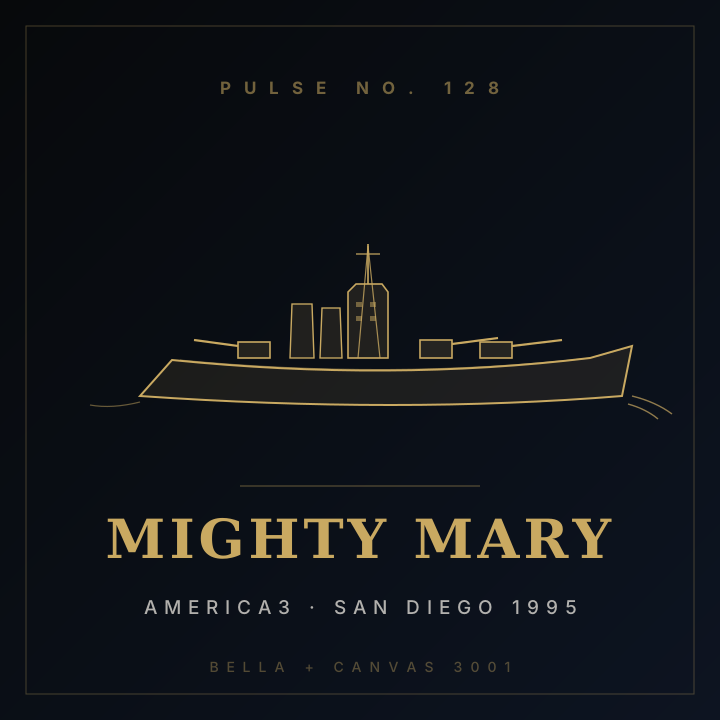
Mighty Mary Tee
MIGHTY MARY · AMERICA3 · SAN DIEGO 1995
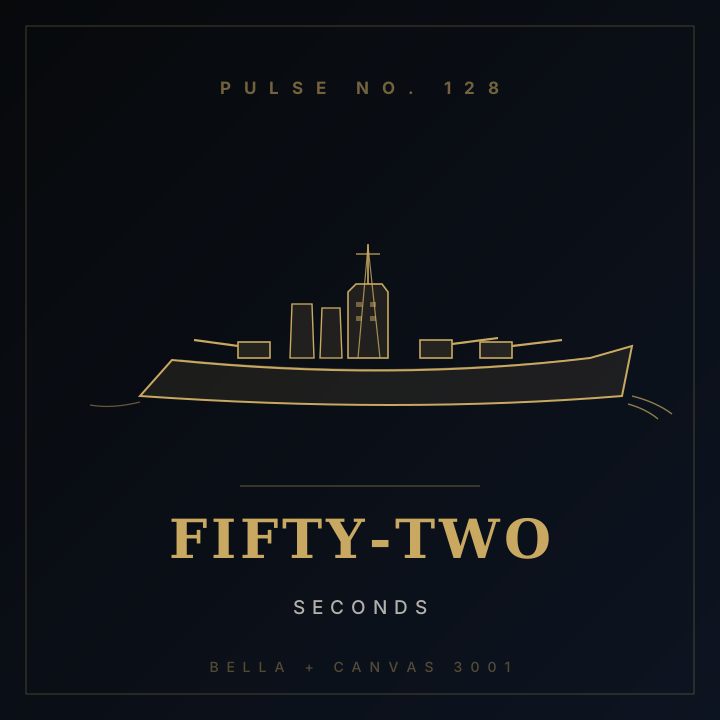
Fifty-Two Seconds
The margin in the deciding race.