HMS Rose — the British frigate that helped start the U.S. Navy, now berthed in San Diego.
The 20-gun Rose hounded Rhode Island's smugglers until the colony asked Congress for a navy. On October 13, 1775, Congress voted for its first armed ships. Her 1970 replica became HMS Surprise in Master and Commander and has been at the Maritime Museum of San Diego since 2004.
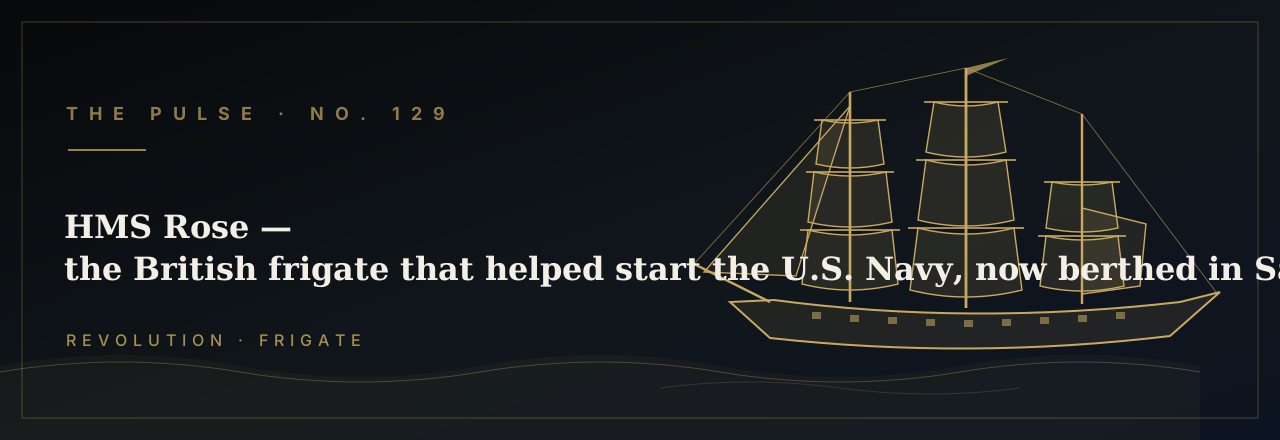
In the summer of 1775, Captain James Wallace brought HMS Rose into Narragansett Bay and proceeded, methodically, to strangle Rhode Island. The 20-gun sixth-rate — launched at Hull in 1757, well-found and aggressively handled — worked the bay's passages with a precision that went beyond enforcement into something closer to siege. Wallace stopped vessels at will, pressed sailors into Royal Navy service, and boarded merchantmen on the strength of suspicion alone. Newport's colonial economy had run for generations on French Caribbean molasses and on trade that pointedly ignored the Navigation Acts; Wallace understood exactly what the colony lived on, and he made the bay itself his instrument.
The effects were specific and cumulative. Fishing boats could not work the bay's grounds without risking impressment. Newport merchants watched their supply lines close passage by passage as Rose extended her patrols. Firewood, grain, and naval stores that had moved freely through the bay for a century began to back up on docks or go unshipped entirely. The colony was uniquely exposed in a way no other on the Atlantic seaboard quite matched: Rhode Island had no reliable overland routes to compensate, and its towns — distributed across islands and peninsulas that depended entirely on water-borne trade — could not substitute land transport for sea. One frigate, well-commanded, was sufficient to reduce it to something approaching a state of blockade.
In late August 1775, the Rhode Island General Assembly passed a resolution calling on the Continental Congress to equip and maintain a Continental fleet — the first such formal call from any colony. The argument was hard to answer: no land force could dislodge a warship from an anchorage. Only another armed vessel could answer Rose. Rhode Island's delegates carried the resolution to Philadelphia with instructions to press it on the floor, and the colony's case was difficult to dismiss. Its exposure was not theoretical. The blockship was already in the bay.
On October 13, 1775 — 251 years ago today — the Continental Congress voted to fit out two armed vessels and appointed a Naval Committee of seven members to direct the work. The ships they had in mind were modest conversions, not purpose-built warships, but the vote itself could not be undone: Congress had accepted, as a matter of settled policy, that the colonies required a navy of their own. The Naval Committee moved quickly. Within weeks it had acquired four vessels and selected Esek Hopkins of Rhode Island — the same colony that had petitioned for the fleet — as the Continental Navy's first Commander in Chief. The institution had its charter, its first ships, and its first commander, all within two months of Captain Wallace's patrols reaching their most aggressive.
The proportions of the outcome deserve a moment's attention. Rose carried 20 guns and a crew of roughly 130 men — a sixth-rate by the Royal Navy's classification, the smallest type rated to a full commander in charge. Against a navy numbering hundreds of warships, she was a patrol frigate on a secondary colonial station, not a ship of the line. And yet her systematic harassment of one colony's sea-dependent economy was the proximate cause of an institution. The navy that Congress set in motion that October would grow over two and a half centuries into a fleet of eleven carrier strike groups, nearly three hundred hulls, and a budget larger than the defense expenditure of most nations on earth. Captain Wallace was doing his job. He did it precisely well enough to make the consequences irreversible.
The original Rose survived the war she inadvertently started, but not by long. After several years of service in North American waters, she was brought to Savannah and deliberately scuttled in the Savannah River in 1779 — sunk as a blockship to obstruct the channel against the Franco-American fleet during the Siege of Savannah that autumn. The frigate that had blockaded a bay and prompted a revolution in maritime policy ended her service lying on a Georgia riverbed while the war she had helped to start ran its final years without her.
Two centuries later, a group of maritime preservationists built a replica of Rose from the original Admiralty drafts. The hull was launched in 1970 at Lunenburg, Nova Scotia — one of the great wooden-shipbuilding towns of the Atlantic world — and spent three decades working the eastern seaboard as a sail-training vessel and tall-ship ambassador. In 2003, the replica was re-rigged and re-named to star as HMS Surprise in Master and Commander: The Far Side of the World, the film adaptation of Patrick O'Brian's Aubrey-Maturin novels. She performed her own sea work, serving as the primary full-scale vessel in the production and earning a second celebrity that no tall-ship replica had previously managed.
She has been moored at the Maritime Museum of San Diego since 2004, still wearing HMS Surprise on her sternboards — a film credit that outlasted the production. She floats on the Embarcadero less than two miles from the piers of Naval Base San Diego, the largest surface warfare base in the world, where destroyers and guided-missile cruisers move in and out on a schedule that would have read, to James Wallace, as the population of a fleet beyond imagination. The navy that Rose made necessary is based, in part, on this bay. The ship that started it is docked here, too, within sight of Point Loma and the open Pacific beyond. The same harbor. The same offshore swell. You could walk her quarterdeck tonight.
Two designs for Pulse No. 129.
Bella + Canvas 3001 unisex tee. Printed on demand and shipped from the U.S. $34.99 + tax + shipping.
Rose Tee
HMS ROSE · NARRAGANSETT BAY · 1775
October 13, 1775
The Navy's birthday.