William Kettner — the congressman who made San Diego a Navy town.
Elected in 1912, 'Brother Bill' Kettner spent four terms winning the Navy and Marine installations San Diego still lives with: the training station, the naval hospital, the Marine base, the North Island air station. He was known as the Million Dollar Congressman.
When William Kettner took his seat in the Sixty-Third Congress in March of 1913, San Diego had the finest natural harbor on the Pacific coast south of San Francisco — twelve miles of sheltered water, Point Loma holding off the swells from the west, the Coronado Peninsula closing the bay to the south, an anchorage deep enough for capital ships — and almost nothing else to show the Navy. No training station. No hospital. No permanent fleet base. No air station on North Island, where the seaplanes would come. In the eight years that followed, the Democratic insurance agent from California's eleventh district — the man his colleagues in Washington would come to call Brother Bill — would acquire all four.
The strategic argument for San Diego was not new. Civic boosters had been making it since the 1890s, pointing at harbor charts and telling Washington that here was a Pacific anchorage to rival any in the world. What changed in the summer of 1914 was the Panama Canal. When the canal opened in August of that year, San Diego became the southernmost deep-water American port on the Pacific coast — the first landfall of consequence for any fleet transiting from the Atlantic, the natural staging hub for a Navy beginning to look seriously westward. The Panama-California Exposition of 1915, held throughout that year in Balboa Park, put the city before the national press at precisely the moment Kettner needed Washington's attention. He was not wasting the opportunity.
His most important relationships were inside the Department of the Navy. Josephus Daniels, the Wilson administration's Secretary of the Navy from 1913 to 1921, controlled the budget requests; Franklin Roosevelt, serving as Assistant Secretary through nearly the same span, built the institutional knowledge and the network that would carry him for three more decades. Kettner worked both men. He brought them to San Diego. He let the harbor speak for itself: the glassy bay, the nearly three hundred clear flying days a year, the mild climate that meant a training facility here could operate every month, which no East Coast base could reliably claim. Daniels came away persuaded. Roosevelt required no persuasion at all.
America's entry into the First World War in April of 1917 converted Kettner's arguments from ambition to emergency. The Navy needed men trained at scale, seaplanes on both coasts, a hospital within reach of the training grounds. North Island — the flat northern end of Coronado, where Glenn Curtiss had established his aviation school in 1911 and the Army Signal Corps had run its early flight experiments — was transferred to the Navy and commissioned as a naval air station. It began as a canvas-hangar establishment, a few seaplanes on a sandspit at the mouth of the bay. It grew, as everything Kettner touched grew, because the site was too good for it not to.
The Marines came in 1919. The Corps needed a West Coast recruit depot — a permanent facility capable of training the flood of enlisted men the war had produced and the peacetime Navy expected to sustain. Kettner helped secure the Dutch Flats site north of downtown: level ground, accessible by rail, far enough from the city to run a rifle range. The Marine Corps Recruit Depot that opened there has trained every recruit west of the Mississippi ever since. The Naval Training Station followed on the waterfront. The Naval Hospital went up on the heights above Balboa Park, close enough to the training grounds to receive casualties directly. His colleagues on the Appropriations Committee had taken to calling him the Million Dollar Congressman.
They were not complaining.
The San Diego that Kettner built is the San Diego that sails. Naval Base San Diego, the direct heir to the facilities he pushed through a generation of appropriations battles, is today the largest surface fleet base in the world — more than fifty ships, a third of the United States Pacific Fleet homeported on the bay he spent eight years lobbying for. Naval Air Station North Island remains on the same sandspit where the first seaplanes lifted off. The Marine Corps Recruit Depot still occupies the Dutch Flats ground, its Mission Revival barracks a registered historic landmark, its drill field unchanged in a century of city growth rising on three sides. Kettner did not build these institutions. He argued them into existence, appropriation by appropriation, a skeptical Congress at a time.
The same harbor he carried into those rooms as a set of charts is out there tonight. The same glassy bay that persuaded Josephus Daniels is past the carrier pier, past the seaplane ramp where North Island began, past the channel markers the fleet still follows in and out. The same summer swells. You could sail it tonight.
Two designs for Pulse No. 130.
Bella + Canvas 3001 unisex tee. Printed on demand and shipped from the U.S. $34.99 + tax + shipping.
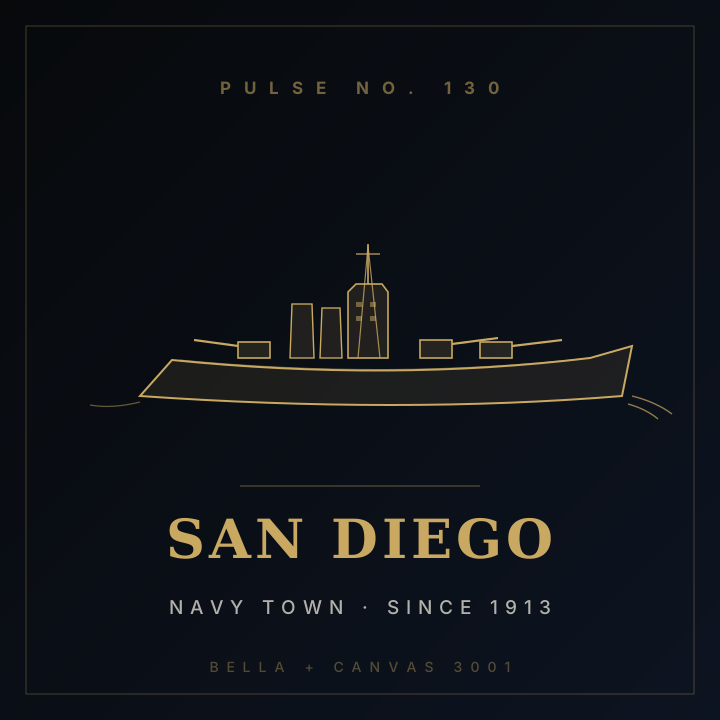
Navy Town Tee
SAN DIEGO · NAVY TOWN · SINCE 1913
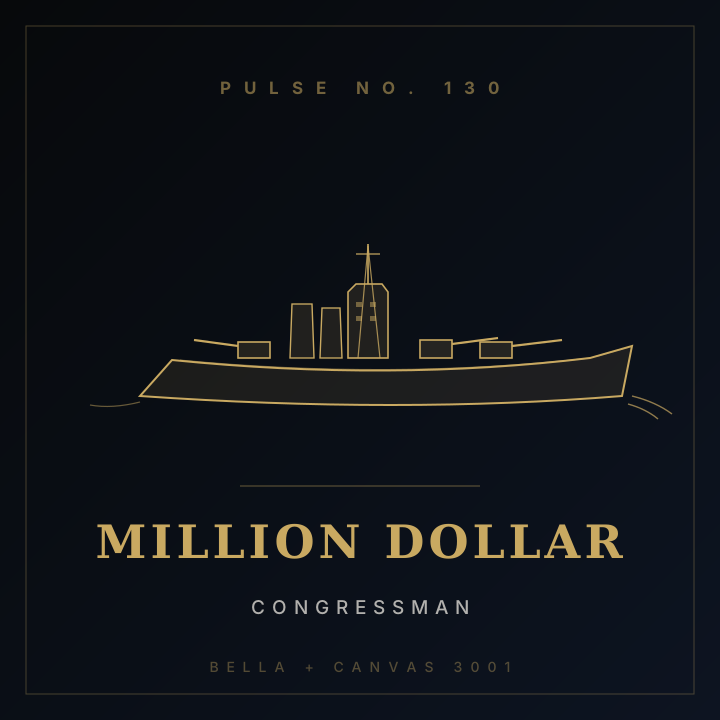
Million Dollar Congressman
What they called William Kettner.