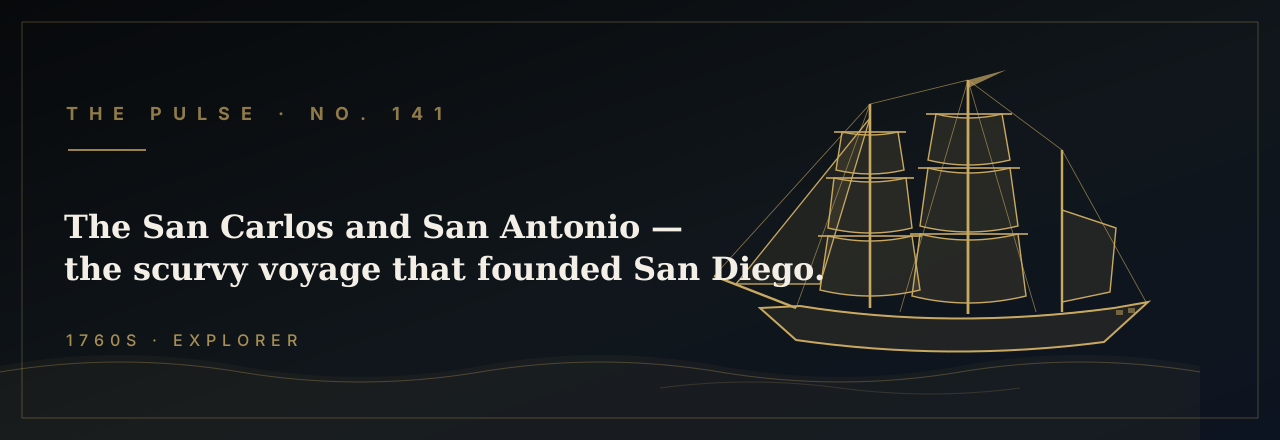
The San Carlos and San Antonio — the scurvy voyage that founded San Diego.
In 1769 two Spanish supply ships reached San Diego Bay, the San Antonio on April 11 and the San Carlos on April 29 after 110 days. Scurvy had wrecked both crews; the San Carlos lost nearly all of her sailors. The survivors' sailcloth hospital on the beach became the start of a city.
Spain had a plan for the western rim of its empire, and in January of 1769 two small packet boats were assigned to execute the hardest part of it first. The San Carlos, flagship of what Visitador General José de Gálvez called the Sacred Expedition to Alta California, cleared La Paz harbor on January 9 under Captain Vicente Vila, carrying soldiers, a Franciscan friar, the royal engineer Miguel Costansó, and enough livestock and seed to plant a permanent colony above the thirty-second parallel. The San Antonio — also known as El Príncipe — followed on February 15 under Captain Juan Pérez. Their destination was a bay a Cabrillo pilot had named in 1542 and that Spanish mariners had since mapped vaguely and mostly forgotten.
The San Antonio made the easier crossing. Favored by wind and a line well off the coast, Pérez brought her into San Diego Bay on April 11, 1769, roughly fifty-four days out of port. Her crew was weakened and several men were sick, but the ship was intact and her people were upright. Pérez anchored, sent a boat ashore, and waited. No flag went up, no ceremony was held. The San Antonio had arrived first but she was alone, and there was nothing worth celebrating yet.
The San Carlos had been at sea since January 9 — one hundred and ten days by the time she finally raised the Point Loma headlands on April 29. She had missed the entrance to the bay on her first approach, been driven north by adverse winds and the southward press of the California Current, and spent weeks fighting her way back down a hostile lee shore. For sailors in 1769, that many weeks without fresh provisions meant one outcome: scurvy — the hemorrhaging gums, the old wounds reopening, the joints that refused to hold weight. The San Carlos had lost her ship's surgeon to the disease before she ever sighted her anchorage, and was being worked by a skeleton of men too sick to stand a full watch.
The scene that greeted the San Antonio's lookouts as the flagship came to anchor was harrowing. Nearly the entire crew of the San Carlos was prostrate below decks. Lieutenant Pedro Fages and Costansó — who had sailed as passengers rather than sailors — were among the few still capable of movement. Of the men who had departed La Paz with such official ceremony, most could not row a boat to shore. The harbor had been reached at great cost, but there was almost no one left to claim it.
What followed was improvised from whatever the two ships could spare. Sailcloth was stripped from spars and rigged as awnings on the beach of what is now the foot of Old Town. The sick were carried from the holds and laid under the canvas — the open sea air that every mariner of the era prescribed as the first cure for scurvy. Pérez turned the San Antonio around and sailed back to Cabo San Lucas to recruit replacement sailors, leaving the dying camp on the beach to hold on. Costansó, one of the few witnesses with the training to record what he saw, described the camp in terms that read more like a field hospital after a siege than the founding of a city.
The colony survived anyway. Gaspar de Portolá reached the bay at the end of June 1769 with the overland division, finding the sailcloth settlement, its graves, and its survivors. Father Junípero Serra formally founded Mission San Diego de Alcalá on July 16, 1769, in a ceremony near the temporary camp — a cross planted, a Mass said, a bell rung over the same ground where the expedition's sick had been laid out on the sand. It was the first permanent European settlement on the Pacific coast of what would become the United States, and the first of twenty-one California missions. Fifty-two more years would pass before the harbor had a real town around it.
The bay those two ships entered is the same bay that is home today to Naval Base San Diego, the largest surface-fleet concentration in the world, and to the working waterfront where naval auxiliaries and cargo ships move through the same anchorage the San Carlos found after a hundred and ten days of open water. The scurvy hospital on the beach was not the first European contact with this coast — Cabrillo had stopped here in 1542, Vizcaíno in 1602 — but it was the first time anyone stayed. Every institution San Diego has built since — its navy yard, its port authority, its grid of streets above the old flood plain — descends from the decision made in that sailcloth camp to hold position and wait for the San Antonio to return with a fresh crew.
The same bay. The same northwest swells pushing up from open water, the same Point Loma headlands standing over the entrance the San Carlos almost missed. You could sail in under that bluff tonight.
Two designs for Pulse No. 141.
Bella + Canvas 3001 unisex tee. Printed on demand and shipped from the U.S. $34.99 + tax + shipping.
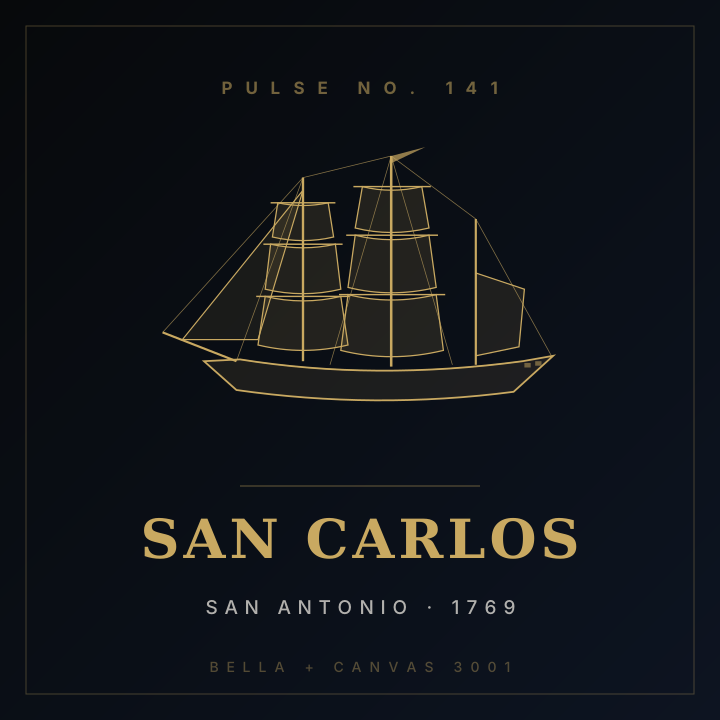
San Carlos Tee
SAN CARLOS · SAN ANTONIO · 1769
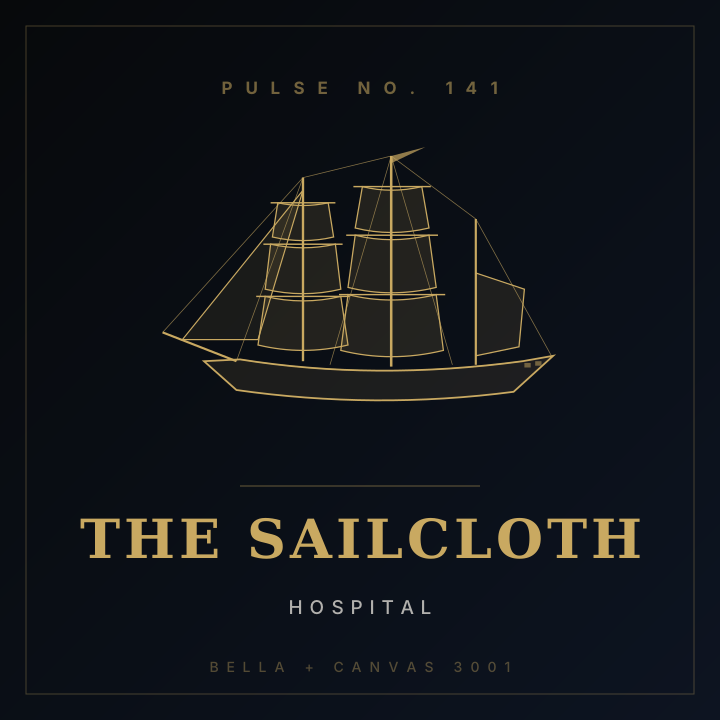
The Sailcloth Hospital
Where San Diego began.