The Akron at Camp Kearny — the day the airship took her ground crew with her.
On May 11, 1932 the Navy's giant airship USS Akron tried to land at Camp Kearny on the mesa above San Diego. Lightened by the sun and spent fuel, she rose with sailors from the training station still holding the lines. Two fell to their deaths; a third hung on for an hour before he was hauled aboard.
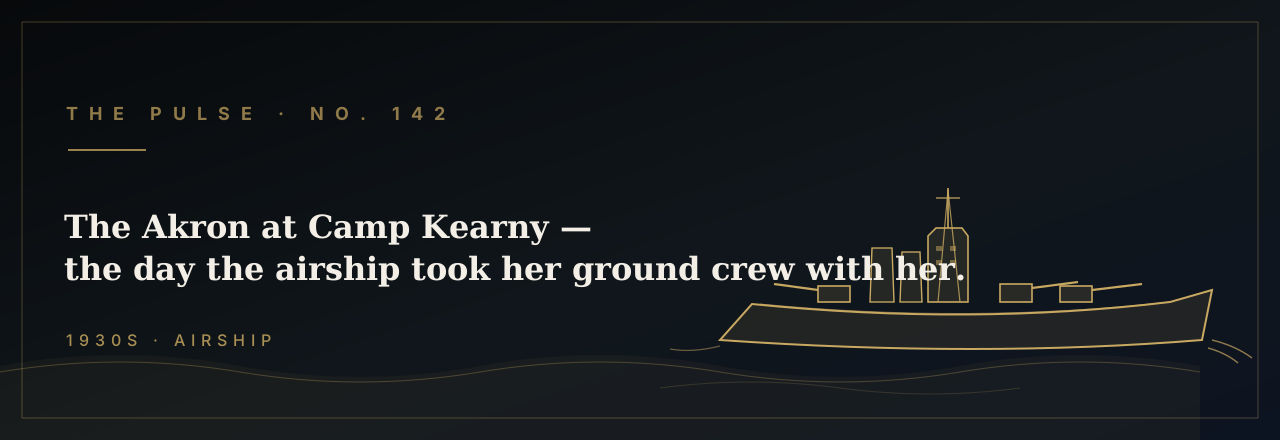
The morning of May 11, 1932, a shadow the length of three city blocks crossed the chaparral of the mesa above San Diego. USS Akron (ZRS-4), the largest airship the United States Navy had ever flown — 785 feet from stem to stern, six and a half million cubic feet of helium — was descending toward Camp Kearny, where a ground handling party from the training station stood ready with mooring lines. By the standards of rigid-airship operations, it was a routine landing. It would not remain so.
Built by the Goodyear-Zeppelin Corporation at Akron, Ohio, and commissioned on October 27, 1931, Akron was the first of two flying aircraft carriers the Navy had ordered under its lighter-than-air program — each designed to carry five Curtiss F9C Sparrowhawk biplanes in an internal hangar, launching and recovering them through a trapeze hook while the ship remained under way. Her sister, USS Macon (ZRS-5), was still under construction at the same Ohio facility. Together they were the Navy's most ambitious attempt to keep aviation permanently aloft, independent of any carrier or shore station — the extended eyes of the battle fleet, ranging hundreds of miles ahead of the gun line.
The doctrine behind them traced to the World War. German Zeppelins had ranged over the North Sea at altitudes beyond the reach of anti-aircraft fire, reporting fleet dispositions before any surface scout could close to visual range. The Navy's Bureau of Aeronautics envisioned Akron and Macon as the Pacific fleet's forward eyes — each one extending the admiral's horizon five hundred miles, arriving over an enemy force before opposing lookouts had spotted a mast. In 1932, a decade before the carrier battles of Midway settled the question of how naval wars were decided, the concept was not obviously wrong.
Akron was on a West Coast demonstration and training cruise, operating out of Naval Air Station Lakehurst in New Jersey. Mooring a rigid airship was not a casual evolution. The ships required a flat, open surface, a handling party of upward of a hundred men, and stable thermal conditions — heat rising from the ground made the enormous hulls buoyant and unruly, working against the handlers' hold. Camp Kearny, the World War I Army training ground spread across the mesa above Mission Valley, offered the open ground and an experienced crew from the nearby station. What it could not offer, on a California morning in May, was cool air.
As the sun climbed, the mesa floor heated and the atmosphere above it thinned. Akron had consumed the better part of two days' fuel on her cross-country passage from New Jersey; she was already lighter than her nominal operating weight before a single line reached the ground. The combination — reduced fuel load, morning thermals rising from the scrub — made her more buoyant than her handlers had calculated. When the crew walked the lines down and the ground party took hold, the ship was not settling through equilibrium: she was straining upward. Before the men could take secure footing or pass the lines to fixed points, Akron lifted. The ropes went taut. Most of the handling party released their grip in time. Three did not.
Carried aloft as the airship climbed, the three men hung from the mooring lines over the mesa. Two lost their grip — or the line gave way — and fell. Both died. The third held on for an hour while Akron drifted above the California scrubland and her crew worked to bring him aboard. They hauled him in alive. Accounts of the incident crossed the wire services that afternoon: photographs of the vast silver hull over the brown hills, spare reports of what had been hanging beneath it. The Navy ordered a formal review of mooring procedures, and the sequence of events at Camp Kearny — a buoyant ship, spent fuel, the California sun — entered the operational record as a case study in the hazards unique to rigid lighter-than-air craft.
Camp Kearny had been a city of canvas during the first World War — mobilization ground for the 40th Infantry Division, the Sunshine Division, before it shipped to France. By 1932 the wartime structures were long gone, but the mesa remained, and San Diego's relationship with military aviation deepened each year. Twenty miles south at the tip of Coronado, Naval Air Station North Island had become the hub of the Navy's Pacific air arm; the bay beyond it held the destroyers and submarines of the 11th Naval District. The accident on the mesa above them was a data point in a developing understanding of what the Southern California landscape could and could not support — knowledge that would eventually shape the aviation complex that grew across the plateau in the years after the next war.
Akron survived the West Coast cruise and returned east, but her time was short. On the night of April 3–4, 1933, she flew into a violent line squall off the New Jersey coast and struck the sea. Seventy-three of her seventy-six officers and men died, among them Rear Admiral William A. Moffett, the architect of American naval aviation, who had boarded as a passenger. Macon followed in February 1935, lost off Point Sur in a second weather casualty. The rigid-airship program ended with them: not defeated in combat, not cancelled on strategic grounds, but worn down by what these machines could not endure. The two sailors who fell at Camp Kearny were among the first casualties of a reckoning that would close the program entirely within three years.
The mesa is still there, flat and pale against the northern sky on any clear morning off the bay. The same May thermals rise from the same scrub. You could look north from the water tonight and find the plateau where, for one hour in 1932, a man's grip on a rope was the only thing between him and the ground.
Two designs for Pulse No. 142.
Bella + Canvas 3001 unisex tee. Printed on demand and shipped from the U.S. $34.99 + tax + shipping.
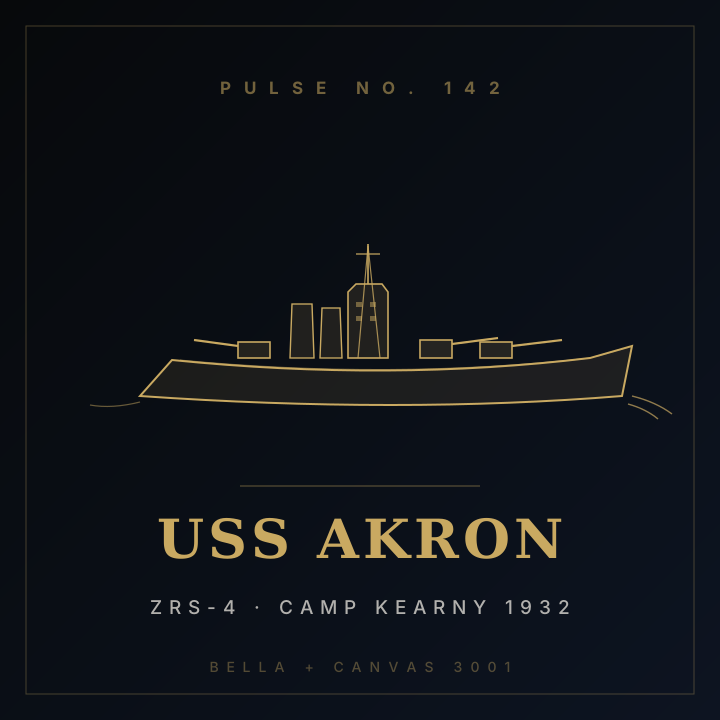
Akron Tee
USS AKRON · ZRS-4 · CAMP KEARNY 1932

Hold On, Bud
Apprentice Seaman Cowart's hour on a rope.