Dragons and the Sea: a maritime natural history.
They were always here — in the clay tablets of Ugarit, in the Norse law codes, in the coral palace at the floor of the Pacific. A fully cited survey of the sea dragon across fourteen traditions, and what a 1938 sailing yacht carries forward from all of them.
A scholarship piece for creators — verified against primary sources, July 2026
I. The Sea Was Always Dragon-Shaped
Before the sea had a name, it had a body. In the oldest written cosmology we possess — the Babylonian Enuma Elish, composed approximately 1700 BCE and preserved in the library of Ashurbanipal at Nineveh — the primordial ocean is not water. It is Tiamat, the salt sea made flesh: immense, pre-form, everything and nothing, commingled with Apsu (the freshwater deep) at the beginning of time. When the storm-god Marduk splits her body in combat, one half becomes the sky and the other the earth. Her eyes become the headwaters of the Tigris and Euphrates. She is not a monster that lives in the sea. She is the sea, personified — and the world is built from her.
The Ugaritic tablets from Ras Shamra (modern Syria), dated 1400–1200 BCE, introduce her cousin: Lotan, whose name means "coiled." The text calls him bṯn brḥ ("the fugitive serpent") and bṯn ʿqltn ("the twisting serpent"), with a third epithet: "the mighty one with seven heads." This is the oldest confirmed seven-headed sea serpent in world literature. When the phrase travels from Ugaritic into Hebrew scripture, it arrives in Isaiah 27:1 almost verbatim: the LORD punishing "Leviathan the fleeing serpent, Leviathan the twisting serpent." Scholar W.G. Lambert argued in 2003 that this is a near-direct quotation. The Ugaritic Lôtān and the Hebrew Leviathan are philologically cognate — the same coiled monster, crossing a cultural border so cleanly that the names rhyme across three thousand years.
The fullest portrait of the sea dragon in ancient Western literature is Job 41. God addresses Job from the whirlwind and catalogs the Leviathan: scales "like rows of shields, shut up closely as with a seal" (41:15), breath that "kindles coals," a flame from its mouth (41:19–21), neck in which "strength abides," and eyes like "the eyelids of the morning" (41:18). This fire-breathing, shield-scaled marine serpent became the template for the medieval Western dragon — every winged creature hoarding treasure in a cave is downstream of Job 41.
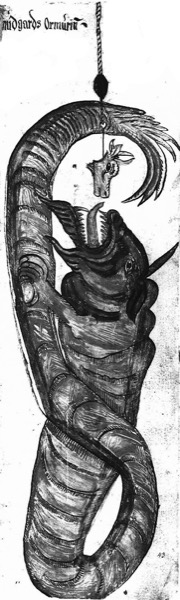
The Norse Jörmungandr — offspring of Loki and the giantess Angrboða — is the tradition taken to its logical end. Odin casts the creature into the ocean that encircles Midgard (the human world), where it grows until it can bite its own tail: the ouroboros configuration, the sea itself as a self-consuming ring. Snorri Sturluson's Prose Edda (c. 1220 CE) preserves three episodes: the fishing trip in which Thor nearly lands Jörmungandr on a hook baited with an ox-head; the lifting contest in which the serpent appears disguised as a cat (the universe shudders when one paw briefly leaves the ground); and Ragnarök, when the serpent rises from the sea, flooding coastlines, and Thor kills it but walks nine steps and falls, poisoned. The Altuna Runestone in Uppland, Sweden (11th century) may show the fishing scene in stone. In the skaldic poem Húsdrápa (c. 983 CE), Úlfr Uggason describes the carved hall-scene: "the gleaming mane of the serpent" (orms glóar fax).
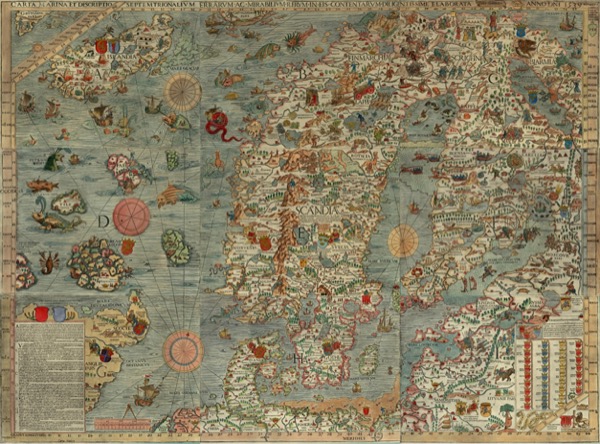
The man who connected all of this to real seamanship was the Swedish archbishop Olaus Magnus (1490–1557), writing from exile in Rome. His Carta Marina (Venice, 1539) is 125 by 170 centimeters of woodcut cartography — the most detailed map of Scandinavia of its era — annotated with sea creatures from Norse oral accounts, Pliny's Historia Naturalis, and direct reports from Norwegian fishermen. The Great Norway Serpent shown off Bergen in the map is described in his companion Historia de gentibus septentrionalibus (Rome, 1555) as "200 feet long and twenty feet in diameter, which leaves the caves and dens under the water in summer nights... it hath commonly hair hanging from his neck a cubit long, and sharp scales, and is black." The zoologist Antoon Oudemans, in his 1892 study The Great Sea-Serpent, identified Olaus's account as the ancestral source for five centuries of Western sea-serpent literature.
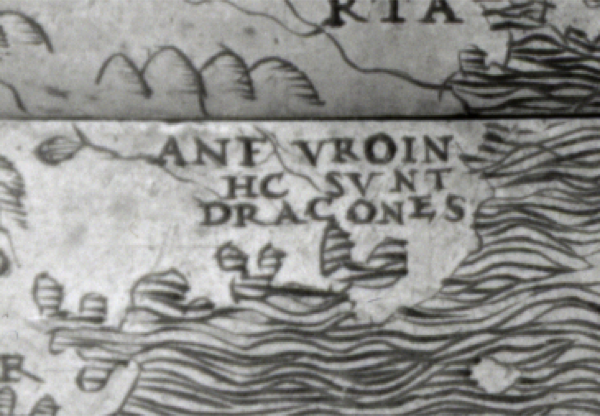
Which brings us to the phrase everyone knows but almost no one has read in context. The copper-alloy sphere now in the New York Public Library's Rare Book Division — the Hunt-Lenox Globe, approximately 11.2 centimeters in diameter, dated by the NYPL to circa 1504–1510 — carries the inscription HIC SVNT DRACONES: "here are dragons." It appears near the eastern coast of Asia, probably the Indonesian archipelago. It is the only known historical map to bear this specific phrase. The cultural image of medieval cartographers routinely warning sailors away from blank spaces with dragon warnings is a Romantic-era invention. It happened once, on a globe the size of a grapefruit. The Atlas Obscura's most credible interpretation is that the phrase may reference Komodo dragons — Varanus komodoensis — reported by sailors from the Indonesian islands. The creature the phrase named was real. What the phrase became, across five centuries of retelling, is everything the sea dragon has always been: a name for what we don't yet know.
II. Dragon as Water Sovereign
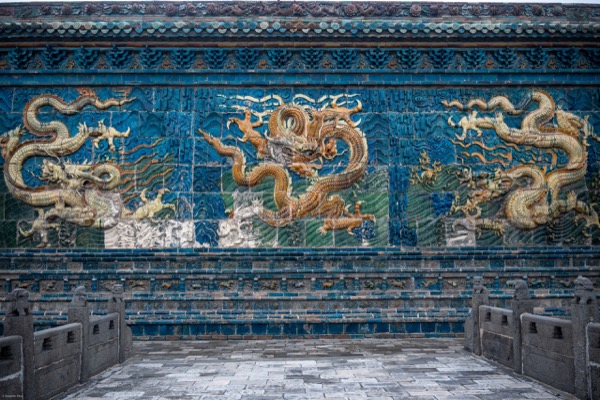
The Chinese dragon is not a monster. The lóng (龍) is a water sovereign — a celestial bureaucrat operating under mandate from the Jade Emperor. The Han-dynasty Confucian philosopher Wang Fu (c. 78–163 CE), in his Qianfulun ("Comments of a Recluse"), recorded the canonical nine-resemblances formula: the dragon's antlers resemble those of a stag, its head that of a camel, its eyes those of a demon, its neck that of a snake, its belly that of a clam, its scales those of a carp, its claws those of an eagle, its soles those of a tiger, its ears those of a cow. Beneath its chin: a pearl. In Tang-dynasty iconography, the pearl represents the moon — sinologist Wolfram Eberhard established that the dragon chasing its pearl equals clouds chasing and swallowing the moon; the pearl IS lunar light in condensed form.
Four Dragon Kings — the Sìhǎi Lóngwáng (四海龍王) — rule the cardinal seas under their shared surname Ao: Ao Guang (敖廣) the East Sea, Ao Qin (敖欽) the South Sea, Ao Run (敖閏) the West Sea, Ao Shun (敖順) the North Sea. They maintain crystalline underwater courts staffed by fish-generals and shrimp-soldiers, mirroring the Confucian bureaucratic state. The Journey to the West (西遊記, attributed Wu Cheng'en, c. 1592) depicts Ao Guang's court at the floor of the East China Sea in some of the most vivid writing in Chinese literature. The Monkey King Sun Wukong arrives to steal Ao Guang's legendary staff — the pillar that once steadied the Milky Way — and the Dragon King, for all his power, must submit both to the celestial bureaucracy above him and, in this scene, to the monkey below him. Dragon Kings receive and execute celestial edicts. Their relationship to mortal sailors was diplomatic: coastal communities throughout Fujian, Guangdong, and Taiwan built Dragon King temples (Lóng Wáng Miào 龍王廟) at every harbor mouth and made ritual offerings before every voyage. This was not appeasement of a monster. It was correct diplomatic relations with a sovereign whose domain you were entering.
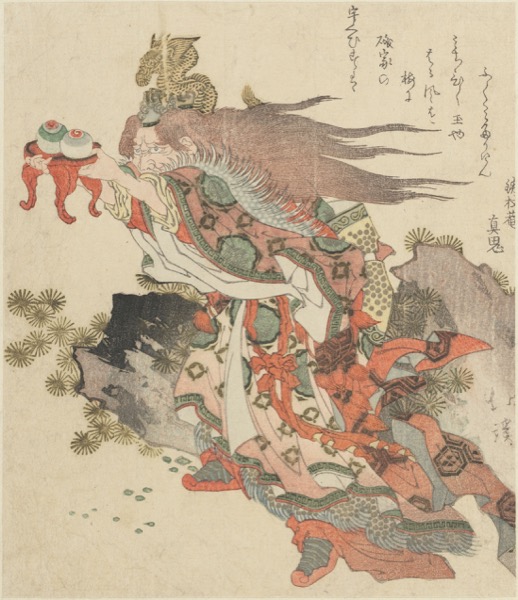
Japan's equivalent sovereign is Ryūjin (龍神), also called Ōwatatsumi, the sea deity of Japanese mythology. His palace Ryūgū-jō is built of red and white coral at the ocean floor. He controls the tides through two objects: the Kanju (干珠, "tide-ebbing jewel"), which causes seas to recede when cast into the water, and the Manju (満珠, "tide-flowing jewel"), which causes seas to rise. These jewels appear in Japan's oldest text: the Kojiki ("Record of Ancient Things"), compiled 712 CE on imperial order — a genuine primary source. The imperial dynasty of Japan traces its descent to Ryūjin through his daughter Toyotama-hime, who married the hunter-prince Hoori after he descended to the Dragon Palace to recover a borrowed fishing hook. Japanese fishermen traditionally know the oarfish (Regalecus glesne) by the name ryūgū no tsukai — "Messenger from the Dragon Palace." When oarfish surface (they typically do so when ill or before seismic events), they carry word from Ryūjin's court below.
The Vietnam founding myth is the most explicit "dragon ancestry" claim in any culture. Lạc Long Quân (雒龍君), the Dragon Lord Lac Long, resident of the Eastern Sea, married the mountain fairy Âu Cơ. Their union produced a sac of 100 eggs that hatched into 100 sons. Lạc Long Quân told her: "I am descended from dragons, you from immortals. We are as incompatible as water is with fire." He took 50 sons to the sea; she took 50 to the mountains. The firstborn became Emperor Hùng Vương, founding the first Vietnamese dynasty. The identity phrase that follows — Con Rồng, Cháu Tiên, "Children of the Dragon, Grandchildren of the Immortal" — is in active use in Vietnam today.
But the most direct mythological precedent for a family of differently-bodied siblings each suited to a distinct function is Ming-dynasty Chinese scholarship: the Nine Sons of the Dragon (龍生九子, Lóng Shēng Jiǔ Zǐ). The tradition was first recorded by the court scholar Lu Rong (陸容, 1436–1494) and most fully cataloged by Yang Shen (楊慎, 1488–1559). The crucial fact: the Nine Sons are NOT standard dragons. Each inherits one aspect of the dragon's nature while taking on a hybrid form suited to a specific function. Bixi (贔屭) takes the form of a tortoise with a dragon head and stands beneath stone steles because he loves bearing great weight. Chiwen (螭吻) is a large-mouthed fish-dragon placed at the tips of roof ridges because he swallows fire and protects buildings from flame. Pulao (蒲牢) is a small roaring dragon mounted at the tops of large bells because he produces sound when struck. Gongfu (蚣蝮) is a water-creature placed on bridge supports because he loves water and stabilizes crossings. Jiaotu (椒圖) has a spiral-shell form placed on door knockers because he keeps his mouth shut and guards thresholds. Walk the Forbidden City and you are walking a catalog of dragon-son iconography: each creature in its correct place, each body plan matched to a function. This is "matched natures" cosmology, and it predates the Western concept of specialized guardian by more than five centuries.
III. The Pacific
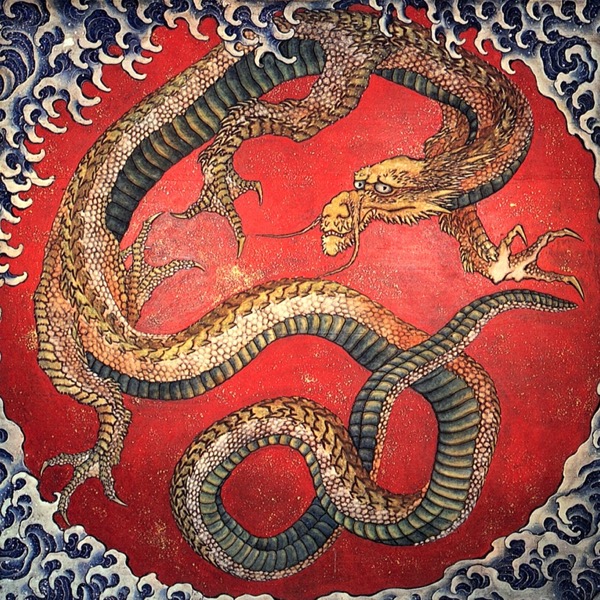
The Hawaiian moʻo are not dragons in the Chinese sense. That frame should not be imposed on them. They are a distinct category of Hawaiian supernatural being — akua (deities) and ʻaumakua (ancestral guardian spirits) — and they are not historical curiosities. They are living spiritual presences for many Native Hawaiian families today.
Scholar Marie Alohalani Brown (University of Hawaiʻi) spent over a decade recovering moʻo traditions from Hawaiian-language newspapers (1834–1948) via the Papakilo Database — more than 8,000 search results for "moo." Her authoritative monograph Ka Poʻe Moʻo Akua: Hawaiian Reptilian Water Deities (University of Hawaiʻi Press, 2020) identified nearly 300 individual moʻo akua: 137 female, 53 male, 93 unspecified, 5 variable by context. The 19th-century Hawaiian historian Samuel Kamakau recorded that when fires were lit near their homes, the moʻo would appear: black as night, glistening in the water, 12 to 30 feet long. Kihawahine — the most powerful moʻo in the tradition, guardian of the Mokuhinia fishpond on Maui — is described by Brown as having "skin like that of an ʻūhā eel but much darker and incredibly shiny." The moʻo are primarily freshwater guardians: streams, fishponds, springs, marshes. Their domain is the threshold between fresh water and salt.
The headland called Lēʻahi — what British sailors named Diamond Head after finding calcite crystals on its slopes — received its name from Hiʻiaka, Pele's youngest sister, who named the peak because its silhouette resembled the brow (lae) of the yellowfin tuna (ʻahi). A second etymology — lei ahi, "wreath of fire" — refers to navigational beacon fires that burned at the summit, visible to outrigger canoes and ships traveling along the Oʻahu coastline. At the summit stood a heiau (temple) dedicated to Paka'a, the Hawaiian wind deity, whose function was to protect those beacon fires from extinguishing. Lēʻahi was, in the most literal maritime sense, a lighthouse — one that had been operating for centuries before the 1917 Coast Guard lighthouse replaced it. The crater itself is a volcanic tuff cone approximately 300,000 years old, formed by a hydrovolcanic explosion when magma met seawater: not lava, but steam and ash.
A note that belongs here, stated plainly: Pele's domain is Halemaʻumaʻu crater at Kīlauea on the Big Island. Lēʻahi is on Oʻahu; it sits within the range of Pele's mythological journey across the archipelago, but it is not her home. Pele is the volcano goddess, the island-builder, the creative-destructive force whose myths map onto the geological record of the Hawaiian chain with documented precision. She is a living religious figure for many Native Hawaiians. Her name belongs to the tradition that carries it, and this essay does not carry it further than these three sentences of acknowledgment.
IV. The Dragons That Guard
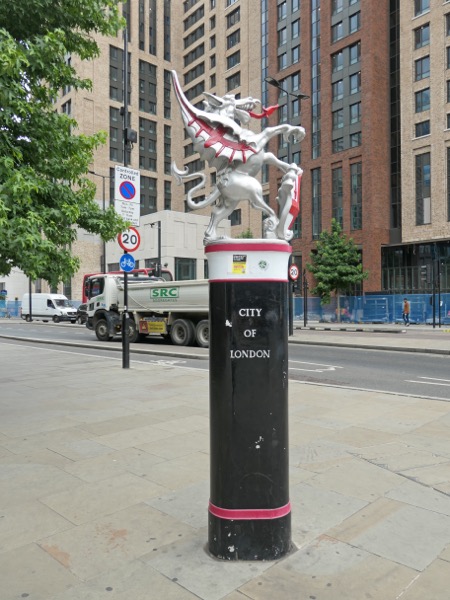
Fourteen silver dragon statues mark the jurisdictional boundaries of the City of London — the Square Mile, one of the world's most valuable financial districts. The design derives from two seven-foot bronze dragons that crowned the 1849 Coal Exchange; when the Exchange was demolished in 1962, the dragons were re-erected at the western boundary on Victoria Embankment. The Corporation of London's Streets Committee formalized them as the official boundary marker design in 1964; half-size replicas were cast by Birmingham Guild Limited and placed at all main City entrances. Every person crossing into the City on foot, by taxi, or by bus passes a dragon standing with a shield. The dragon does not threaten the incoming visitor. It announces a threshold — you are entering a distinct jurisdiction with its own rules, traditions, and authority. This is the guardian function at its most literal: marking the line between ordinary space and a special protected domain.
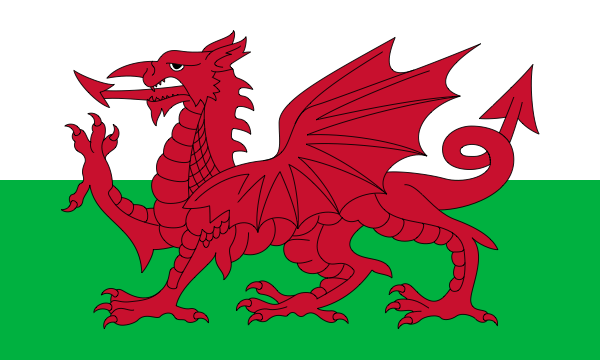
Wales gives us the red dragon's oldest documented career as a guardian. The Historia Brittonum (828 CE), attributed to the scholar Nennius, records Merlin's prophecy at Dinas Emrys: a red dragon and a white dragon fight in an underground pool, and Merlin interprets them — the red dragon represents Wales, the white the Saxon invaders, and the red will ultimately prevail. The symbol has been in continuous use since at least 655 CE under King Cadwaladr of Gwynedd. The Welsh Football Association's "Cymru" identity campaign, accelerated around the 2022 World Cup qualification, paired the ancient dragon with clean modern typography and produced an estimated 300% increase in Wales national team shirt sales — one of the clearer recent demonstrations that a heritage guardian symbol gains rather than loses force when treated with design restraint.
Viking ship culture took the guardian function to sea directly. The Icelandic law code Grágás ("Grey Goose Laws," in use from approximately 930 CE, written down c. 1117–1152 CE) specifies that carved dragon-heads (dreki-höfuð) must be removed from the prows of approaching ships before landfall in Iceland, so that the landvættir (land spirits) are not frightened or provoked. The Landnámabók ("Book of Settlements") records the same practice: figureheads were removable and intended to be taken down when approaching friendly shores. The Birka dragonhead — a 13.5-gram tin-alloy dress pin, 45mm long, with a carved dragonhead terminal, excavated from Birka's Black Earth Harbour in Sweden and published in the journal Antiquity in 2018 — represents the same figure worn close to the body: a threshold guardian, a protective figure mediating between the safe world and open water. The dragonhead frightened enemies and sea spirits while underway; it was respectfully stowed in known waters. This is not inconsistency. It is the conditional logic of guardianship: protective in alien waters, observant at home.
The most precise statement of the guardian who chooses to shelter is in the Pali Canon. The Muccalinda Sutta (Udāna 2.1, Khuddaka Nikāya) records what happened at the sixth week after the Buddha's awakening, on the bank of the Nerañjarā River. A storm arose. Mucalinda, the nāga king — a multi-headed serpent whose form in Cambodian and Thai Buddhist art shows seven cobra hoods spreading like a parasol — came out from his dwelling, encircled the Buddha's body seven times with his coils, and stood with his large hood spread over the Buddha's head for seven days: "Let not cold, heat, horseflies, mosquitoes, wind, sun, and creeping creatures touch the Gracious One." When the storm ended, Mucalinda assumed the form of a youth, joined his palms, and saluted. He then returned to his own dwelling. No compulsion, no taming, no command. The nāga recognized the merit of the being before him and chose to serve. In the earliest visual record of this scene — a 2nd-century BCE relief at Pauni, Maharashtra — Mucalinda appears with five heads guarding an empty throne (the aniconic Buddha). In the 12th-century bronze from Cambodia or northeast Thailand now in the collection of the Art Gallery of South Australia (accession 36334), seven heads form the sheltering canopy. The body plan here is not a threat. It is architecture: a sheltering organism.
This is the pattern across traditions: the same physiological form that signals danger is re-coded as protection the moment it enters a relationship of reciprocity with a human community. Folklorist David E. Jones argued in An Instinct for Dragons (Routledge, 2000) that serpentine dragon figures may reflect deep evolutionary threat-detection responses to large predators, which cultures then sublimated into sacred guardians through ritualized appeasement. Whether or not the evolutionary claim holds, the cultural pattern is consistent across the fourteen traditions surveyed here. The threat and the guardian are the same creature, at different ends of the same relationship.
V. The Real Animals Inside the Myth
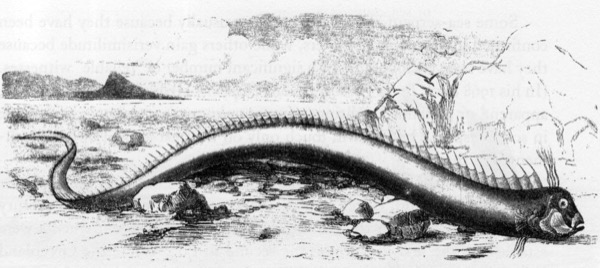
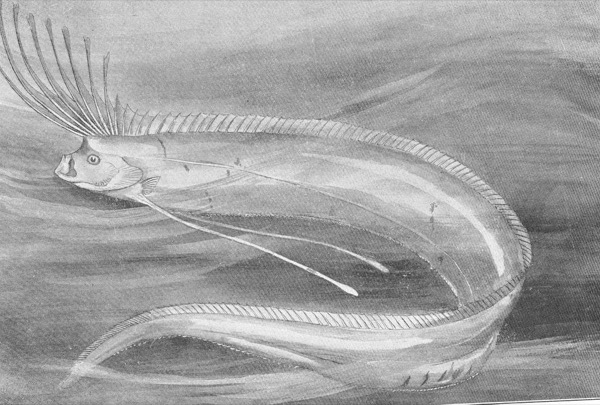
The oarfish (Regalecus glesne) is silver, up to 8 meters confirmed in length, with a red dorsal fin that runs the full length of its body like a crown. It lives in the mesopelagic zone — 200 to 1,000 meters deep — and surfaces when ill or, anecdotally, before seismic events. Japanese fishermen call it ryūgū no tsukai: "Messenger from the Dragon Palace." When one washes ashore, the local community understands it as Ryūjin sending word from below. The scientific illustration published by the Fisheries Marine Institute of Biology in 1860 shows the creature exactly as described in every sea-serpent account of that era: long, thin, undulating, finned like a living banner. The zoological and the mythological are the same animal at different distances from the water.
The sea snakes of the Indo-Pacific — banded sea kraits (Laticauda colubrina), yellow-bellied sea snakes (Hydrophis platurus) — are genuinely serpentine, genuinely venomous, genuinely long. Moray eels can reach three meters. Giant squid were known from beak fragments found in sperm whale stomachs long before they were photographed alive; Bishop Pontoppidan's 1752–53 account of the Kraken ("the largest and most surprising of all the animal creation") is the amplified memory of encounters with Architeuthis at the surface. The giant Pacific octopus, seen once at night from the deck of a small boat, is easily mistaken for something for which there is no name.
The Chinese tradition is direct about this. The Jiaolong (蛟龍, "flood dragon" or "hornless dragon") is described in the Song-dynasty text Moke Huixi as "shaped like a snake with a tiger's head, several fathoms in length, living in brooks and rivers and bellowing like a bull." Multiple scholars, including those working on southern Chinese zoological texts, identify the Jiaolong's probable original referent as the saltwater crocodile (Crocodylus porosus), which in antiquity ranged through the rivers of central and southern China. The Yue people (southeastern China and the Vietnam border region) tattooed their bodies with Jiaolong patterns to identify with the creature and avoid its attacks — an ancient record of human-crocodilian proximity. The myth carries the memory of an animal encounter. The transformation timeline recorded in the 6th-century text Shuyi ji — a water snake, after 500 years, transforms into a jiaolong; a jiaolong, after a millennium, transforms into a lung dragon — is not magical thinking but a cultural notation of the same creature at different scales of relationship with human communities. The serpent you see every day is a snake. The serpent you cannot categorize is a dragon. The serpent you worship is a Dragon King.
VI. Why a Boat's Log Is Writing About Dragons
Because JADA has five of them.
This is openly a work of imagination — an in-universe origin myth for a vessel built in Stockton, California in 1938, which raced five Transpacs, placed second overall twice, and has sailed San Diego Bay for approximately twenty years. What follows is not a claim about any living religious tradition. It is an acknowledgment of the traditions that made this mythology possible, each one cited above, each one honored by being used accurately rather than casually.
The Black Guardian draws its body plan from the jiaolong of the classical Chinese texts (Shanhaijing, 4th–1st century BCE; Shuyi ji, 6th century CE): hornless, eel-serpentine, immense, no limbs or vestigial only, a white throat pouch that bioluminesces in dark water. This is the open-sea form — the creature that was present when the keel was laid in 1938 and felt the first rivets enter the hull. In Five Phases cosmology, black is north, winter, and the depths that conceal power. It is not summoned. It simply was.
The Green Guardian draws its body plan from Wang Fu's nine-resemblance formula (Han dynasty, c. 100 CE) and the Qinglong (青龍, "Azure Dragon of the East"): camel head, deer antlers, long sensitive barbels trailing in river current, carp scales in 117 count, eagle talons, pearl luminous at the throat. This is the freshwater guardian of the Sacramento–San Joaquin Delta — the waterway where JADA was built. Chinese laborers built the Delta levee system through the 1860s–1880s; a river dragon inhabiting those channels is historically grounded. It is the most terrestrial of the five, capable of resting on riverbanks, a worker-dragon, a keeper of the watershed.
The White Guardian draws its body plan from two traditions: the Birka-style dragonhead of Viking ship culture (Grágás law, c. 930 CE; Birka dragonhead, published Antiquity 2018) and the Celtic Christian figure of Jasconius in the Navigatio Sancti Brendani (c. 800–900 CE) — the creature so vast it was mistaken for an island, patient, luminous, ultimately benign. It is the shipwright's guardian: nearly translucent, mother-of-pearl white, refracting moonlight, the size of the ship it protects. It perches at the stem post the way a figurehead does. When JADA enters her home waters, it bows its head and falls silent.
The Red Guardian draws its body plan from the Chinese Zhulong (燭龍, "Torch Dragon") of the Shanhaijing — the solar creator dragon of geological antiquity — and is placed at Lēʻahi (Diamond Head) as a maritime lighthouse figure: the ancient fire of the headland, born 300,000 years ago when magma met seawater in a hydrovolcanic explosion. It guards the approach to Oʻahu's coast the way the navigational beacon fires at the summit once guided outrigger canoes. It does not claim Hawaiian religious identity. It recognizes the power of a place that has been recognized as powerful since before humans arrived in Hawaiʻi, and it stands at the threshold between deep ocean and a volcanic headland that is already sacred on its own terms.
The Blue Guardian draws its body plan from the Yinglong (應龍), the only explicitly winged dragon in canonical Chinese mythology (Shanhaijing), which used its wings to summon rain and its tail to mark flood-channels for the legendary flood-control works of Yu the Great — and from the European wyvern tradition of heraldry (attested from the Great Parliamentary Roll of 1312): two hind legs, two great wings that function as primary limbs, an attenuated body built for minimum mass and maximum sail area. This is the wind guardian, the fastest and youngest of the five: Azure scales that shift color against the sky, nearly invisible against it. It does not land on JADA's deck. It circles, uses the vessel as a reference point, rests one clawed foot on the masthead during a lull, then lifts on the next quarter-shift of wind.
Five differently-bodied siblings, each shaped to a function. The Nine Sons of the Dragon were the precedent. The five guardians are the continuation of a practice that has been running since the Ming dynasty and, through the dynasty, back to the Han and the Ugaritic tablets and the fire beneath the sea. JADA carries them. They are not decoration. They are the logic of guardianship that every maritime tradition across fourteen cultures arrived at independently: the dragon is not the threat. The dragon is what you put between the threat and the people you are responsible for.
Research conducted July 2026. All mythological claims verified against primary texts and identified scholars. Cultural sensitivities flagged and respected: Hawaiian moʻo traditions treated per Marie Alohalani Brown (University of Hawaiʻi Press, 2020); Pele's name used only in acknowledgment, not in origin-myth framing; taniwha (Māori) not invoked without iwi consultation. Primary texts cited throughout. For companion scholarship on the queen as an institutional idea across history, read The Office of Queen. For the theory of objects in origin myths, read our previous entry: The McGuffin: A Field Guide to the Objects Stories Chase.
Gallery: the archive